
Research at the Columbia Global Paris Center
The Paris Center hosts research opportunities across a range of topics and disciplines. These projects explore subjects spanning from climate and environmental research to archival work and the history of Reid Hall.
Contemporary Thought Archival Research Grant

Dedicated to exploring key ideas in contemporary thought, this research grant is co-sponsored by the Columbia Global Paris Center and Institut Mémoires de l’Édition Contemporaine (IMEC). The fellowship supports a graduate student conducting research in Paris by providing funding for a month-long summer research stay at Reid Hall and IMEC.
2025 – 2026 Application
The grant encourages a multidisciplinary approach and is open to research-creation methods. Priority will be given to PhD candidates or postdoctoral researchers (up to five years after the defense of their thesis).
The selected grantee will be offered a residency at the Abbaye d’Ardenne for three consecutive weeks, followed or preceded by one week at Reid Hall. The grantee will receive a gross amount of €3,000.
In return, the grantee will submit a 20,000-character article (including spaces) to IMEC and the Columbia Global Paris Center. Additionally, the grantee may be invited to contribute occasionally to publications from both institutions.
Applications are now closed.
Announcement of recipient: September 24, 2025
This year, the grant will focus on Black American art or literary history. Open exclusively to Columbia University graduate students.
This collaboration began in September 2025 with the launch of the Jean Baudrillard Program. Baudrillard—an incisive thinker of modernity and a central figure in French Theory— deposited his personal library at Reid Hall and entrusted his archives to IMEC.

About Jean Baudrillard
The philosopher and sociologist Jean Baudrillard (1929-2007) shaped late 20th-century critical theory with his work on simulation, hyperreality, and postmodernity. His writing—ranging from The System of Objects to Simulacra and Simulation and The Transparency of Evil—engaged deeply with the symbolic logic of contemporary life, mass media, technology, and political spectacle.
Baudrillard once described himself, not without irony, as a "pataphysician at 20, a situationist at 30, a utopian at 40, transversal at 50, viral and metaleptic at 60."
Born in Reims and raised in a modest family, he earned a scholarship to attend the Lycée Henri-IV in Paris, completed his studies at the Sorbonne, and began his intellectual career by translating German theorists such as Brecht and Marx. Over the decades, he became one of the most provocative figures associated with French Theory—a transatlantic term that crystallized France’s global intellectual influence in the humanities.
In the Archives
Baudrillard at Reid Hall
The Reid Hall Library houses Baudrillard’s complete book collection. All told, it contains close to 1500 volumes, ranging from art to philosophy, fiction to essays. Baudrillard annotated over 300 of these books – marginalia that bear witness to how he constructed some of his most well-known theories.
His widow Marine Baudrillard received offers for the collection from many universities. However, she felt it would be best housed at 4, rue de Chevreuse, as Jean had previously been involved with Reid Hall, and the address remains, now as ever, a cross-cultural intellectual destination.
Baudrillard at IMEC
The Jean Baudrillard collection comprises the archives that escaped his tendency to erase traces. It includes a number of texts, several lectures, interviews, and notably the handwritten notebooks he kept throughout his life, as well as thematic files compiled by the author. In addition, the collection contains a body of scholarly texts and academic work on Jean Baudrillard.
About IMEC
Founded in 1988, IMEC is located at the historic Abbaye d’Ardenne, near Caen in Normandy, and preserves a vast and unique collection of literary, intellectual, and artistic archives. Its holdings span publishing houses, journals, and key figures from the intellectual and cultural life of the 20th century—writers, philosophers, historians, editors, translators, and designers. IMEC’s mission is not only to conserve these materials but to make them available for critical inquiry and creative research.
Contacts
If you have questions regarding the grant application, please contact
If you have other questions concerning the grant or would like to reach out regarding a potential collaboration, please contact
Brunhilde Biebuyck
Director
Columbia Global Paris Center
[email protected]
Reid Hall History internship
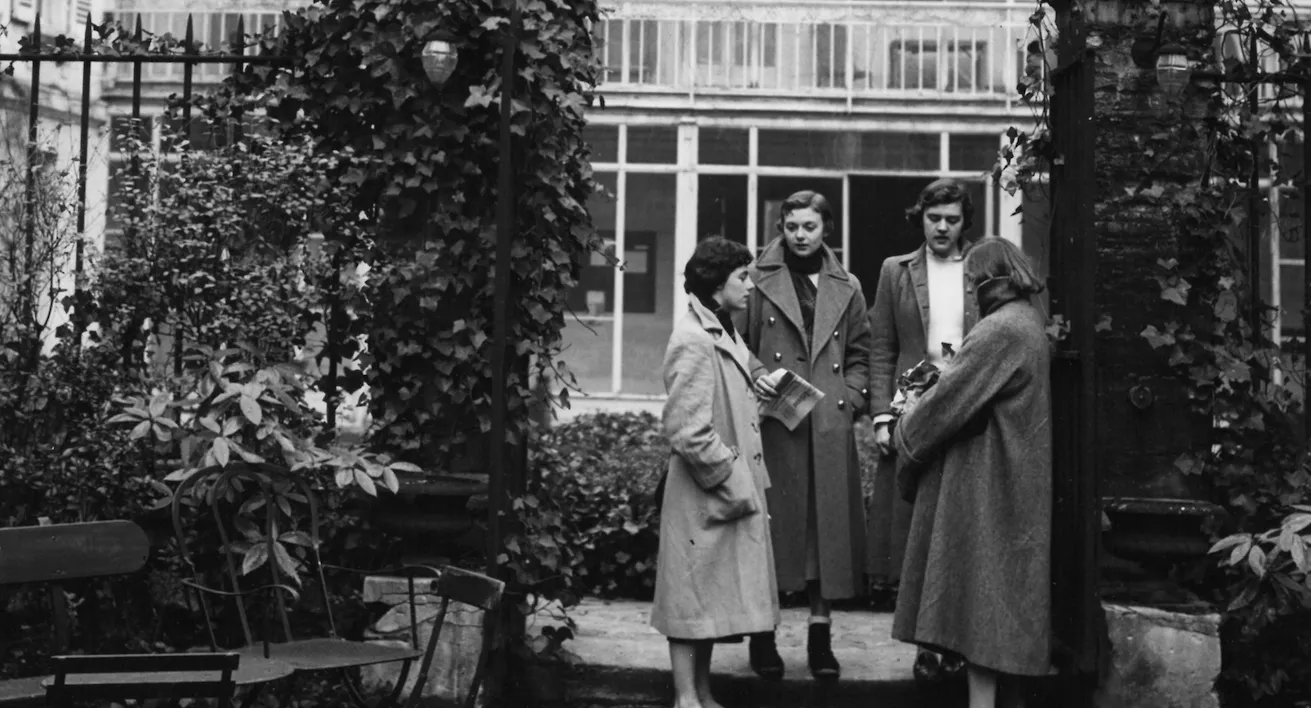
Sponsored by Columbia Global in New York, the Reid Hall History Intern works closely with the Paris Center Director on research focused on women artists and academics who lived or worked at 4 rue de Chevreuse between 1893 and 1939. The internship is open exclusively to Columbia University undergraduate or graduate students specializing in History or Art History.
Contacts
If you have questions regarding the internship, please contact
Brunhilde Biebuyck
Director
Columbia Global Paris Center
[email protected]
Climate Intelligence Lab
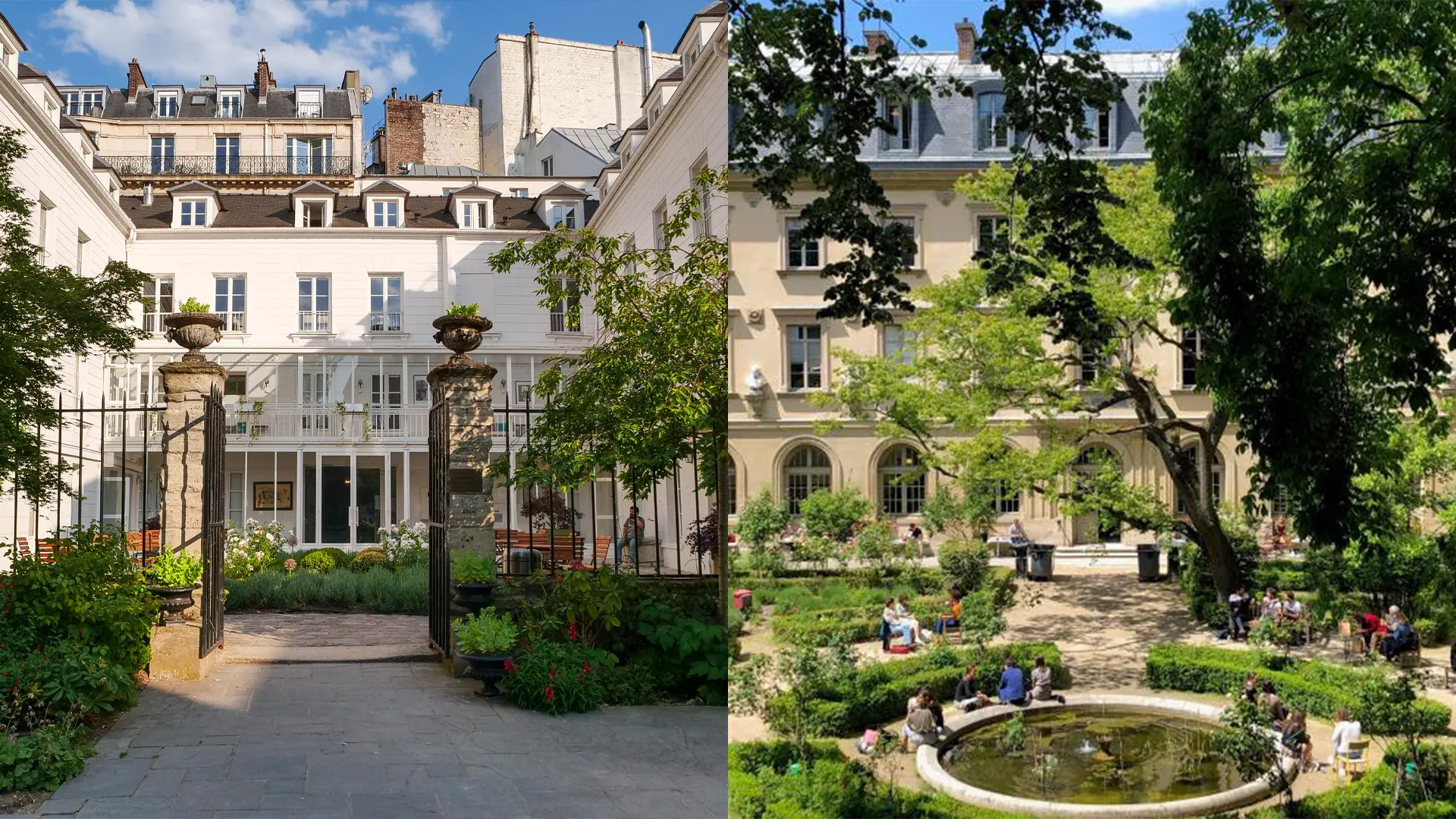
Pierre Gentine has developed the European dimension of his climate research, working at the Columbia Paris Center and in close collaboration with researchers at the École normale supérieure, particularly the Laboratoire de Météorologie Dynamique (LMD). He intends to build a Paris-based research group, including postdoctoral scholars working at the intersection of climate science, atmospheric physics, and artificial intelligence. Their research will explore new approaches to weather and climate prediction, including differentiable modeling and AI agents operating across timescales from short-term weather forecasting to long-term climate projections. Particular attention will be given to complex processes such as clouds, convection, rainfall, drought, land-atmosphere interactions, and extreme events. The group will work closely with colleagues at ENS and within a broader international network that includes Columbia’s Learning the Earth with Artificial Intelligence and Physics (LEAP) Center and the National Center for Atmospheric Research in Boulder. As a European node within this network, the Paris group will foster scientific exchange and collaboration among researchers at Columbia, in France, and across Europe. It will also establish Reid Hall as a base for sustained transatlantic collaboration in climate science.
Alongside this research program, Gentine also plans to teach in Paris, bringing his work on climate science, atmospheric modeling, and artificial intelligence into the classroom. The course will complement the activities of his Paris-based research group and provide an educational dimension to the broader collaboration with ENS and other European partners. It will also offer students an opportunity to engage with emerging approaches that combine the physical sciences with machine learning to address some of the most challenging problems in weather and climate prediction.
Agorakademi
Directed by Nilüfer Göle, professor of sociology at EHESS, funded by the Nomis Foundation, and hosted at the Columbia Global Paris Center, the AgorAkademi Project aims to query the emancipatory potential of the Public Space in late modernity.
Occupation movements, contested monuments, and controversial images catalyze the Agora and call for the renewal of political and scientific agendas. In the global age, where migration flows and the circulation of ideas and objects create dynamic of multicultural conditions, the Public Space becomes the site for demonstrations, the visibility of differences, intercultural encounters, and clashes around religious and secular norms.
The representation of images and objects become a subject of debate between values of the sacred and the freedom of expression. The (re)conversion of monuments and the destruction of statues question politics of memory and historical legacy in present-day relations of power.
AgorAkademi proposes to study the Public Space around three axes, namely agencies and imaginaries, contested monuments and statues, and controversial images and objects. To explore the emancipatory and creative power of the “Public square,” “Agora,” and “Maidan” in different cultural settings, an interdisciplinary approach is adopted to connect the topographic, aesthetic, and physical dimensions of the public space with the more abstract, philosophical, and sociological dimensions.
Contacts
If you have questions regarding AgorAkademi, please contact
Nilüfer Göle
Director
AgorAkademi
[email protected]
Le projet de recherche AgorAkademi dirigé par Nilüfer Göle explore les dynamiques complexes du lien social au sein des sociétés multiculturelles. En mettant l’accent sur l’espace public, cette recherche examine comment celui-ci peut être un lieu d’émancipation et de créativité, favorisant la visibilité des acteurs, les interactions interpersonnelles, ainsi que les expressions esthétiques.
AgorAkademi réunit des chercheurs, des artistes et des acteurs sociaux engagés dans le but de générer de nouvelles perspectives sur l’étude de l’espace public à l’ère de la mondialisation. Ce projet s’intéresse particulièrement à l’émergence des initiatives citoyennes et aux formes de partage et de solidarité qui se développent dans des contextes difficiles, tels que les régimes autoritaires, l’immigration forcée et les crises environnementales.