Decolonizing African Agriculture
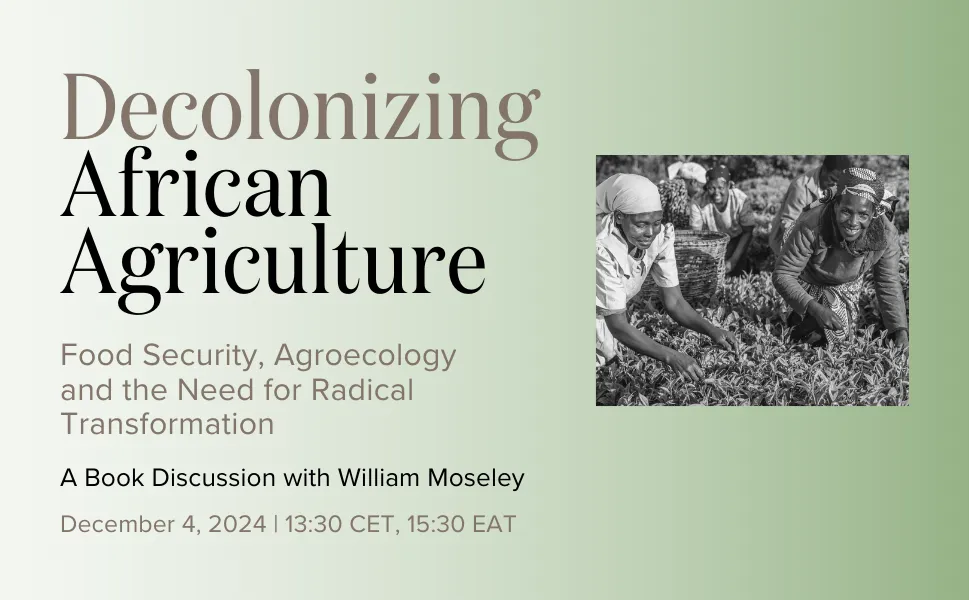
William Moseley's book Decolonizing African Agriculture (CUP,2024) compellingly analyzes why many farming and food policy approaches have failed in Sub-Saharan Africa. Moseley criticizes the dominance of Western, colonial agricultural science, which he argues is deeply entrenched in power dynamics. Moseley advocates for a shift towards non-colonial, indigenous agronomy as a crucial step in achieving sustainable food security. According to Moseley, this approach stimulates social innovation essential for supporting small-scale farmers' livelihoods.
Columbia Global's Tunis and Nairobi Centers, in collaboration with Columbia University Press, are honored to host William Moseley, who will delve into these themes extensively. The book is structured into four insightful sections:
- Foundational Concepts: Introduction to Political Agronomy, Political Ecology, and Agroecology.
- In-depth Case Studies: Comprehensive analysis of Mali, Burkina Faso, South Africa, and Botswana based on extensive field research.
- Successful Models and Forward Strategies: Examining successful local initiatives and proposed pathways emphasizing ecological principles in agricultural systems.
- Towards Resilient Food Systems: Advocacy for transformative development supporting agroecology, vibrant rural communities, and interconnected smaller cities. The discussion will underscore the imperative for global institutional reforms aligned with sustainable farming and food policies.
This session is crafted to engage academic, policy, and broader community audiences keen on international food security issues. It promises to deliver profound insights suitable for those exploring the intersections of food politics, agroecology, and sustainable development.

William G. Moseley is the DeWitt Wallace Professor of Geography, and Director of the Food, Agriculture and Society Program, at Macalester College, Saint Paul, Minnesota. He is the author of more than 100 peer-reviewed articles, book chapters, and nine books, including, most recently, Africa's Green Revolution: Critical Perspectives on New Agricultural Technologies and Systems (2016) and Land Reform in South Africa: An Uneven Transformation (2015). He currently serves as President-Elect of the Mande Studies Association and sits on the scientific advisory panel to the United Nations' Committee on World Food Security.

Philip Munyua is a data science leader with a Ph.D. in Computer Information Systems from Purdue University and an MA in Sustainable Development from Columbia University. After spending several years in the United States honing his expertise in data science, applied economics, and sustainable development, Philip returned to Kenya in 2022 to drive innovation in agriculture and community-led development.
As the founder of two ventures, NY Data Inc., a data-driven solutions company, and KINAITORE Enterprise Ltd., an agricultural value-addition start-up, Philip is committed to revolutionizing Kenya's agricultural sector. At KINAITORE, he leads efforts to enhance food security, address climate challenges, and create sustainable livelihoods through operations in premium sifted maize flour milling, animal feed production, and poultry farming. His work integrates cutting-edge data science techniques to optimize production processes and improve the quality of agricultural products while fostering economic empowerment for local communities.
Philip's leadership is marked by his deep commitment to sustainable development, community growth, and innovative agricultural practices. Through his work at KINAITORE, he addresses critical issues such as rural economic development, climate change adaptation, and equitable access to nutritious food. His experience spans global projects, including work with the World Bank, United Nations, Earth Insitute, USAID, and private sector entities across Africa and the U.S.A. With a clear vision for the future, Philip continues to build strategic partnerships and explore opportunities for collaboration. He aims to advance sustainable agricultural solutions that transform Kenya's food systems and contribute to global discussions on decolonizing agriculture and achieving sustainable development.