
Business, technology, and innovation are shaping an evolving world, driving transformations that impact every aspect of our lives. Below, we summarize some of the projects and events that we launched in recent months in the areas of digitalization, innovation, and entrepreneurship.
Educating youth on the evolving digital world
With ChatGPT and other AI-powered bots gaining traction in every sector, it’s important to teach tomorrow’s leaders how to navigate the rapidly evolving AI landscape.

To that end, numerous programs were hosted by the Columbia Global Center in Tunis geared toward training young minds on this cutting-edge field, including a rigorous Artificial Intelligence Boot Camp for high schoolers. Organized in partnership with the Pristini School of AI at the University of Tunisia and aiphabet, a free online learning platform, the three-day event provided a crash course on concepts crucial to the understanding and application of artificial intelligence, from machine learning and neural networks to programming in Python. Months before, a Columbia Business School MBA cohort visited the Pristini School, bringing together students and professors from both institutions for an exchange of ideas and learnings.
And recently, the Institute for Ideas and Imagination in Paris held a seminar on the short-lived digital architecture movement of the 1990s led by young Arab architects (including Zaha Hadid) offering a reframing of these works not as lesser imitations of Western trends, but as pioneering efforts in digital architectural design.
Nurturing scholarly entrepreneurship on a global scale
Meanwhile, a group of Columbia Business School students were able to discover Turkey’s startup scene through another intensive program. Through the Columbia Global Center in Istanbul, students met with business leaders at the forefront of innovation and enjoyed a seminar led by professor Soli Özel of Kadir Has University, who talked about geopolitical development in the region.
At the same time, thanks to its free-trade agreements in Europe, Africa, and the Middle East, Tunisia is poised to become a major modern business hub. But will it be able to create an environment that is attractive to investors? That’s the question that Columbia Business School students aimed to explore during a week-long visit to Tunis, as part of the Chazen Institute’s Global Immersion: Business and Entrepreneurship in Tunisia program.
Promoting sustainability through technological advancement
At the Columbia Global Center in Beijing, climate and energy experts brainstormed strategies for mitigating the impact of climate change on investments. The main takeaway? “Winners of the future will be those who can adapt their business models faster to these uncertain scenarios,” said CBS professor Bruce Usher.
The Institute for Ideas and Imagination shined a light on environmental innovations through a panel discussion on eco-friendly construction practices, which included tech-savvy ways to increase the use of local resources in order to minimize the carbon footprint associated with transporting materials.
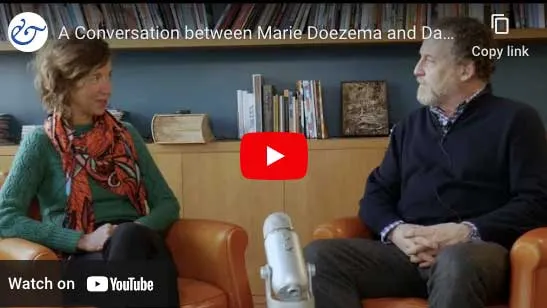
In the same vein, climate expert David Goldberg from the Columbia Climate School spoke with Marie Doezema at the Columbia Global Center in Paris about carbon capture and storage in the Indian Ocean’s Kerguelen Plateau, where this technology has shown immense potential. Goldberg predicts that such a project would scrub roughly 250 million tons of CO2 from the atmosphere per year. Doezema is the center's special projects manager.
Assessing how artificial intelligence can help (and harm) society
Is artificial intelligence good or bad? If you ask the experts, it’s both.
As an example of how it can be harnessed for good, the Transforming Wastewater Infrastructure in the U.S. project is developing machine and deep-learning models to predict septic tank failure across the nation, an initiative expected to benefit thousands in the Black Belt region of Alabama and beyond.
But there’s also a dark side to the new technology. At a panel discussion hosted by the Committee on Global Thought, experts on AI examined the potential for exploitative practices and transhistorical impact on labor rights. And at the Columbia Global Center in Rio, experts held a discussion about the potential threat of AI on national security.
Using digital tools to improve health in disadvantaged communities
In Ghana, Columbia World Projects is supporting a new phone-based savings app in the Combating Household Air Pollution with Clean Energy project (Read more about the unique partnership behind the project). The app supports Ghanaian households in surmounting the upfront cost barriers to purchasing liquefied petroleum gas.
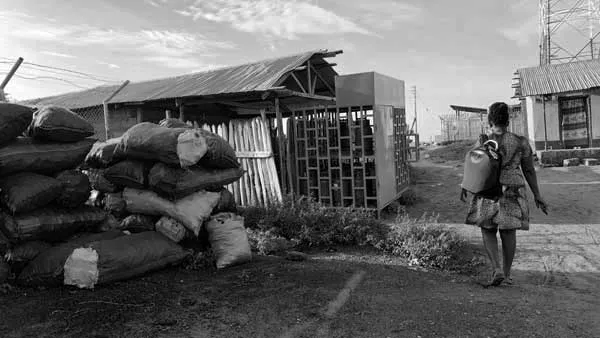
In a similar vein, the Columbia Global Center in Amman convened a panel of experts in migrant health to discuss how digital technologies could help make health information and services more easily accessible to refugee youth. The conversation, as part of the Refugees Act and Communicate for Health initiative, centered on the findings of a regional mixed-methods study held in Turkey, Jordan, and Lebanon.
In Tunisia, the Global Center there joined forces with researchers at the University of Sousse to demonstrate how Columbia’s Robotics and Rehabilitation Lab is employing robots to improve essential motor functions (walking, reaching) in victims of stroke, cerebral palsy, and other neuromuscular conditions.
Championing inclusion and social responsibility
Columbia World Projects and the Columbia Global Center in Beijing sponsored an event that delved into the different perceptions and realities of digital governance in China. Featuring Daniela Stockmann, author of Governing Digital China, the session acknowledged the danger that widespread misinformation poses to democracy.
The Committee on Global Thought hosted an internship that provided M.A. student C. Julius Junck the opportunity to explore methods for democratizing access to personal financial management. The internship was in conjunction with the Advanced Projects and Applied Research in Fintech at the Columbia Business School.
Catalyzing growth and creativity in business
The Beijing Center launched the Columbia Startup Accelerator in China (CSAC), designed to support young entrepreneurs. “The CSAC camp is a perfect place for startups to grow,” said Columbia University alumnus Guojun Zheng, cofounder of Moriverse. “The program provides us with a wealth of entrepreneurial courses, an amazing lineup of mentors, and the opportunity to connect with investors, allowing us to quickly differentiate ourselves in the industry and move towards a higher goal.”
Similarly, a group of professors from Columbia Business School — in partnership with the Global Centers in Nairobi and Tunis — launched the Entrepreneurship and Competitiveness in Africa program (EC-Africa), which aims to equip entrepreneurs from mid-sized African companies with the tools, networks, and resources necessary to thrive in today’s dynamic global economy.
And at a women-led Demo Day hosted by the Beijing Center, more than 30 women entrepreneurs gathered to present their business ideas to some of the most influential angel investors in China, who offered advice on scaling their entrepreneurial efforts.