Celebrating Innovation in AI & Society
Two Columbia faculty have received Tier 1 awards in the inaugural Columbia Global Innovation Awards to pursue research in India at the intersection of AI and society.
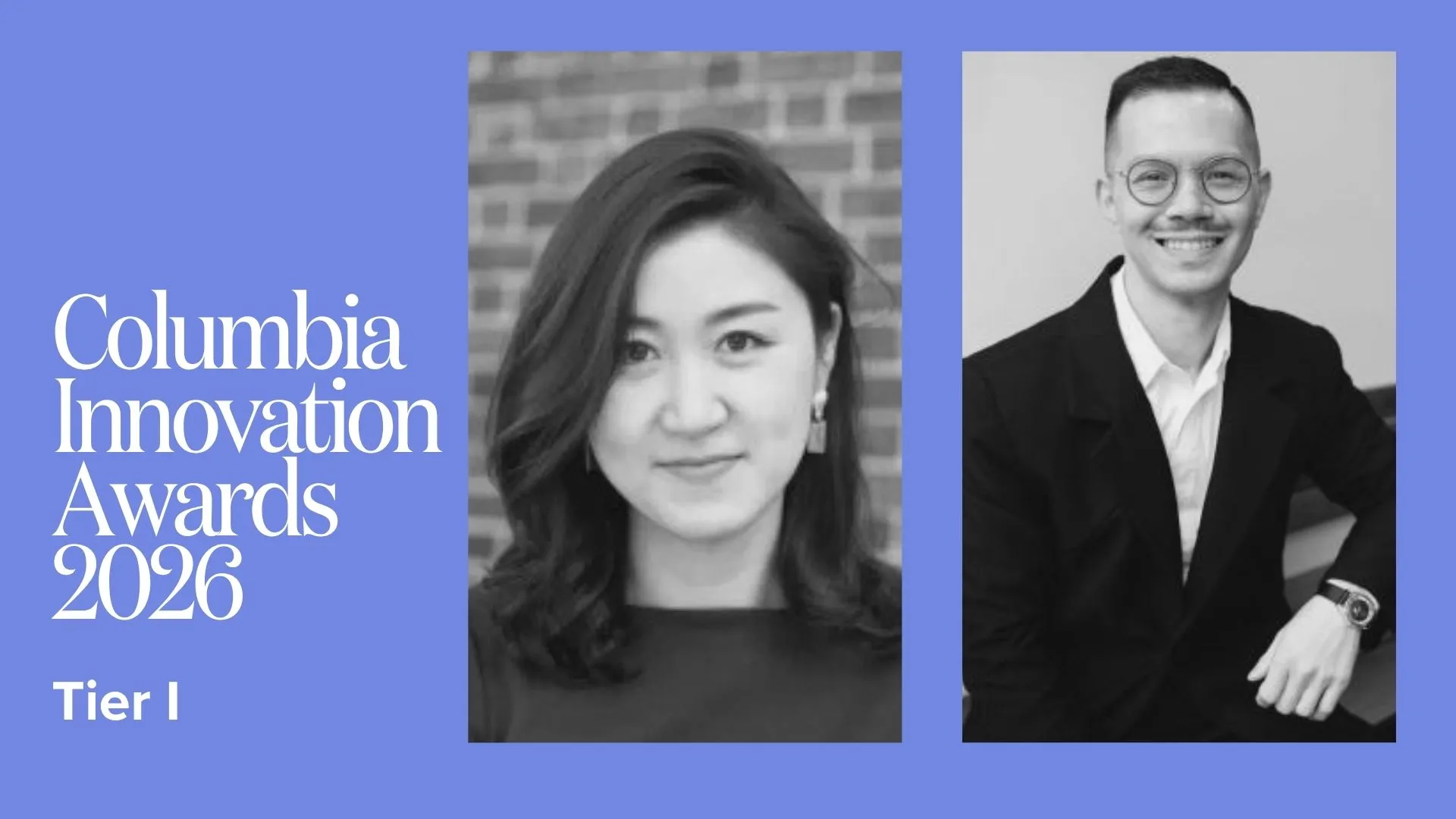
Two Columbia faculty have received Tier 1 awards in the inaugural Columbia Global Innovation Awards to pursue research in India at the intersection of AI and society. Eunji Kim will explore how AI-driven entertainment recommendations can shape social and political norms, while Thoai Ngo will examine how AI can support—and be used responsibly by—frontline health workers in rural India. Together, the projects explore how AI can influence both the care we receive and the content we consume.
Columbia Global Innovation Awards, whose 2026 theme is “Artificial Intelligence and Society," support Columbia faculty and researchers developing ideas that explore how AI can move beyond the laboratory and become a tool for education, healthcare, community engagement, and social change.
For projects working internationally, the awards are designed to connect faculty with one of Columbia's Global Centers. This model places local partnerships and context at the heart of innovation—and creates opportunities for research developed at Columbia to be tested, adapted, and shaped through engagement with communities around the world.
The Tier 1 Concept and Convening Awards support early-stage ideas. With awards of up to $25,000 over 12–18 months, they give faculty the space to explore new questions, build partnerships, conduct initial research, and develop the foundations for larger initiatives.
Three larger Mumbai-connected projects (Tier 2 and 3 - $150,000- $300,000 for up to three years) are also under consideration, spanning climate resilience, cancer risk prediction, and healthy ageing. This opportunity will move the research forward from ideas to real-world impact in India.
Read more about the awardees and their projects below:
India's healthcare system relies on a vast network of frontline workers, including ASHAs, Auxiliary Nurse Midwives, and Anganwadi workers, who connect communities with essential health services.
The project, “AI and Frontline Health Workers in Rural India: Mapping Use, Potential, and Ethical Considerations,” will explore how these workers are already encountering AI, where the technology might genuinely help, and what ethical and practical challenges need to be addressed.
Rather than beginning with the assumption that AI is the answer, the researchers want to understand the real needs of frontline workers first.
The team led by Thoai Ngo, Chair, Heilbrunn Department of Population and Family Health (PopFam), Mailman School of Public Health and Shalmali Joshi, Assistant Professor of Biomedical Informatics, Vagelos College of Physicians and Surgeons will conduct a literature review and interviews with frontline health workers, policymakers, NGOs, and technology developers. Together with the Antara Foundation and Columbia Global Center Mumbai, they will also convene stakeholders to identify opportunities for future research and responsible AI-enabled interventions.
The ultimate goal is to develop an ethical and practical roadmap for AI in community healthcare—one grounded in the experiences of the people who deliver care on the ground.
A second Tier 1 award takes an entirely different approach to the relationship between AI and society. Eunji Kim, Assistant Professor of Political Science at Columbia University, with co-investigator Tanushree Goyal, Assistant Professor of Political Science and International Affairs, Princeton University, will explore how AI-powered entertainment recommendation systems may influence social and political attitudes in India.
Their project, “AI, Entertainment, and the Formation of Social and Political Norms in India,” starts with an everyday experience: opening a streaming platform and being told what to watch next. Behind those recommendations are algorithms that increasingly shape what audiences see. But what happens when the content we consume begins to shape how we think about society?
The researchers will investigate whether AI-driven recommendations reinforce existing gender stereotypes and political attitudes—or whether they could instead be used to introduce audiences to stories and characters that challenge conventional ideas. The project will focus particularly on young men and explore whether exposure to films portraying women in non-traditional roles can influence attitudes around women's autonomy, employment, marriage, and civic and political engagement.
"My research asks how entertainment media shapes political and social attitudes, and India is one of the most consequential places in the world to study that question right now. Streaming platforms there reach over 600 million users, and engagement-optimized recommendation algorithms increasingly decide which films young people see - films that often model traditional gender roles, while norm-challenging stories remain rare," said Kim.
The team will combine research into recommendation algorithms with focus groups and the development of a future field experiment. Columbia Global Center Mumbai will help facilitate academic and civil-society partnerships as the project develops. "This award lets us lay the groundwork for a field experiment testing whether redirecting that algorithmic curation can broaden rather than entrench gender and political norms among young men. Columbia's Mumbai Global Center gives us an anchor to build the in-country partnerships that make this kind of research possible," said Kim.
"Over the next 18 months, we expect to map what India's major streaming platforms actually recommend to young men by default, develop and pilot a set of instruments for measuring gender and civic norms. Along the way, Columbia students will get hands-on training in algorithm auditing and field-experimental methods, which I see as one of the most durable outcomes of the project," she added.