Voices, Memory and Cross-Border Networks: Dialogues Between Kurdish Women and Plurinational Feminisms in Latin America
Columbia Global Emerging Scholar Dilan Bozgan presented her anthropological research on the cross-border circulations, representations and women’s networks in the Global South.
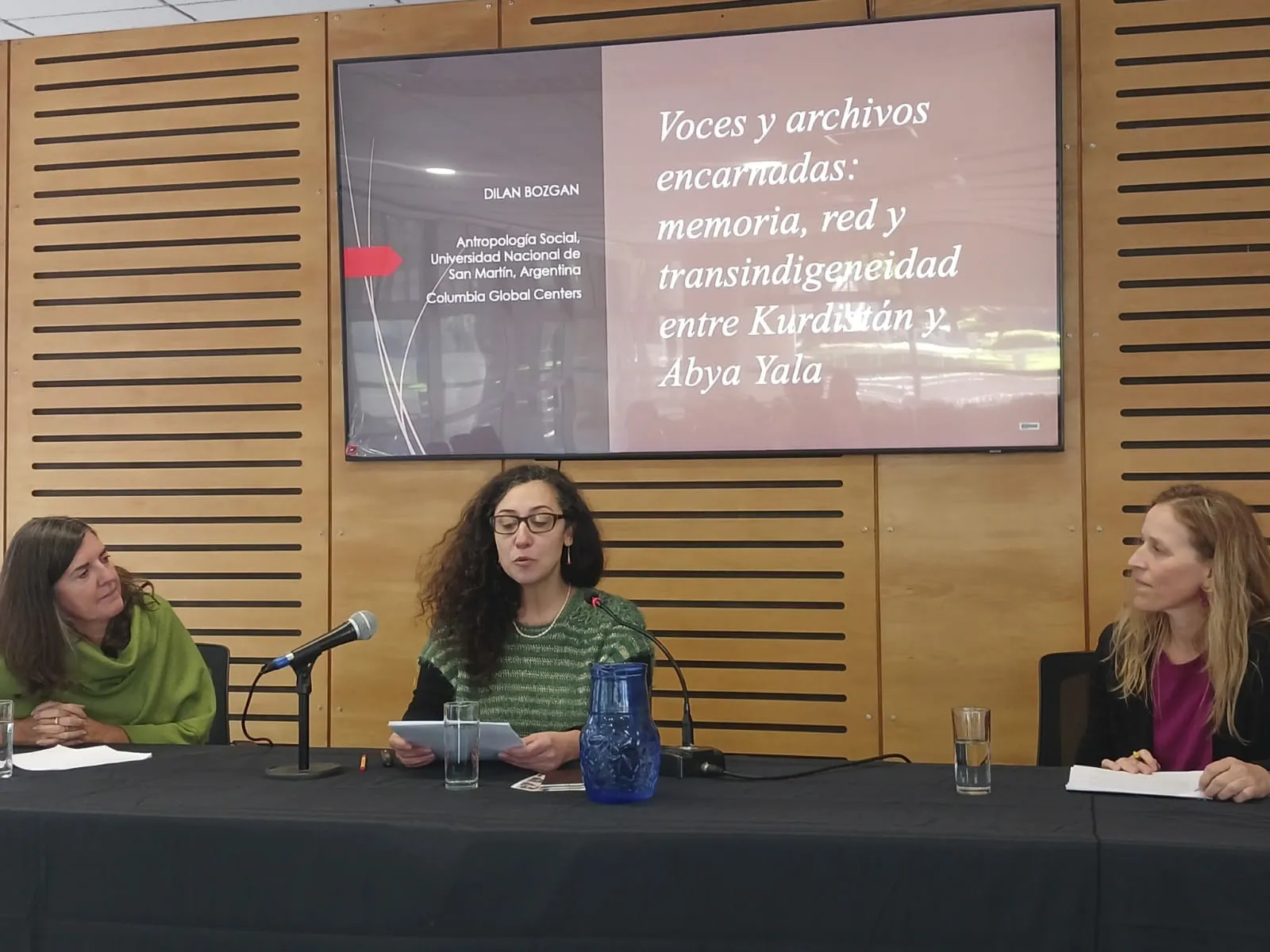
In the academic seminar "Women in the Archive: race, networks and the power of the word" held at the Pontificia Universidad Católica de Chile (UC Chile), Dilan Bozgan, Columbia Global Emerging Scholar, presented her anthropological research on the cross-border circulations, representations and networks of women in the Global South. Her work examines the political participation of Kurdish women in Turkey and, after their migration, their resonances with indigenous women in Latin America, proposing to explore the limits and possibilities of cross-border dialogue.
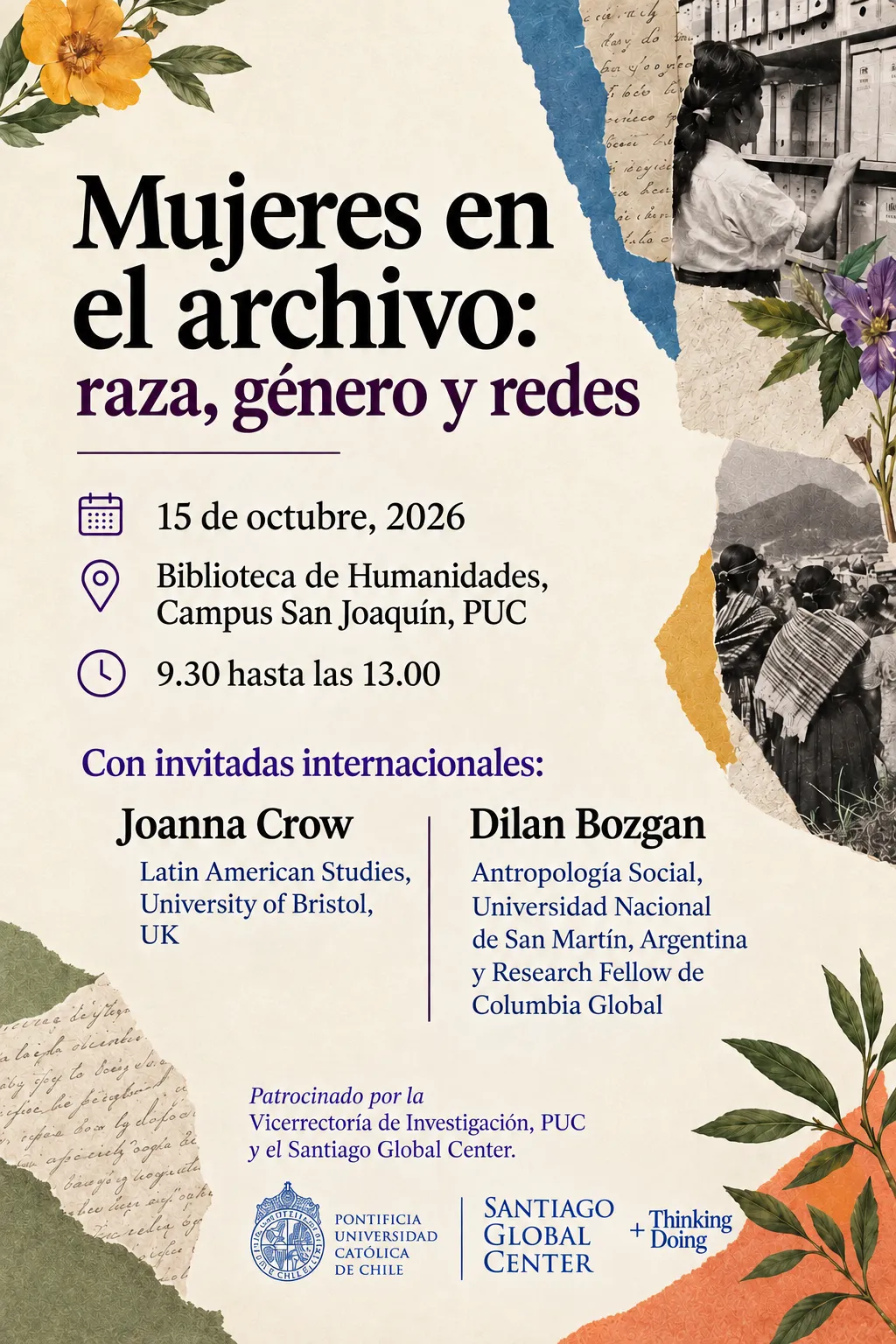
The seminar, held on October 15, 2026, was convened by Allison Ramay, director of the Department of Literature of the School of Letters at UC Chile. Bozgan spoke in the first session together with Joanna Crow, professor of Latin American Studies at the University of Bristol (United Kingdom).
“How and under what conditions can the voices of those who have been historically marginalized be heard?” was the main question of focus in the presentation by Bozgan. Her presentation, entitled "Embodied Voices and Archives: Memory, Network and Transindigeneity between Kurdistan and Abya Yala,” was based on her doctoral research in Social Anthropology at the Universidad Nacional de San Martín (UNSAM), Argentina. Bozgan proposed that the voices of indigenous women are formed in the articulation between memory, representation and political action, constituting themselves as embodied voices capable of intervening in the public space, generating links and transforming political imaginaries.
Migration and research
Based on her ethnographic work in Argentina between 2013 and 2025, Bozgan shared her reflections on how migration reconfigures research and scientific identity. Her own migratory trajectory, from Turkey to Argentina, allowed her to transform her frameworks of intelligibility and reevaluate the place from which knowledge is produced.
Her research in Turkey analyzed the representation and political participation of Kurdish women since the 1990s in the framework of the Kurdish question, observing how they built spaces for organization, care and social reconstruction in the face of state violence and armed conflict. Subsequently, her relocation to Argentina opened a new horizon for reflection: the change of language, interlocutors and academic traditions allowed her to put the struggles of Kurdish women in dialogue with those of indigenous women and leaders in Latin America. This comparative view showed that, while in Turkey the central debate revolves around the lack of constitutional recognition of a stateless people, in Argentina it is organized around the demands of plurinationality, territorial and historical reparation within the nation-state.
Plurinationality and the politics of listening
In her presentation, Bozgan focused on the ethnographic data of her fieldwork (2013-2025) in the National Women's Encounters (ENM), a historical and central space for feminism in post-dictatorship Argentina. She analyzed the process of transformation that led to the renaming of the space as a Plurinational Encounter promoted by women from various indigenous peoples (Mapuche, Qom, Wichí, Guaraní, among others), who questioned the hegemony of urban and creole feminism and established a territorial, decolonial and plurinational perspective. In this scenario, she examined how the interventions and words of Kurdish women were received by feminist audiences crossed by these debates on plurinationality and interculturality. From her approach, the audibility of a subaltern voice is not automatic or neutral: it depends on the political, cultural and social conditions in which it circulates, as well as on the shared languages and grammars that make listening possible.
Transindigeneity and networks
In the political scenarios of exchange between the Kurdish women's movement and indigenous feminisms in Latin America, Bozgan analyzed the formation of a plurinational and cross-border feminist network. This collective fabric weaves together concerns around self-determination, the defense of territory, memory, political healing and decolonization, without ignoring the asymmetries and historical or political differences between the movements involved.
For Bozgan, transindigeneity offers a critical tool for analyzing these encounters without assuming an automatic equivalence between peoples, geographies or experiences of struggle. Her proposal encourages the recognition of asymmetries, the difficulties of translation and the tensions that emerge when different political trajectories come into contact, conceiving listening as a practice located outside the hegemonic frameworks of the nation-state.
In short, Bozgan’s proposal invites us to think of listening as a political practice that requires time, attention and willingness to review one's own frameworks of interpretation. Historically marginalized voices are not simply silences waiting to be filled: they are living archives, crossed by memories, bonds, affections and decisions capable of transforming both those who speak and those who listen.
By interweaving the struggles of the Kurdish women's movement with indigenous and plurinational feminisms in Latin America, Bozgan's research opens up new perspectives to understand how networks of cross-border solidarity are woven in the Global South and how conditions of situated listening attentive to the complexities of dialogue between peripheries are constructed.