Are Indian Cities Ready for a Climate-Driven Influx?
The fourth episode of the "NIUA Expert Talk Series" featured Dr. Alex de Sherbinin, Columbia Climate School as he explored how climate change is influencing rural to urban migration and whether cities are prepared to handle the resulting population shifts. In collaboration with Columbia Global Center Mumbai, three sessions of this ongoing talk series for India's senior government officials will feature experts from Columbia University
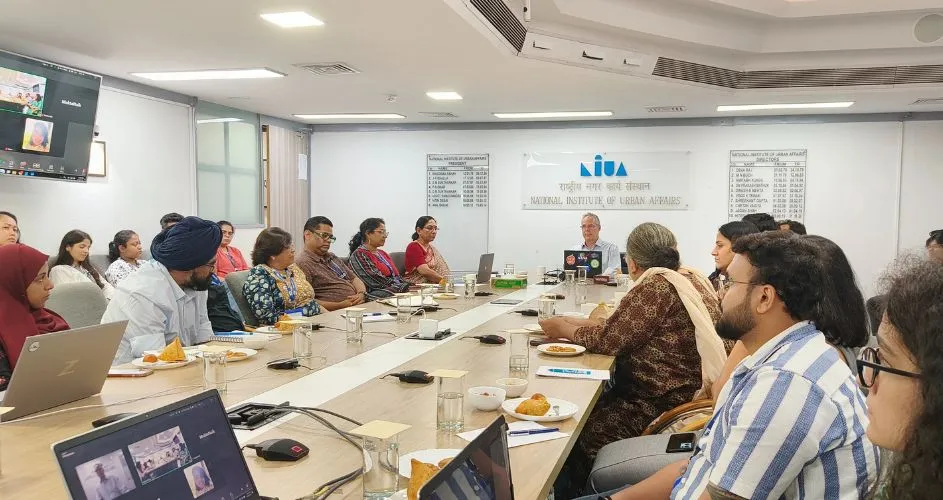
With rising climate stress, millions in rural India are turning to cities for survival, raising critical questions about whether urban India is prepared for this shift.
Speaking at the inaugural session of the National Institute of Urban Affairs Expert Talk Series with Columbia Global Center Mumbai on climate change science and adaptation, Dr. Alex de Sherbinin, Director and Senior Research Scientist at the Center for Integrated Earth System Information at the Columbia Climate School, explored how climate change is influencing rural to urban migration and whether cities are prepared to handle the resulting population shifts.
“Climate-induced migration is not just a future possibility. It’s happening now. Cities must invest in infrastructure, services, and policies to support both current residents and new arrivals,” said Dr. de Sherbinin .
In his talk, titled “Climate Impacts on Rural to Urban Migration: Are Cities Ready for the Influx?”, Dr. de Sherbinin shared findings from his ongoing research in drought-prone regions of India. He explained that while India has one of the lowest permanent migration rates from rural to urban areas globally, millions participate in circular migration — a form of seasonal, temporary movement driven by a lack of rural job opportunities.
“These men leave their villages for nine to eleven months a year to find work in cities, returning only briefly for festivals or family needs,” he noted. Yet this widespread pattern is rarely captured in migration studies or government data. “This form of migration is invisible in most climate literature,” noted Dr. de Sherbinin, adding that such movement is hard to track and model due to a lack of granular data.
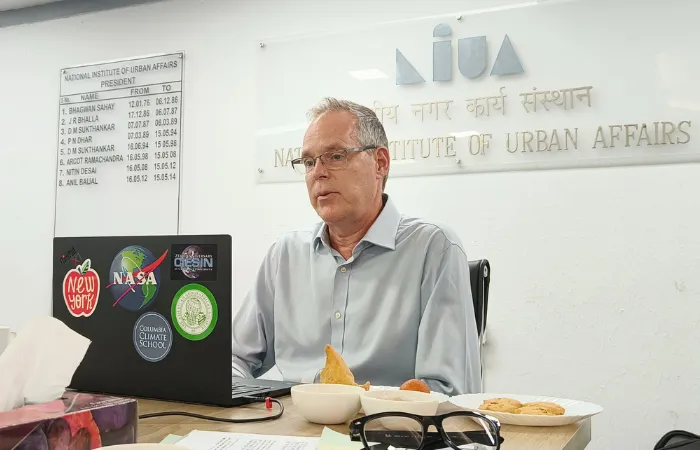
Heat, Drought, and Labor Exodus
Dr. de Sherbinin shared early findings from a research project titled Displaced Livelihoods, focusing on drought impacts in Uttar Pradesh and Bihar. Drawing on 40 years of village-level drought data and census data from 2001 and 2011, the study found that:
- Drought significantly reduces male agricultural workforce participation, especially in areas like the Gangetic Plains.
- Severe droughts in the year prior to a census led to visible declines in agricultural labor participation.
- Under a high-emissions scenario, up to 5% of India’s agricultural workforce could be pushed out of farming in the coming decades.
These declines in farm labor are used as a proxy to estimate migration to cities.
In early 2026, the research team will begin fieldwork in Bijar and Uttar Pradesh, surveying 2,000–3,000 rural households. The survey will examine how factors like caste, wage programs (such as MGNREGA), and access to crop insurance shape migration decisions.

Cities Expanding Into Danger Zones
While rural livelihoods face rising stress, cities are expanding, often into high-risk zones.“Indian cities are growing rapidly, but much of that growth is happening in flood-prone and water-scarce zones,” Dr. de Sherbinin said, sharing projections that seven Indian cities will exceed 10 million residents by 2030.
He pointed to alarming trends:
- Urban growth in flood-prone zones is outpacing that in safer areas — with India among the highest-risk countries.
- Cities like Bengaluru are already facing seasonal water shortages, a situation expected to worsen across India by 2050.
- Heatwave frequency is projected to rise from 4.7 to nearly 7 events per year in low-income countries if global temperatures breach the 3°C mark.
The talk also featured global data from a CIESIN postdoctoral scientist on “person-days” of extreme heat — a measure that multiplies the number of people by the number of extreme heat days. In India, the number of such days is rising sharply, mainly due to growing urban population and rising temperatures.
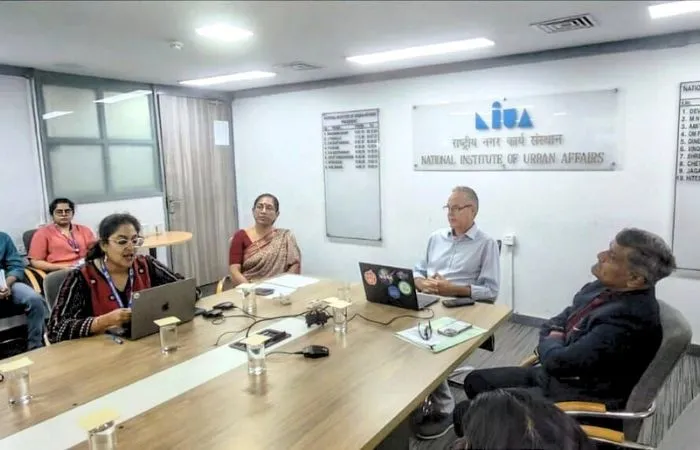
Who’s Most at Risk?
A second project shared by Dr. de Sherbinin mapped how low-income neighborhoods in cities — often informal settlements without proper road or utility access — face heightened climate risks.Using building footprint data and street maps, researchers identified areas cut off from city infrastructure and more vulnerable to hazards like heat, flooding, and water scarcity. This method the identification of low income neighborhoods was validated in cities like Lagos, Nairobi, and Mumbai, and may help city planners better target climate adaptation efforts.
Dr. de Sherbinin emphasized that combining climate hazard data with socioeconomic and spatial data is crucial to understanding how risk is distributed — and who is most vulnerable within cities.
The talk concluded with Dr de Sherbinin noting that understanding who migrates, why, and where they go is essential for building resilient, inclusive cities that can withstand the pressures of both climate change and rapid urbanization. “Cities need to prepare now,” said Dr. de Sherbinin, “not just to cope with climate-driven migration, but to ensure that the most vulnerable communities aren’t left behind.”