Migration in Latin America: Analysis from a Historical, Social and Public Policy Perspective
Specialists concur: migration must be seen as an engine of social transformation and not solely from an emergency perspective.
Migration in Latin America should be seen as a long-term structural phenomenon rather than as a short-term crisis. This was the core message shared by experts in the latest seminar organized by Columbia Global Center Santiago.
The event, part of Columbia Global’s ongoing commitment to drive dialogue on migration, brought together researchers from different disciplines to analyze the challenges and opportunities posed by human mobility in the region, with special emphasis on Venezuelan migration and its effects on Chile and other South American countries.
Through approaches that spanned history, social psychology, public policy and migration studies, the speakers agreed that future responses must prioritize integration, social cohesion and the recognition of migrants as actors that contribute to the economic, cultural and social development of host societies.
The panel began with a presentation by Franklim Colletti, Columbia Global Emerging Scholar, who questioned the political and media tendency to present migration as an exceptional crisis. From a historical perspective, he argued that migration is nothing new in Latin America. It is a permanent process that transforms the societies that receive newcomers over the long term.
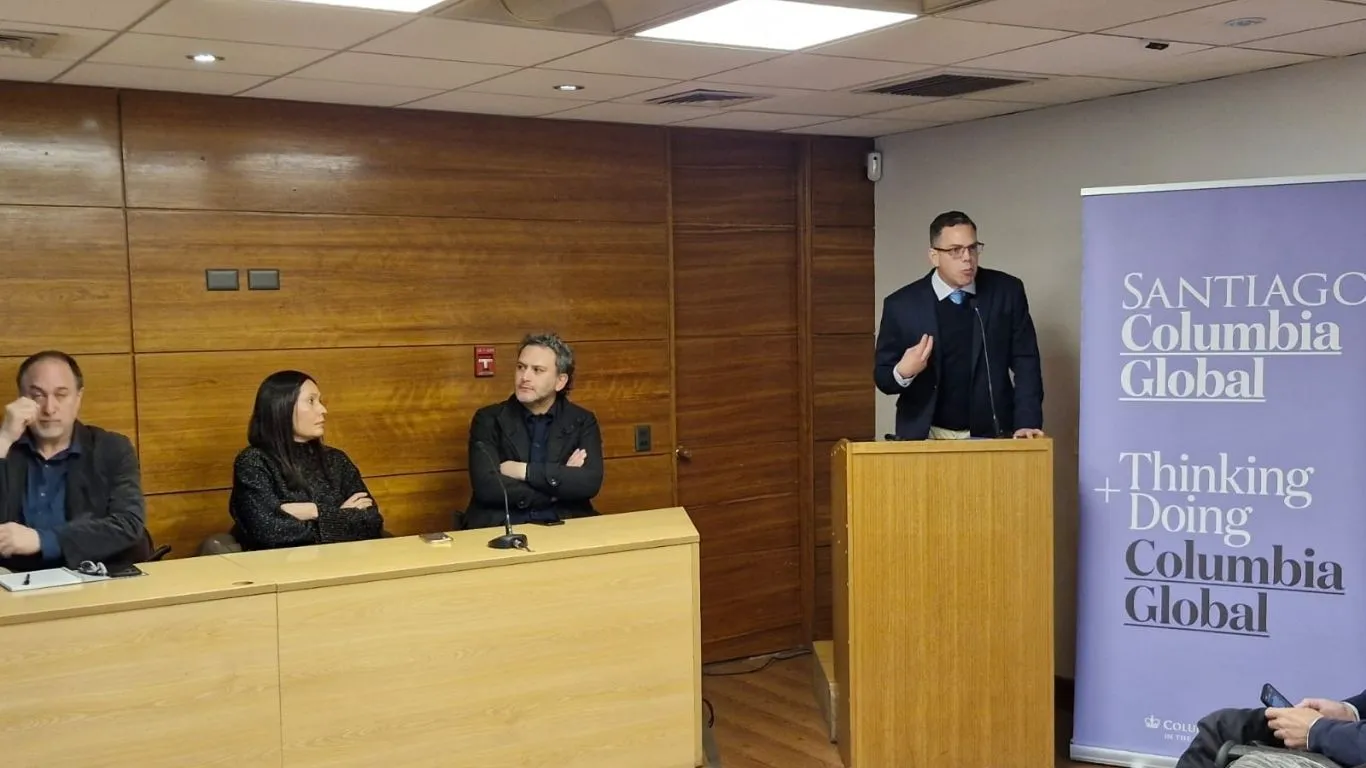
"Migration is not an exception - it is a historical structure, and within this historical structure it is not a crisis," Colletti said, reinforcing that migration should be understood as a phenomenon that has historically shaped Latin America, and not as an exceptional emergency.
Colletti explained that Latin American identity is the result of successive waves of migration, including European colonization, the presence of native peoples, African slavery, European migrations in the 19th century, and contemporary regional movements. In this context, he pointed out that economic, food, and institutional crises have historically been one of the main drivers of human displacement.
He described the Venezuelan case as the largest human displacement in Latin America’s recent history. While acknowledging the significant challenges that this phenomenon represents for countries, he also highlighted its economic, social, and cultural contributions. As an example of integration processes, he mentioned Chile’s national youth baseball team, made up of children from Venezuelan families who have developed a fully Chilean identity without losing their family roots.
His speech concluded with a call to replace reactive responses with public policies aimed at strengthening integration, resilience, social cohesion and the recognition of the contribution of migrants.
The second speaker, Roberto González, professor at the Pontificia Universidad Católica de Chile’s School of Psychology and Director of the MIDE UC Measurement Center, addressed the relationship between migration and social cohesion, focusing on the receiving society. Based on a longitudinal study initiated in 2006, he explained that understanding the attitudes of the Chilean population towards immigration is essential in designing effective public policies.
Among the study’s main findings, it showed that positive attitudes towards migrants have decreased over time, especially after the increase in immigration and following the 2019 outbreak of social unrest in Chile. However, he emphasized that these trends do not affect all population groups equally.
González’s research identified that the quality of interpersonal contact is the most important factor in reducing prejudice and strengthening coexistence.
"Social cohesion is built on the basis of good ties," he said, showing evidence that the quality of contact between migrants and the local population reduces prejudice and strengthens support for integration policies.
González also highlighted differences according to age and educational level. While young people show considerably more favorable attitudes towards immigration, the most negative perceptions are concentrated among people over 65 years of age. Similarly, a higher level of education is associated with greater openness to migration.
Addressing issues in formulating public policies, he raised the importance of promoting spaces where migrants and local communities can interact on equal terms, such as plazas, sports, churches, community centers, and social organizations, highlighting that social cohesion is built on quality human relations.
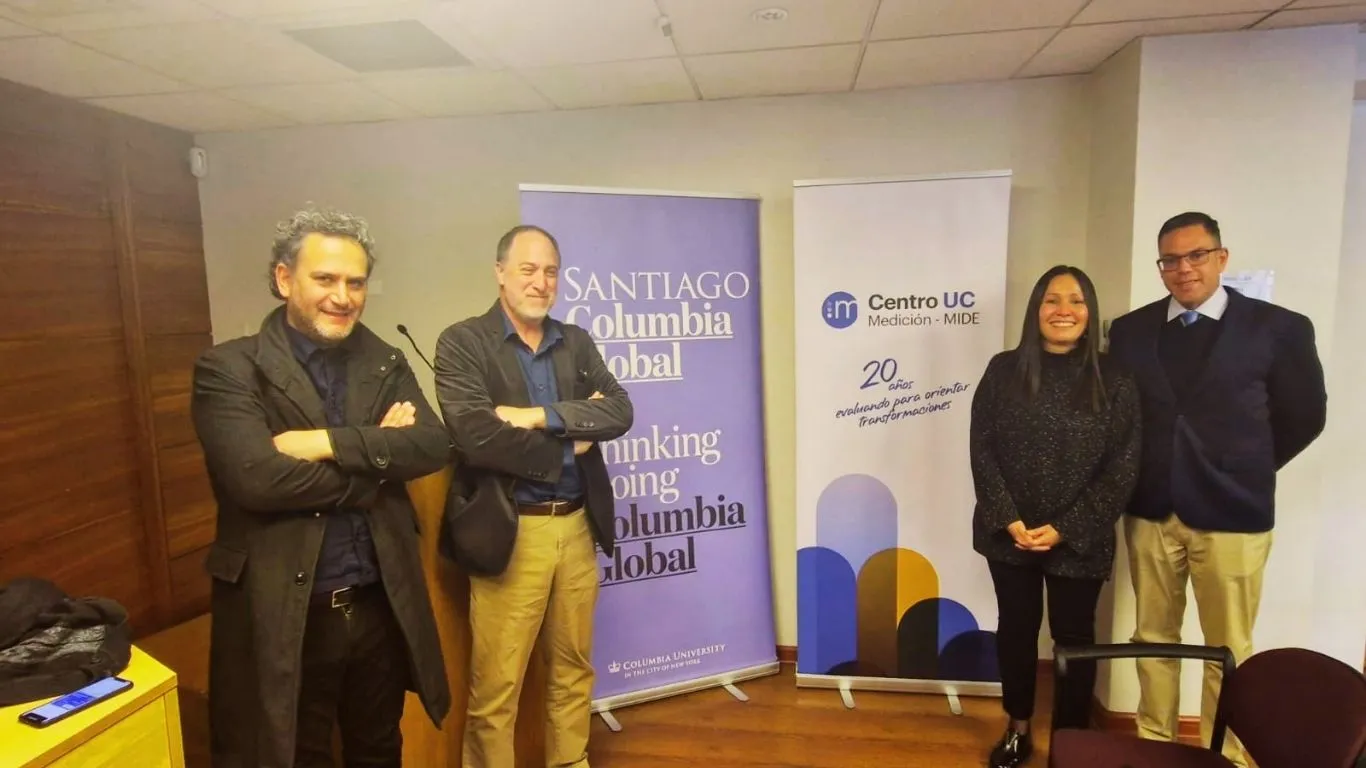
Subsequently, Neida Colmenares, professor and Head of the Public Administration Program at Universidad de Santiago de Chile’s (USACH) Department of Public Management and Policy, presented preliminary results of her research that compares the institutional responses of Chile, Colombia, and Ecuador to the Venezuelan exodus.
Her analysis identified a permanent tension between humanitarian discourses and security-oriented policies: many discourses that appeal to humanitarian principles end up legitimizing greater immigration controls.
Colmenares also questioned the fact that migrants are portrayed only as beneficiaries of services, as victims or threats, proposing to recognize them as political subjects with rights and the capacity to participate.
"The host states prefer to manage Venezuelan migration as a matter of administrative regularization and not a matter of international protection," she said, noting that states have privileged administrative mechanisms over strengthening the refugee system.
In relation to the political debate, Colmenares presented an analysis of Chilean leaders’ social network publications between 2017 and 2025. The results show a predominance of narratives that link Venezuelan migration with irregularity, security and border control, especially during election periods.
Regarding nations’ responses, she pointed out that Chile, Colombia, and Ecuador resorted mainly to decrees and administrative resolutions, with little legislative debate. Although the three countries used similar mechanisms, significant differences were identified: Colombia used these tools to facilitate regularization processes through the Temporary Protection Statute, while Chile and Ecuador adopted more restrictive approaches, generating greater obstacles to regularization.
Finally, none of the three countries studied significantly strengthened their refugee systems, privileging temporary administrative mechanisms that generate legal uncertainty and difficulties for long-term integration, she noted.
The last presentation was given by Nicolás Pedemonte, Director of the Fernando Vives SJ Center for Applied Social Research at Universidad Alberto Hurtado, who proposed analyzing Haitian migration as a case study to understand contemporary migratory processes. He explained that Haiti is one of the most studied diasporas in the Western world and that via this experience, integration dynamics can be observed that are different from those of Venezuelan migration.
Among his main observations, he indicated that the so-called "Chilean dream" did not produce the expected results for many Haitian migrants and that, although this community has lost relative weight within the migrant population in Chile, it continues to be a relevant case for understanding the current challenges of integration.
Despite the diversity of approaches presented during the seminar, the four panelists agreed on several key points: migration must be understood as a permanent phenomenon; integration depends both on public policies and on the quality of relations between migrants and host communities; political and media narratives have a decisive influence on the social perception of migration; and future responses should prioritize integration, social cohesion and the recognition of migrants as key actors in the development of host societies.
"We must rethink migration in Latin America, not only as a crisis, but as a structural phenomenon, as a transformative force," Colletti said, summarizing the seminar's cross-cutting message: migration must be approached as an engine of social transformation and not only from a logic of emergency or security.