Frontline Responders & Witnesses: Collateral Damage of Restricted or Banned Access
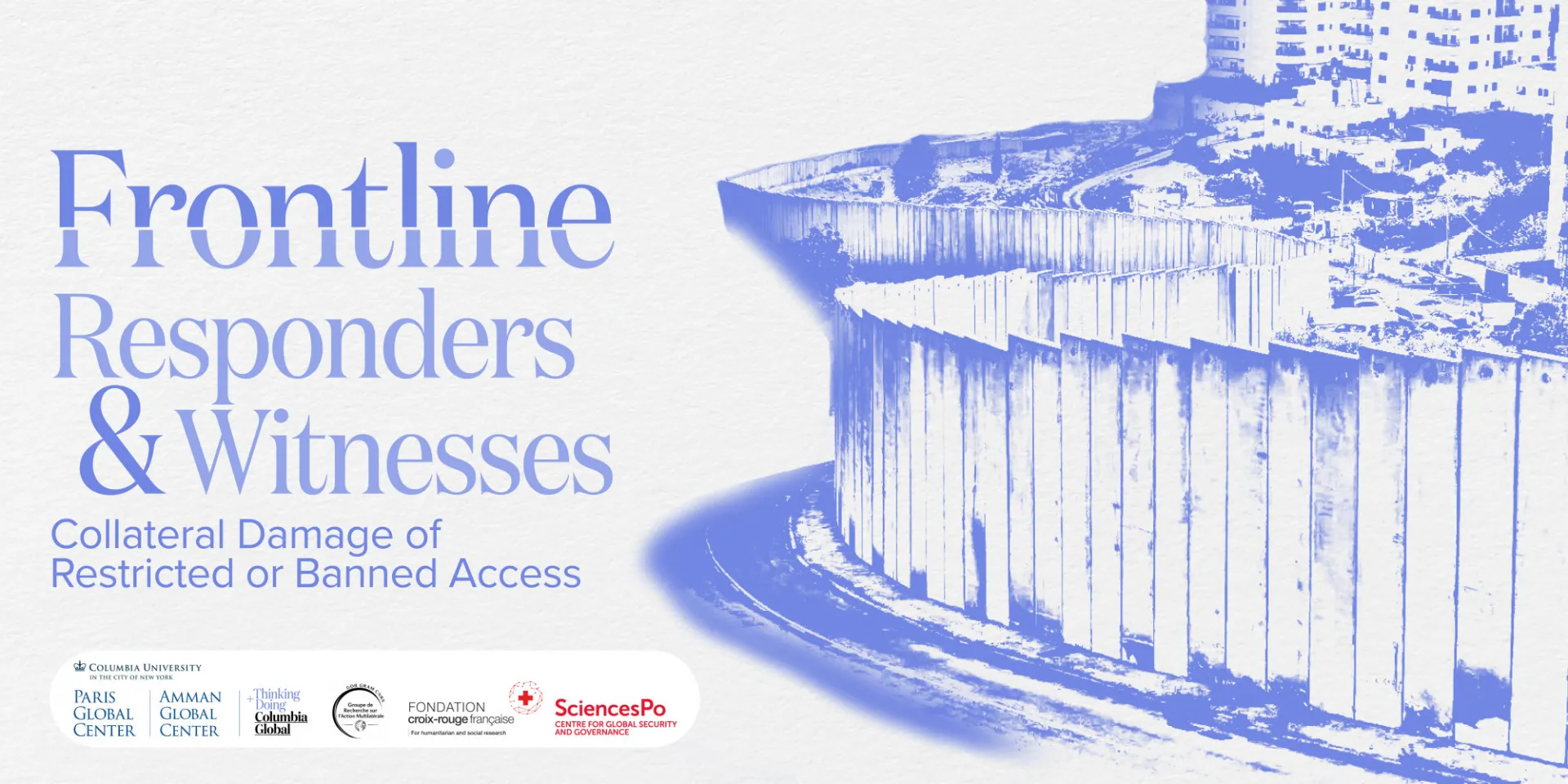
Frontlines was an event co-organized with the French Red Cross Foundation and Sciences Po to explore the realities and challenges of three sectors working at the frontlines of humanitarian crises and conflicts: journalism, humanitarian action and field research.
Across today's humanitarian crises, access to conflict zones is increasingly restricted or entirely denied. In places such as Gaza and Sudan, blockades, insecurity, and political constraints have profoundly transformed the work of humanitarian organizations, journalists, and researchers, while placing ever greater responsibility on local actors who are often the only ones able to respond, document events, and bear witness.
This public conference brought together leading humanitarian practitioners, journalists, and scholars to examine how restricted access is reshaping the production of knowledge, humanitarian response, and international accountability. Through a series of conversations drawing on experiences from Gaza, Sudan, Syria, and other conflict settings, speakers explored the consequences of denied access for affected populations, the evolving relationship between international and local responders, and the legal and ethical challenges raised by today's conflicts.
—
Organized by the Columbia Global Paris Center, the Columbia Global Amman Center, the French Red Cross Foundation, and the Groupe de Recherche sur l’Action Multilatérale (GRAM) at Sciences Po CERI, with the support of the Alliance Program.
This event took place in Reid Hall’s Grande Salle Ginsberg-LeClerc, built in 1912 and extensively renovated in 2023 thanks to the generous support of Judith Ginsberg and Paul LeClerc.
Frontlines is a unique event comprising two parts: the first is a closed seminar organised at Sciences Po by the GRAM thematic network. It aims to take stock of the conditions for academic research into these issues, the establishment of joint research programmes, the search for potential funding, and ways of navigating this particularly challenging new context. The second part is a public conference hosted at Reid Hall to raise broader public awareness of the challenges currently facing humanitarian aid.
Reid Hall, the Columbia Global Paris Center, the Institute for Ideas and Imagination, and the Columbia Global Center Amman are not responsible for the views and opinions expressed by their speakers and guests.
Columbia Global Center Amman advances knowledge sharing through public events, research projects, educational workshops, and practical trainings to connect ideas and perspectives across local and global contexts. Contact us to explore opportunities to partner, collaborate, or participate in our upcoming programs and events. We continue to build on our work together across our key thematic areas.
Speaker Spotlight
Nicoletta Antonini, Deputy Head of Delegation and Protection Coordinator for the ICRC Regional Delegation in Paris
Rawan Damen, Director General of ARIJ (Arab Reporters for Investigative Journalism)
Dr. Maria Gabrielsen Jumbert, Senior researcher PRIO (Peace Research Institute Oslo) and Associate researcher at SciencesPo-CERI
Dr. J.C. Salyer, Professor of Anthropology and Law at Barnard College
Virginie Troit, Executive Director of the Fondation Croix-Rouge française
Adel Zaanoun, Head of Agence France-Presse (AFP)’s bureau in Gaza