Scaling Impact in a Changing Climate: Columbia Convenes US-China Dialogue on Nature-Based Solutions
On August 3, 2026, Columbia Global Center Beijing convened a roundtable on scaling nature-based solutions (NbS).
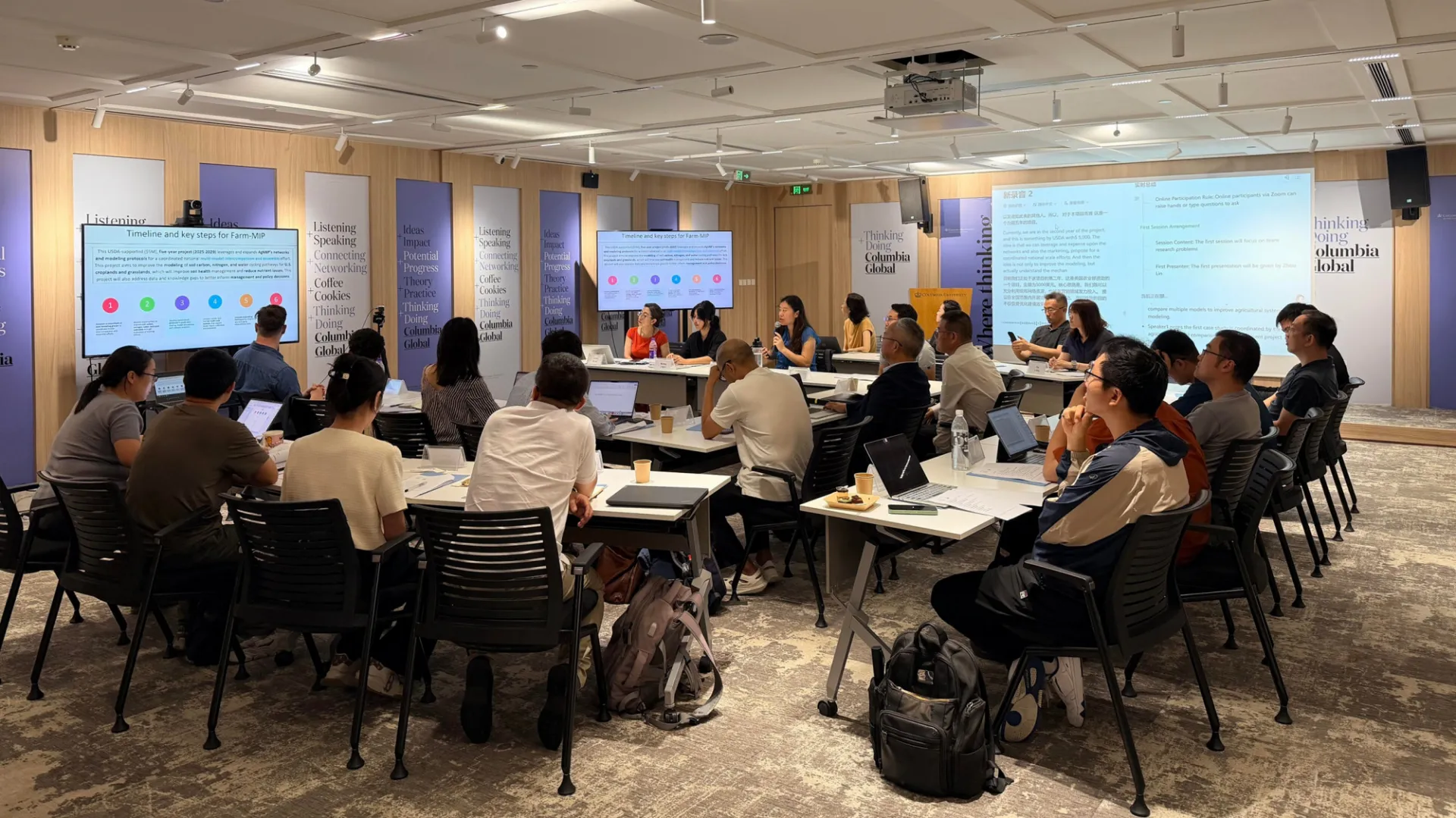
Supported by Columbia University’s President’s Global Innovation Fund, this workshop was led by Columbia scholars Prof. Yushu Xia, Assistant Research Professor at the Lamont-Doherty Observatory, and Dr. Viorel Popescu, Senior Lecturer at the School of Professional Studies.
It gathered scholars, practitioners, and industry leaders from the U.S. and China to generate actionable insights for advancing nature-based solutions (NbS) from compelling research to scalable, on-the-ground impact. Participants explored how to integrate biodiversity conservation with carbon sequestration, sustainable agriculture, biodiversity financing, and cross-border collaboration in an era of intensifying climate risks.
Soil, Grassland, and Rice Paddies: Precision Science for Nature’s Climate Solutions
Prof. Yushu Xia presented a new research program illustrating the scientific rigor behind effective NbS. A USDA-funded initiative brought together experts to compare agricultural models, standardizing inputs across multiple frameworks to clarify how regenerative practices affect carbon, nitrogen, and water.
“We need to go beyond a single measure,” Xia said, noting that multi-model approaches proved more robust than individual ones.
Columbia graduates Caroline Gaskin, Ruzhuo Chen, and Zachary Paul Mayer from the Ecology, Evolution and Environmental Biology program shared findings from their NbS research projects. Gaskin’s review of Chinese agroforestry economics revealed that while 45% of the reviewed studies focused primarily on farm income, they also recognized ecological co-benefits as a supplement. The review of alpine grassland management on the Qinghai-Tibet Plateau conducted by Chen and Mayer found that while year-round grazing exclusion helps degraded lands recover, diversity declines after a decade without grazers—suggesting that moderate, rotational grazing best balances ecological health and herder livelihoods.
“You Get Out What You Put In”: The Real Cost of Large-Scale Reforestation
Prof. Jun Yang of Tsinghua University assessed a large-scale afforestation program in the Beijing Plain, which planted over 100 million trees across 146,000 hectares, increasing forest cover from roughly 15% to 31%. Carbon sequestration reached an estimated 2.54 tons per hectare per year, while biodiversity increased dramatically.
Yet Yang stressed that scale alone guarantees nothing. Contrasting Beijing’s success with a large-scale failed afforestation campaign in Turkey, he argued that scaling up NbS requires three critical elements: strong political leadership, long-term resource commitment, and alignment with local needs. Beijing’s project succeeded not only because it met the city’s need for increased green space, but also because it curbed urban sprawl and addressed public demand for a better environment after the 2012 smog crisis.
“You get out what you put in,” Yang stated. “If we don’t commit this amount of money and take on NbS projects of this magnitude, we cannot make enough contributions to limiting further global warming.”
When Nature Meets Markets: Financing NbS Without Greenwashing
A central tension was how to fund NbS without distorting its purpose. Dr. Jianchu Xu of the Chinese Academy of Sciences argued that ecological restoration must be powered by market demand, citing projects in Kenya and Mali linking dryland restoration to the global textile industry through crops like Calotropis procera. "Value chain powered by economy," he said. "The solution is from the market."
Dr. Li Wang of Fudan University agreed that NbS must speak the language of finance, describing efforts to align projects with the Taskforce on Nature-related Financial Disclosures (TNFD) to attract bank investment. Isadora Wang of Transition Asia noted that decarbonizing heavy industry is inseparable from agricultural and forestry inputs.
Yet participants warned of market pitfalls. One participant distinguished between NbS as a public good requiring sovereign leadership and market-oriented mechanisms such as carbon credits, which risk greenwashing without oversight. Prof. Xia cautioned that current carbon markets often lack trustworthy baselines. “If we wait for all our models to be perfect, then it’s too late,” she said, “but we need to think about additionality and tradeoffs.”
The Measurement Revolution: eDNA and the Quest for Real Biodiversity Data
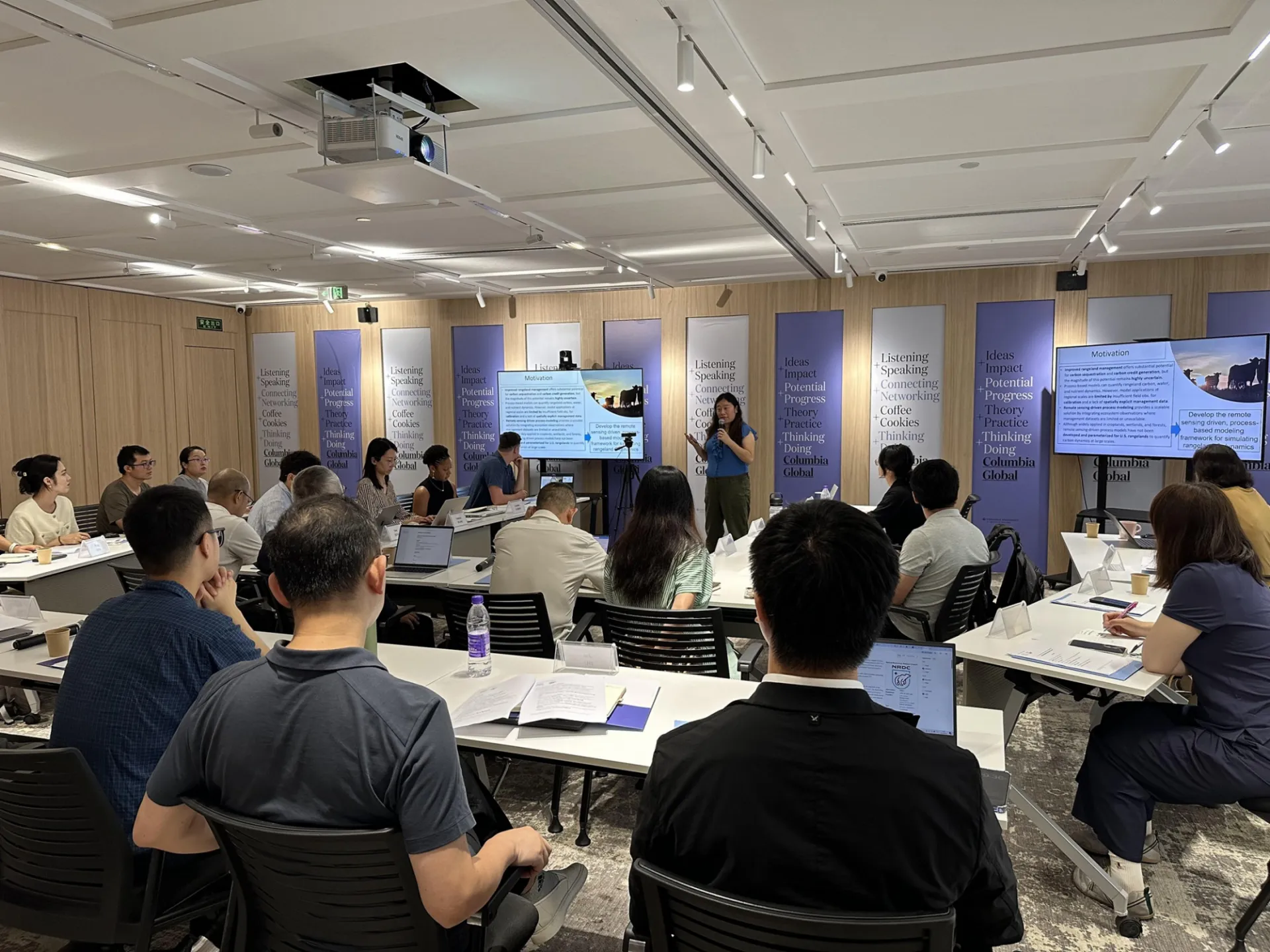
Dr. Viorel Popescu of Columbia University tackled the Achilles’ heel of NbS: proving biodiversity outcomes. While satellite data can track forest cover, “you may have a beautiful forest, but it’s an empty forest” devoid of wildlife, he noted. Reviewing global studies, he found that half of NbS interventions measured only plants, and 57% failed to distinguish native from non-native species.
Popescu presented a breakthrough proof-of-concept with the Kunming Institute of Zoology using environmental DNA (eDNA) from water samples in the Gaoligong Mountains. The method detected nearly 400 species across mammals, birds, fish, amphibians, and reptiles — data that would have taken years to collect using conventional methods like camera traps, bioacoustic sensors, and visual surveys. Using specialized statistical models to filter false positives and false negatives, the team showed that protected areas in the Gaoligong Mountains harbored the highest concentrations of wild and threatened mammals.
“The triple win for mitigation, adaptation, and ecosystem health is real,” Popescu argued, “but only when you measure well.”
He called for training “translators” fluent in ecology, data science, and finance. “This is the goal of our new MS in Biodiversity Data Analytics at Columbia SPS: training professionals who can bridge these disciplines and make decisions that are good for people and the planet”
From Think Tanks to Grassroots: The Human Side of Scaling
In the roundtable, participants confronted the gap between research and implementation. China’s policy environment offers global lessons, yet local barriers persist—including, in some cases, land being leased for less than 3 years, which discourages long-term investments.
The group agreed that interdisciplinary collaboration is essential. “We need to train translators and exchanges of ideas like these are critical,” Popescu insisted. Professor Xu agreed and suggested, “We have a lot of knowledge already; taking action now is more important than ever .”
Closing the workshop, Prof. Xia emphasized that scientific collaboration between the U.S. and China must endure regardless of geopolitical tensions. With plans for a follow-up technical workshop on modern methods in nature data analysis already underway, the Beijing roundtable delivered a clear message: nature-based solutions must be scientifically rigorous, economically viable, and locally rooted, and the time to act is now.
Watch the Event: