U.S.-China Educational Ties at a Crossroads: Columbia Scholars Map a Path Forward
On August 12, three scholars with more than two decades of experience in U.S.-China educational exchange gathered at the Columbia Global Center Beijing for a candid assessment of the state of people-to-people ties between the two countries.
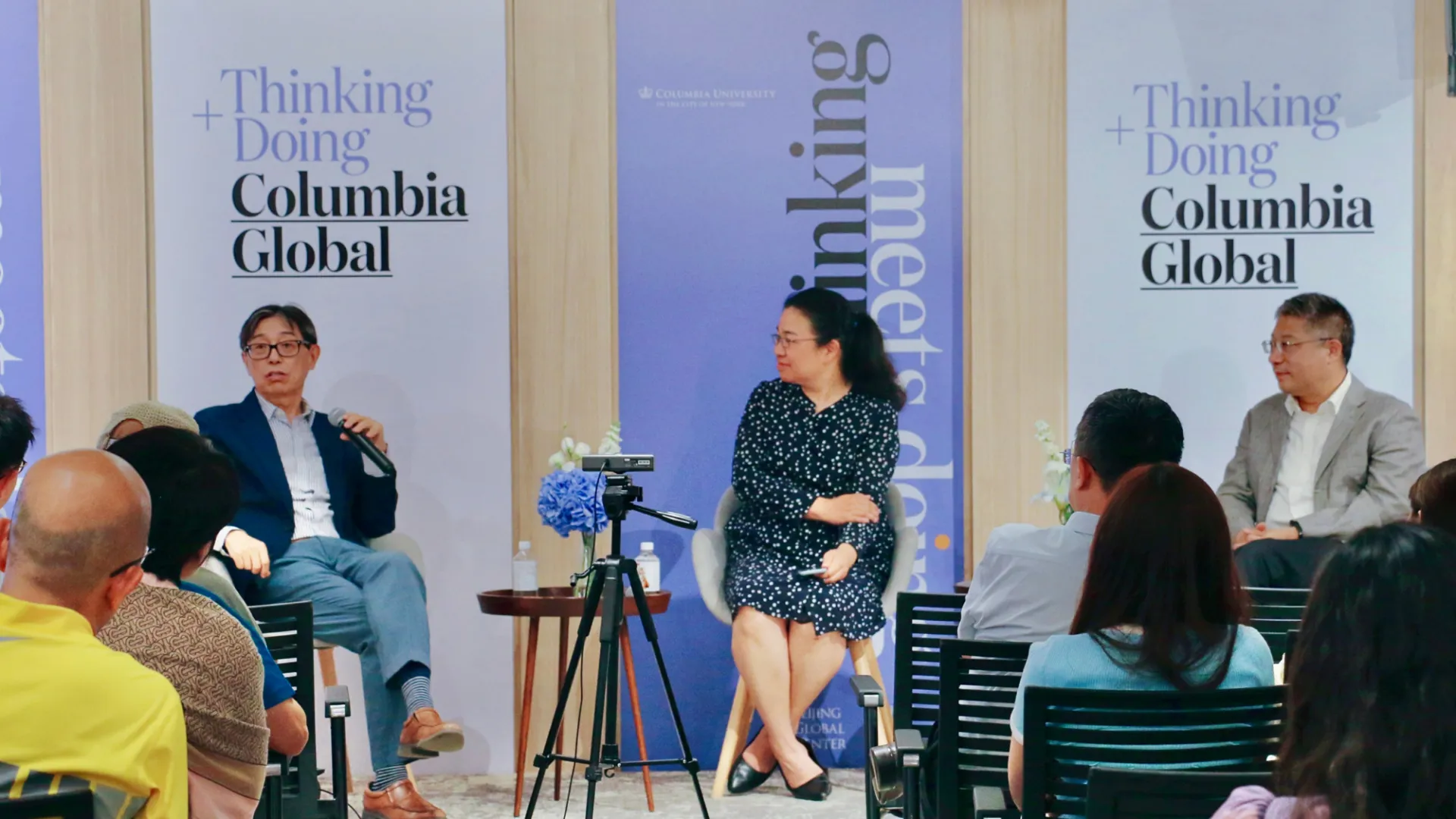
Cohosted by the Weatherhead East Asian Institute, the event brought together leading voices from both academia and institutional exchange. It featured Prof. Xiaobo Lü, Anne Whitney Olin Professor of Political Science at Barnard College, Columbia University, and Founding Director of the Columbia Global Center Beijing; Jing Zhang, Director of the China Center for International Educational Exchange at the China Education Association for International Exchange (CEAIE); and Prof. Po Yang, Tenured Associate Professor and Chair of the Department of Education Economics and Administration at the Graduate School of Education, Peking University.
Public Opinion: From Highs to Lows
Prof. Lü opened the discussion with a striking timeline of American public sentiment toward China, drawn from decades of polling data. According to the Pew Research Center, favorable views of China among the American public reached more than 70 percent during a period of bilateral warmth in 1988. By 2005, positive and negative opinions were roughly split. But the situation deteriorated rapidly after 2022, with approximately 70 percent of Americans holding unfavorable views and favorable ratings dropping to roughly 20 percent."
Yet the data also contained a subtle but notable shift that has attracted increasing attention from researchers on both sides of the Pacific. A Pew Research Center survey conducted in early 2026 indicated that American views of China improved for the first time since the pandemic, with favorable ratings climbing back to between 20 and 30 percent. A closer look at the numbers, Lü noted, reveals a significant generational divide: younger Americans are beginning to view China more favorably, while those aged roughly 40 and above remain largely hostile.
The scholars agreed that understanding the attitudes of younger Americans—and creating meaningful channels for them to engage directly with China—may be one of the most consequential challenges for the future of bilateral relations. If the trend holds, they suggested, it could reshape the political landscape for U.S.-China engagement over the coming decades.
The Data: A Dumbbell-Shaped Recovery
Prof. Lü presented a stark comparison: at its peak during the 2019–2020 academic year, the number of American students in China ranged from approximately 11,000 to 15,000. Today, that figure has fallen to fewer than 2,000, a decline driven by the combined effects of the COVID-19 pandemic, geopolitical tensions, and shifting academic priorities.
The shift is visible in university classrooms as well. Lü noted that Chinese language enrollment at Columbia peaked during the 2015–2016 academic year and has declined steadily since. The trend, he emphasized, is not unique to Columbia but reflects a national pattern across American higher education. In contrast, Korean language enrollment has risen—a phenomenon widely attributed to the global spread of Korean popular culture.
The picture, however, is not uniformly bleak. Jing Zhang offered data from official exchange programs that suggest a different trajectory at the non-degree level. The "1+2+1" Sino-U.S. Joint Training Program, which has operated for 26 years and encompasses approximately 50 American state universities and nearly 180 Chinese institutions, saw its physical operations disrupted during the pandemic but never fully halted. It has since recovered to roughly 600 participants annually.
The result is what the scholars described as a dumbbell-shaped structure: a sharp decline in degree-seeking students at one end, and robust short-term exchange programs at the other. This structural imbalance, they warned, raises serious questions about whether the next generation of American "China hands" will have the depth of on-the-ground experience necessary to navigate an increasingly complex bilateral relationship.
Resilience and New Models
Prof. Po Yang proposed a more imaginative path forward: opening internship opportunities for foreign students at Chinese multinational corporations. She noted that companies such as ByteDance and Meituan are actively expanding into markets including the Middle East, Brazil, and Southeast Asia, and have a growing demand for employees with local cultural and linguistic backgrounds. These firms, she argued, represent an underutilized resource for rebuilding people-to-people ties.
"Foreign students may not stay to work in China," Yang said, "but they may well work for Chinese multinationals abroad. We need to create those opportunities for them."
Alumni as Bridges
Toward the end of the event, the conversation turned to the role of alumni networks in sustaining bilateral ties. Zhang issued a direct appeal to the Columbia alumni in attendance at the Beijing Global Center: "If each of you brings one American classmate or mentor to China, the impact will multiply. If we simply wait for policy to improve, little will happen. No action is too small."
Prof. Lü directed his appeal toward a more concrete resource: "If you are in a position to donate in the future," he said, "direct your contributions to programs related to China. That is where the need is greatest, and that is where the impact will be most lasting."