Why Is “Primitivism” So Hard to Shake?
Reid Hall Faculty Visitor Zoë Strother spent several weeks in Paris studying the French edition of Leni Riefenstahl’s controversial photobook of the Nuba peoples and researching the restitution of African objects at the Musée du Quai Branly.
Zoë Strother is the Riggio Professor of African Art at Columbia, specializing in Central and West African art history with a focus on the twentieth and twenty-first centuries, publishing on African art, masks and masquerade, photography, and the history of iconoclasm and restitution in Africa. Her work also examines European "primitivism" through figures like Sara Baartman, Carl Einstein, and Leni Riefenstahl, and her current research centers on aesthetic emotions in Congolese art history. She visited Reid Hall this fall as part of the Faculty Visitorship Program co-sponsored by the Columbia Global Paris Center and the Institute for Ideas and Imagination.
—
When Zoë Strother was an undergraduate art history student at Bryn Mawr College, the only art they taught was European. Then, as a graduate student at Yale, she attended a lecture on African art by Sylvia Boone, the first African American woman to receive tenure at the university. “Wow, this is so fresh,” she recalls thinking, “instead of the hundredth study of impressionism or something, I should investigate this.” So she signed up for Boone’s class. “It was the best decision of my life.”
Strother now serves as the Riggio Professor of African Art at Columbia University, specializing in Central and West African art in the 20th and 21st centuries. She has published books and essays on Congolese art history, masks and masquerade, photography, the history of iconoclasm in Africa, and restitution.
Earlier this fall, Strother spent several weeks as a faculty visitor at Reid Hall in Paris, researching her two latest projects: the publishing history of Leni Riefenstahl’s landmark photobooks of the Nuba peoples and the restitution of African objects at the Musée du Quai Branly. Both relate to a topic that has run through her career: “primitivism.”
“I would be happy ditching the term,” says Strother, “but my Europeanist colleagues won’t let go.” So she’s resorted to using it, albeit in quotation marks. After all, there is no such thing as a “primitive” artist or person. Rather, what counts as “primitivism” depends largely on the speaker’s perspective. More specifically, how one feels about the impact of modernization on society. Do you think that modernization brings progress and greater sophistication? Or do you think it leads to social alienation and loss of authenticity? “In this vein,” writes Strother, “‘primitivism’ can be viewed as a reaction against modernization, whether negative or positive.”
Take Leni Riefenstahl’s photobooks of the Nuba peoples. The first, titled The Last of the Nuba, came out in 1973 and showed photos of the Mesakin Nuba people of rural Sudan as they farmed, wrestled and performed funeral rites, largely in the nude . “Well away from the trade routes,” read the book’s flap copy, “from the disruption of alien cultures and the meretricious ideas of Western Man, these fragile groups of noble men have clung to their traditional culture with a rare and stubborn devotion.”
The book was a massive hit, and critics praised it for depicting the Nuba peoples’ culture as simple, pure and timeless. Then came Susan Sontag and her essay Fascinating Fascism. It reminded people that Leni Riefenstahl was a leading director of Nazi propaganda films, and argued that these photos, with their obsessive focus on naked, muscular bodies, belonged to the same fascist aesthetic as those films. It also denounced this portrayal of the Nuba peoples’ culture as “a primitivist ideal: a portrait of a people subsisting in a pure harmony with their environment, un- touched by ‘civilization.’"
Despite this, the book remained popular. A few years later, Riefenstahl released a second one, The People of Kau, and inspired a whole genre of coffee-table books that portrayed African cultures through a similar lens.
Why were people so drawn to these images? That’s one of the questions Strother is trying to answer by examining the publishing history of Riefenstahl’s original book.
So far, she’s found some interesting patterns: “What really fascinated the American audience ... was the male body. You were at the end of the Vietnam War, and this image of a strong, powerful, male physique that was peaceful. It was very moving to people. In Europe, what ends up getting emphasized will be the female body.” While in Paris, she researched the French edition of the book, along with papers from its publisher held at the Institut Mémoires de l’édition contemporaine (IMEC).
In Paris, Strother also worked on the restitution of African art, a live issue in France.
In 2018, Senegalese academic and writer Felwine Sarr and French art historian Bénédicte Savoy published a report claiming that more than 90 percent of sub-Saharan Africa’s material cultural heritage was outside the continent and recommended that France return African objects in its national collections that were taken without consent.
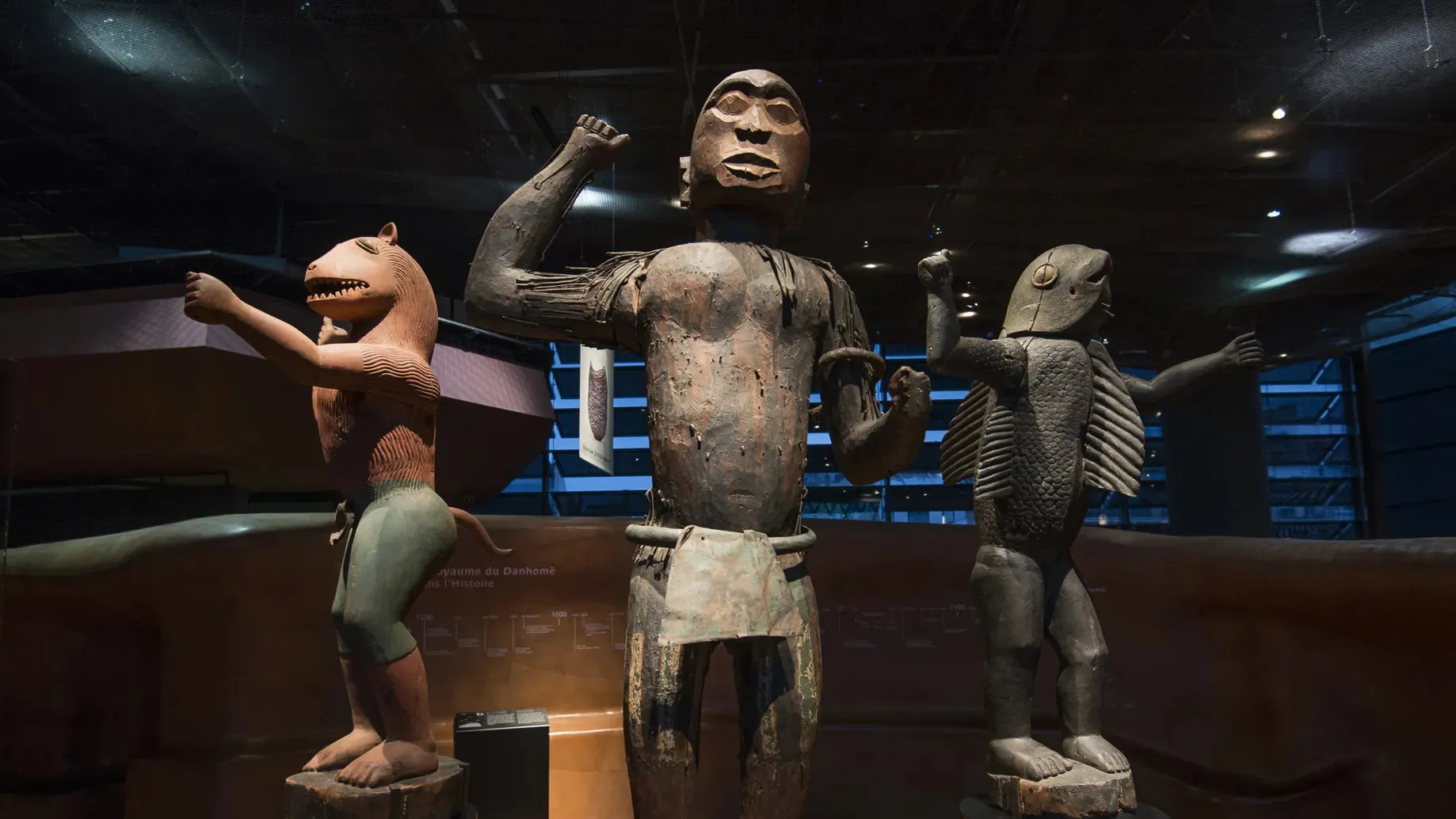
Soon after, French President Emmanuel Macron announced that 26 statues and other ceremonial pieces held at the Quai Branly museum would be sent back to the Republic of Benin, and promised that more would follow. In the ensuing years, however, progress stalled, and very few other objects were restituted. But this past May, nearly eight years later, France finally passed a law allowing it to hand back illicitly acquired cultural property without a separate act of Parliament for each case.
Beyond the slow pace, Strother has a few issues with the country’s restitution efforts, starting with the statistic at the heart of the 2018 report: that more than 90 percent of sub-Saharan Africa’s cultural heritage is outside the continent. In a 2019 article for The Art Newspaper, she noted that the report’s authors attribute the figure to a 2007 estimate of the size of African museum collections, which she said is sometimes far off the mark.
More important, she argues, the number counts mainly “classical” works, the kind collected between about 1885 and 1930, and leaves out all the art made in Africa since. “Such a selective view of what constitutes cultural heritage continues the colonialist paradigm that African cultural achievement should be defined by European criteria,” she wrote. “It also perpetuates the misguided notion that African cultural production effectively died in 1885 and everything produced thereafter is illegitimate and debased in quality.” Essentially, another case of “primitivism.”
In an effort to address these problems, among others, Strother organized a symposium at Columbia University in 2019 titled “The Restitution Debate: African Art in a Global Society.” It brought together curators and scholars from Africa, Europe and the United States, including Sarr and Savoy, to consider arguments made since the report’s publication.
Years later, Strother sees signs of change in French attitudes. While in Paris, she met with Gaëlle Beaujean, head of the Africa collections at the Quai Branly, who told her about the museum’s plans to renovate its African galleries and show more contemporary African art, a prospect Strother found exciting. She also attended a talk by Savoy on the restitution in 1815 of thousands of objects taken by Napoleon’s armies — proof that it is, in fact, possible.
Strother will return to Paris in March and April to continue her work on restitution. She also plans to revisit some of her research on the masks of the Pende people of the Democratic Republic of the Congo, this time through the lens of aesthetic emotions. It’s a thoroughly complicated topic, she says, “but I take pleasure in it.”