Remembering Mario Vargas Llosa: A Life of Letters, Politics, and Provocation
On World Book Day, we remember the Peruvian Nobel Laureate who passed away on April 13.
Born in Arequipa, Peru, in 1936, Mario Vargas Llosa became one of the most influential voices in 20th-century Latin American literature. His literary career began early, shaped by formative years marked by family upheaval and rigid discipline. In 1950, his father sent him to the Leoncio Prado Military Academy in Lima to complete his secondary education. Those two years would later inspire his breakthrough novel, La ciudad y los perros (The Time of the Hero, 1963), published at age 27 and now considered one of the defining works of the Latin American Literary Boom.
After leaving the military school, Vargas Llosa moved to Piura to finish high school while living with his uncle Luis and aunt Olga. He began working as a journalist, writing reports and interviews for newspapers, magazines and radios, and published his first play. In 1953, he entered the National University of San Marcos in Lima to study law and literature, immersing himself in political activism and aligning with the Communist Party in opposition to the dictatorship of Manuel Odría.
At age 19, Vargas Llosa married Julia Urquidi, his aunt Olga’s sister, in a union that scandalized his family. The couple lived in Paris, where he established himself as a prolific writer and journalist. After a decade together, Mario and Julia ended their relationship when he became involved with Patricia Llosa Urquidi—his first cousin and Julia's niece—whom he married the following year. Together, they had three children: Álvaro, Gonzalo, and Morgana. He recounted this period in his 1977 semi-autobiographical novel La tía Julia y el escribidor (Aunt Julia and the Scriptwriter).
The Peruvian Question and a Passion for Politics
Among Vargas Llosa’s best-known works are Conversación en la catedral (1969), Pantaleón y las visitadoras (1973), La guerra del fin del mundo (1981), El pez en el agua (1993), La fiesta del chivo (2000), and Travesuras de la niña mala (2006). In Conversación en la catedral, the main character, Santiago Zavala, poses the now-famous question: “¿En qué momento se había jodido el Perú?” (“At what moment had Peru gone wrong?”)—a haunting reflection that has echoed across the continent—and through Vargas Llosa’s own life—for almost half a century.
A passionate political thinker, Vargas Llosa distanced himself from Marxism and broke ties with Fidel Castro’s regime in the early 1970s, aligning himself instead with classical liberalism. He ran for president of Peru in 1990, losing to Alberto Fujimori in a tight runoff election. That same year, he moved to Madrid and began a long-standing relationship with the Spanish newspaper El País, contributing biweekly columns for over three decades.
His first column, “Elogio de la dama de hierro” (“In Praise of the Iron Lady”), was dedicated to former British Prime Minister Margaret Thatcher—whom he met on several occasions. The piece was published on December 1, 1990, just three days after her almost 12 years as PM. Until his death, Vargas Llosa remained an outspoken figure, challenging both the left and the right with provocative views.
A Lasting Connection with Columbia University
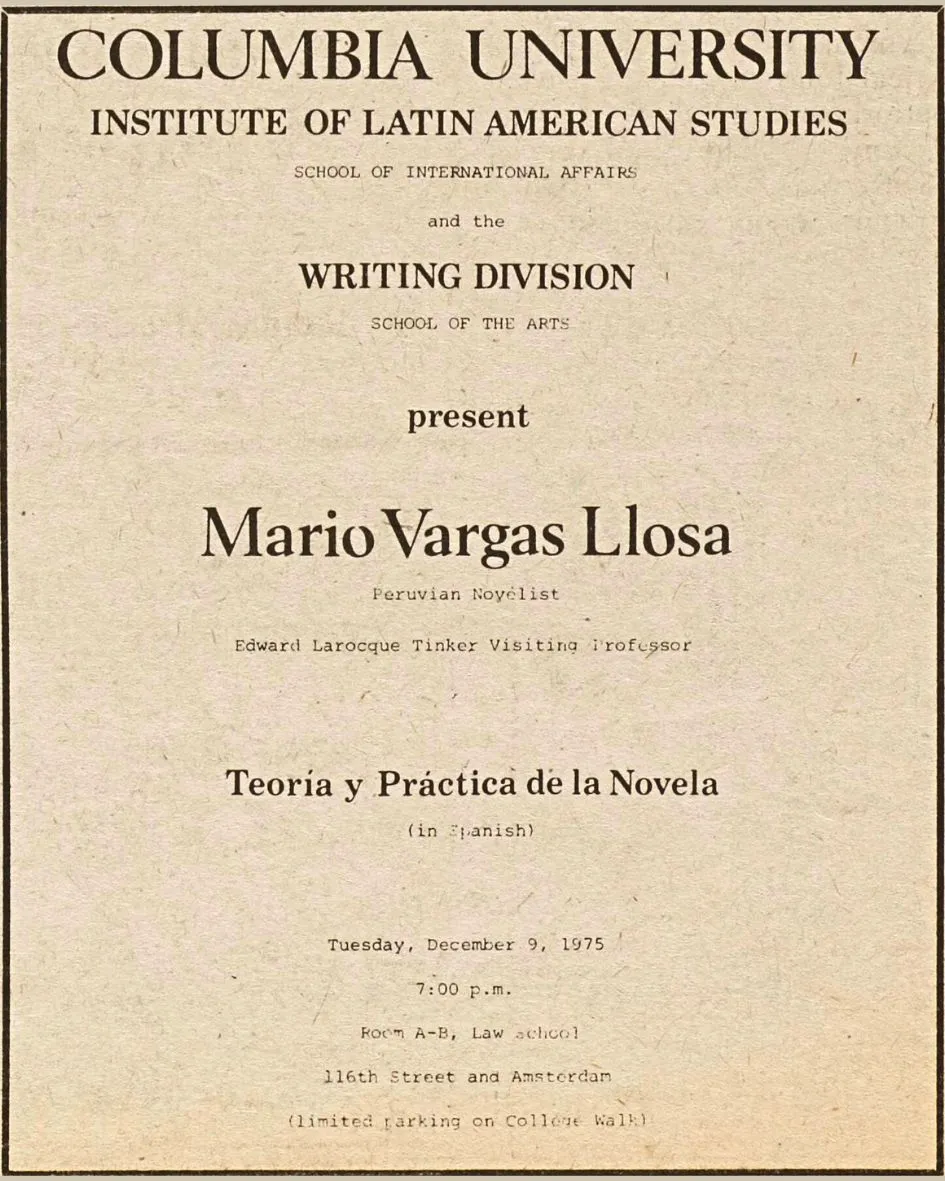
Like many of the great literary minds of the 20th century, Vargas Llosa maintained a meaningful connection with Columbia University. In the fall of 1975–76, he was invited as the Edward Larocque Tinker Visiting Professor. During that time, he led discussions such as “Theory and Practice of the Novel”, held in December 1975 (as featured in The Columbia Spectator issue pictured below).
He returned to Columbia in the 1980s for additional literary events and again in 2005 to participate in the World Leaders Forum, in collaboration with the Rolex Mentor and Protégé Arts Initiative. The event, titled “Across Generations and Borders: Mentoring Artists in a Global Culture”, brought together eight artists to discuss the role of mentorship in the arts.
During the symposium, Vargas Llosa remarked: “You cannot teach creativity—how to become a good writer. But you can help a young writer discover within themselves what kind of writer they would like to be.”
In response to a journalism student’s question, he reflected: “The truth of art lies not in its ability to mirror reality but in its power of persuasion. Art allows us to dream, to expand our vision beyond the constraints of our existence, to fulfill desires that are unattainable in real life. In so doing, it enables us to reach an understanding of life that a completely accurate depiction can never convey,” he stated, adding “That is why authoritarian regimes instinctively distrust artistic creation.”
Less than a year later, Vargas Llosa returned to Columbia to receive the Maria Moors Cabot Prize, awarded by the Graduate School of Journalism since 1938 to journalists who have made significant contributions to inter-American understanding. That year, fellow recipients included Ginger Thompson (The New York Times), José Hamilton Ribeiro (TV Globo, Brazil), and Matt Moffett (The Wall Street Journal).
At the ceremony, the master of ceremonies stated: “We honor Mario Vargas Llosa for his distinguished contributions to journalism. As an indefatigable reporter and radio correspondent, a meticulous craftsman of language, and a chronicler of the achievements and failures of humanity, Vargas Llosa has spent his life defending democratic values and promoting inter-American understanding.”
Vargas Llosa’s passion for journalism was unwavering. Upon receiving the Cabot Prize, he declared: “Journalism—whether informative or opinion-based—is the greatest guarantor of freedom, the best tool society has to expose what is failing, to promote justice, and to strengthen democracy.”
Over his multifaceted career, he received honorary degrees from the world’s most prestigious universities and earned hundreds of accolades—including the Rómulo Gallegos Prize (1967), the Cervantes Prize (1994), and the Nobel Prize in Literature (2010).
In October 2023, he published his final work of fiction, Le dedico mi silencio (I Dedicate My Silence to Her). Two months later, on December 13, he published his last Piedra de Toque column in El País, bringing an end to more than three decades of literary commentary. “Talented journalists seek the truth like a sword that cuts through anything. To lie or manipulate is easy, but the truth eventually prevails. Those who defend the truth serve their readers and their time. That’s what I humbly aspired to do with my column ‘Piedra de Toque’,” he wrote in his final words for the paper.
A Legacy of Boldness
Observer, provocateur, relentless questioner, Vargas Llosa was never afraid to challenge norms. His life was marked by controversy and courage, including a now-legendary punch he threw in 1976 at his—until then— intimate friend Gabriel García Márquez, after which the two literary giants never spoke again.
Through his political views, personal decisions and fearless novels, at once tender and incisive, humorous and tragic, Mario Vargas Llosa left a lasting imprint on Latin American identity and his work will continue to provoke and inspire readers around the globe.