The Intersection of Black Studies and Space: Mario Gooden Research Residency in Paris
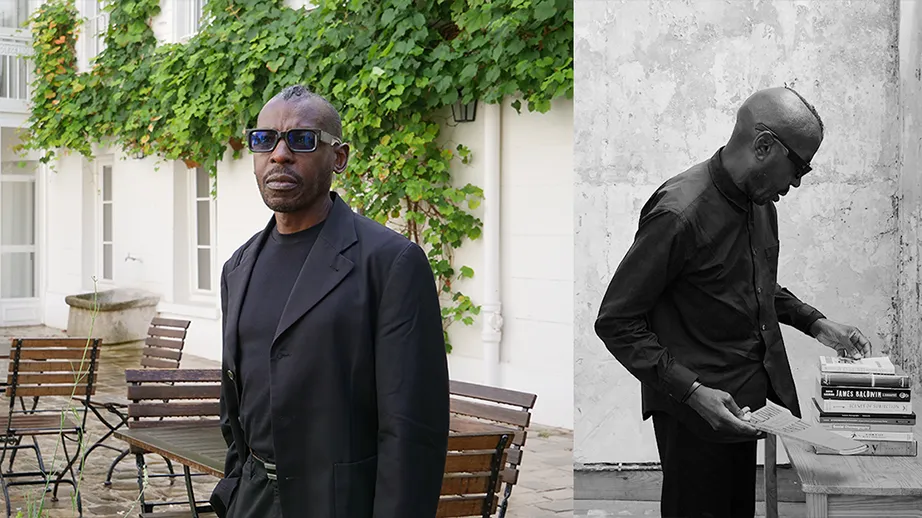
In a compelling fusion of architecture, Black Studies, and astrophysics, Mario Gooden, architect and scholar, is deepening his exploration of the intersections of race, space, and liberation through a new installation-performance project titled Black Holes Ain’t So Black. Currently in residence with L’AiR Arts at Atelier 11 in Paris, Gooden has spent the past several weeks researching, scripting, and editing this multidisciplinary work, which will premiere at Pioneer Works in Brooklyn.
“I actually began working on this piece about two and a half years ago,” Gooden says. “It’s taken on several iterations—initially as a kind of architectural non-lecture—but here in Paris, I’ve been rescripting the oration, weaving in voices like James Baldwin, Toni Morrison, Alice Walker, and Stephen Hawking.”
The title Black Holes Ain’t So Black is a direct reference to Hawking’s 1988 book A Brief History of Time, in which the physicist describes the event horizon of a black hole—the edge where light cannot escape—as “a bit like running away from the police and just managing to keep one step ahead but not being able to get clear away.”
“That statement has always resonated with me,” Gooden reflects. “When I first read it, I was floored. It was like finding Black Studies inside A Brief History of Time. That phrase stuck with me.”
Gooden’s work draws upon astrophysics as metaphor, but its content is grounded in cultural and historical experience. His three-channel video and performance installation enacts what he calls “spatial praxes of liberation,” using archival film, simultaneous oration, choreography, and architecture to collage moments from historic and contemporary Black life.
The influence of James Baldwin is central to this current iteration. Gooden has been tracing Baldwin’s own stays in Paris as a form of fugitivity from the racial violence of mid-century America. “I’ve been working on Baldwin’s voice in the oration—bringing in his time in Paris in 1948 – 1957—moments when he was both writing and escaping,” Gooden explains. “That sense of exile and confrontation with space is important to how this work comes together.”
Gooden, a Professor of Professional Practice at Columbia GSAPP and Director of its Master of Architecture program, also co-directs the Global Africa Lab, which investigates spatial forms across the African diaspora. In this way, Black Holes Ain’t So Black builds on his broader inquiry into architecture’s entanglement with race, gender, technology, and power.
The performance will be developed further in a residency at EMPAC in Troy, New York, before being workshopped at the EMPAC Festival in April 2026. Collaborators include choreographer Jonathan González and writer and filmmaker Thuto Durkac-Somo.
“I’m thinking about how space performs—how it can hold memory, violence, and liberation simultaneously,” Gooden says. “And how Blackness navigates that space—not as a void, but as something with density, gravity, and a future.”