From Protests to Public Health: Mailman Students Bring Global Research to Life in Chile
Two Mailman grad students, Mahima Agrawal and Jaia Wingard, reviewed their Chile-based research performed through the Applied Practice Experience (APEx) program.
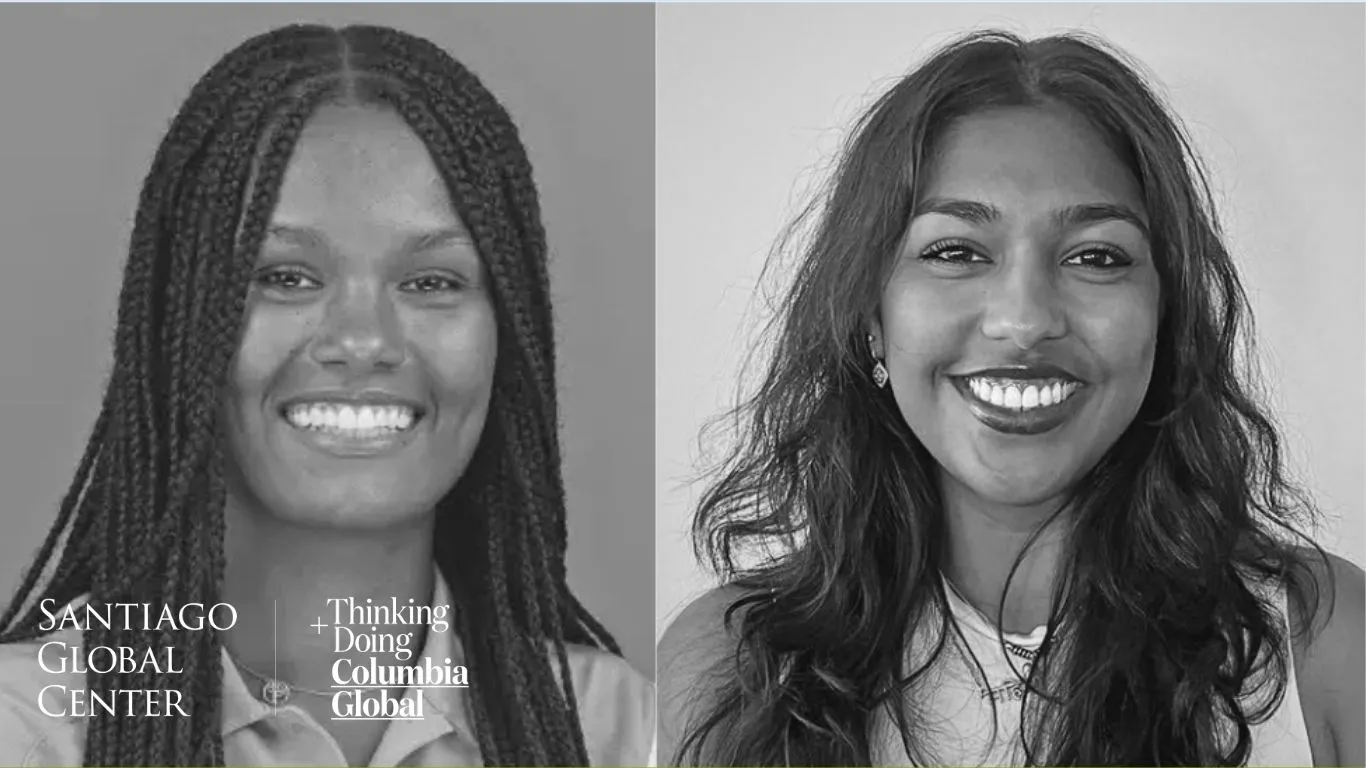
How do students learn from preparing complex protest data or reviewing global research on aging? What insights emerge when they work across borders and disciplines?
This summer, two Columbia Mailman School of Public Health students explored those questions through the Applied Practice Experience (APEx) program—supported by the Columbia Global Center Santiago in partnership with Universidad Mayor’s Center for Intercultural and Social Studies (CISS) in Chile.
The program, now in its seventh year with CISS, pairs Columbia students with Chilean researchers to address pressing health and social challenges. Whether on the ground or collaborating virtually, students gain a deep understanding of local contexts while contributing to work that can inform policy far beyond national borders.
Mahima Agrawal: Tracking Social Movements
Working from the United States, Mahima Agrawal—a master’s student in Public Health and Bioethics—teamed up with Universidad Mayor faculty Natalia Miranda and Diego Palacios to explore Chile’s long history of social movements.
Her project applied protest event analysis to data gathered from 54 newspapers and 18 media outlets, as well as a dataset compiled of more than 28,000 protest events from 2008 to 2020 from the Chilean Center for Studies on Conflict and Social Cohesion (COES). The work examined movements like the student-led “Penguin Revolution,” the feminist wave, and the ongoing campaign to reform Chile’s private pension system.
“What stood out,” Agrawal explained, “was the extraordinary diversity of organizations participating in protests. You can’t apply a one-size-fits-all approach to understanding them. Each mobilizes differently.”
Through her research, she gained a broader perspective on how socio-political forces influence public health and the lived experiences of Chileans.
Jaia Wingard: Rethinking Successful Aging
While Agrawal worked remotely, Jaia Wingard, a master’s student in Applied Biostatistics, spent the summer in Santiago alongside CISS Associate Professor Alexis Sossa. Her focus: understanding “successful aging” in a country where life expectancy is rising, but not all older adults thrive.
Reviewing 113 studies from 2020 to 2025, Wingard found that while physical activity is consistently linked to better health, overlooked factors—like pet ownership, resistance training, or lifelong learning—could play important roles. She also highlighted the value of cultural dimensions, such as spirituality and intergenerational wisdom, which remain underexplored in the literature.
“Healthy aging isn’t just about physical health,” Wingard noted. “It’s about social engagement, resilience, and ensuring people have access to the resources and environments that support them throughout their lives.”
A Partnership Across Regions
For Nicolás Montalva, Director of CISS, the collaboration with Columbia is about more than research output. He described the program as an opportunity to explore applied social science research in practice.
Carly Hutchinson, Adjunct Assistant Professor of Sociomedical Sciences at Columbia Mailman, agrees: “The partnership with CISS and the Santiago Center is invaluable. It offers our students real-world research experience and fosters mutual learning between institutions.”
Global Centers in Action
The APEx program in Santiago is one example of how Columbia Global Centers connect students and faculty with partners worldwide to co-create knowledge and address shared challenges. By convening local expertise, providing research infrastructure, and cultivating long-term relationships, these centers turn academic inquiry into practical insight.
When the APEx students arrive in Chile, they are welcomed at the Santiago Center and participate in a presentation regarding culture, etiquette, and what to do (and not do) during their stay in Santiago. They are also provided ground support if and when needed for the duration of their in-country experience.