Conversations, Collaborations, and Creativity in Paris with Columbia Faculty
The Atelier podcast, which highlights some of the unique discussions that take place at Reid Hall, also offers a behind-the-scenes look at Columbia faculty’s research, teaching, and collaborations during their immersive visits to Paris.
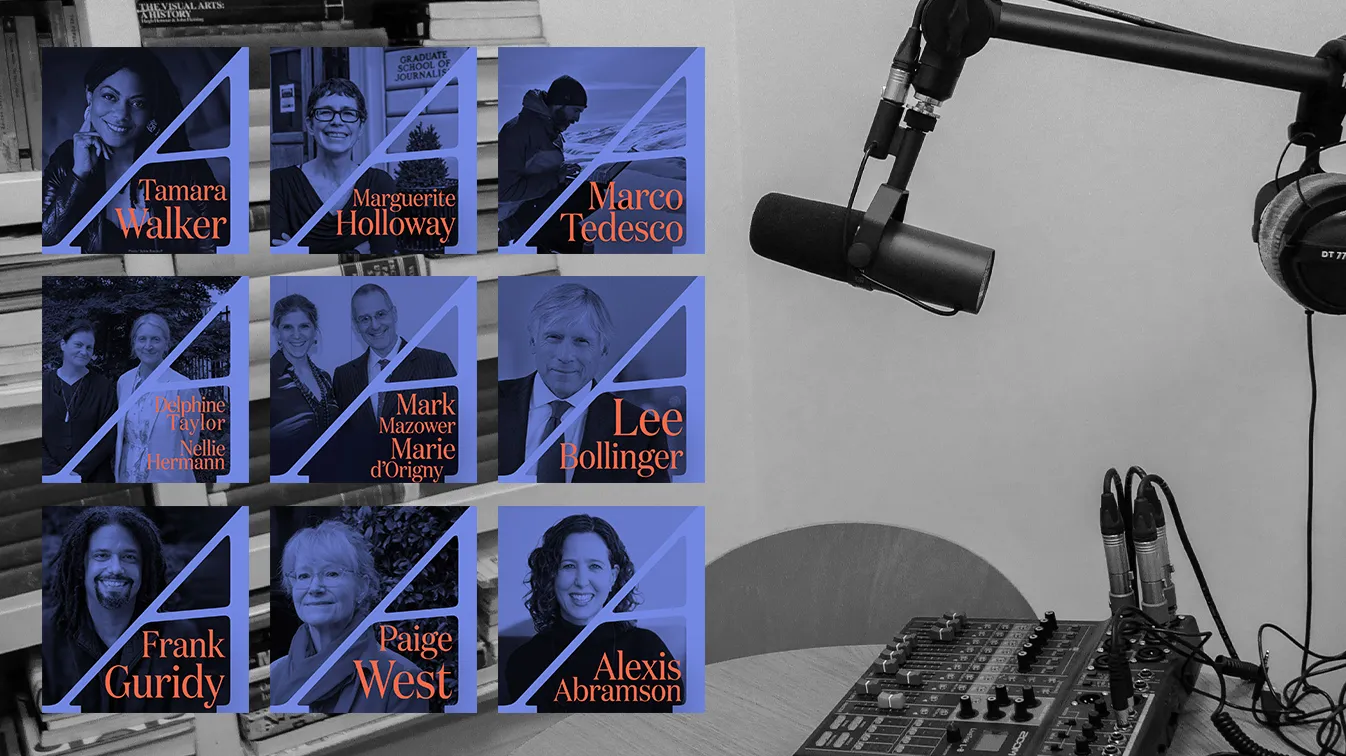
As applications open for the 2026 – 2027 Faculty Visitorship Program at Reid Hall, the Columbia Global Paris Center and the Institute for Ideas and Imagination invite faculty to bring projects to Paris for 2–3 weeks of immersive research, collaboration, and public engagement. Reid Hall provides more than a workspace: it is a catalyst for interdisciplinary dialogue, a hub for unexpected encounters, and a place where synergies flourish.
The Atelier podcast, produced by the Columbia Global Paris Center, offers listeners a window into what happens when Columbia scholars spend focused time in the Paris environment. Across two seasons, the podcast has demonstrated the interdisciplinary, relational, and project-driven nature of faculty work at Reid Hall.
Time at Reid Hall transforms how faculty engage with primary sources, fieldwork, and long-term research. Nikolas Kakkoufa spoke about archival discovery and queer history, exploring Greek folk poetry and its historical contexts. He highlighted how Reid Hall’s environment allowed him to reflect on fragmented archives and synthesize material that might have otherwise remained siloed: “I think being here, in Paris, gives you a sense of perspective and distance, a space to put the pieces together,” he noted in conversation.
During his visit to Paris, Arctic climate scientist Marco Tedesco reflected on planetary urgency and the emotional weight of field research: “Being in a different space, even for a few days, allows you to step back from the immediacy of data and see the bigger story.” Meanwhile, Tamara Walker reflected on the experiences of African Americans abroad over the course of the 20th century, and the reality of studying abroad today, the cornerstone of Reid Hall’s foundation.
Reid Hall also fosters dialogues across disciplines. Delphine Taylor and Nellie Hermann, an inaugural fellow of the Institute, illustrated this through narrative medicine: a discipline that blends creative writing with medical practice. Their first joint visit to Paris was followed by several workshops and conferences with Paris-based practitioners. Columbia professor Gil Hochberg and Kamal Aljafari, an Institute Fellow, spoke on Atelier about their longstanding scholarly and artistic relationship, as Hochberg had written about Aljafari’s films before they crossed paths again at Reid Hall.
Professor Mark Mazower and Marie d’Origny, who jointly direct the Institute for Ideas and Imagination, described it as a yearlong cohabitation experiment. A blend of history, philosophy, and artistic inquiry designed to encourage spontaneous collaboration, a further example of interdisciplinary work at Reid Hall.
Faculty at Reid Hall often spend time sharing their work with students, public audiences, and institutions. Peter Susser shared insights on inclusive musicianship, emphasizing accessibility and cross-cultural dialogue, following several summers in Paris, teaching Music Humanities, a Columbia undergraduate Core course. Frank Guridy participated in public events at Reid Hall, notably during the Paris Olympics, where he and doctoral student Evan Brown explored stadiums, protest, and public history.
Upon the publication of new books, Marguerite Holloway and Tamara Walker discussed environmental journalism and international education, respectively. As Walker noted, reflecting on her visit to Reid Hall: “The joy of being here is meeting people, hearing their questions, and seeing how the city, the archives, the conversations, all interact to shape your work in ways you didn’t anticipate.”
Some conversations focus on urgent global challenges, from climate to human rights. Vijay Modi reflected on energy access and equity, emphasizing how research can link global crises to local solutions. Columbia Climate School deans Alex Halliday and Alexis Abramson reflected on the university’s role in climate action, while Jack Snyder explored pragmatic approaches to human rights. Former University President Lee C. Bollinger weighed in on free speech and academic freedom, highlighting the responsibility of institutions to foster reflection and dialogue.
These episodes demonstrate that Reid Hall was and continues to be a beacon of knowledge, creativity, and collaboration at the intersection of French and American exchange, a space of reflection for Columbia faculty, Institute Fellows, students, staff, and visitors alike. As Delphine Taylor described her experience: “Being in this space, surrounded by people thinking across disciplines, it just opens up possibilities you didn’t even know you were looking for.”
Applications for the 2026 – 2027 Faculty Visitorship Program are now open. Scholars are invited to propose projects, test ideas, and imagine the conversations their work might spark at Reid Hall. Learn more here.
Listen to the episodes:
Human Rights for Pragmatists with Jack Snyder, the Robert and Renee Belfer Professor of International Relations in the Political Science Department and the Saltzman Institute of War and Peace Studies (Spotify, Apple Podcasts)
Merging Healthcare and Personal Narratives with Delphine Taylor, M.D., Associate Professor of Medicine at Columbia University Medical Center and practitioner at NewYork-Presbyterian and Columbia University Irving Medical Center, and Nellie Hermann, Creative Director of the Program in Narrative Medicine at Columbia University (Spotify, Apple Podcasts)
Wandering Scholars: From 20th-century Travelers to Study Abroad with Tamara Walker, historian and Associate Professor of Africana Studies at Barnard College (Spotify, Apple Podcasts)
How Universities Are Responding to Climate Change with Alex Halliday, Founding Dean Emeritus of the Columbia Climate School and former Director of the Earth Institute (Spotify, Apple Podcasts)
Play, Protest, and Politics in American Stadiums with Frank Guridy, the Dr. Kenneth and Kareitha Forde Professor of African American and African Diaspora Studies (Spotify, Apple Podcasts)
Marco Tedesco is Measuring Polar Ice Caps: They’re Melting Faster with Marco Tedesco, Lamont Research Professor at the Lamont-Doherty Earth Observatory of Columbia University and Adjunct Scientist at the NASA Goddard Institute for Space Studies (Spotify, Apple Podcasts)
When Scholars and Artists Collaborate for a Year with Mark Mazower, Ira D. Wallach Professor of History and Stavros Niarchos Foundation Director of the Institute for Ideas and Imagination, and Marie d’Origny, Paris Director of the Institute (Spotify, Apple Podcasts)
Greek Folk Poetry and Queer History with Nikolas Kakkoufa, Senior Lecturer in Modern Greek and Director of Undergraduate Studies of Classics, Ancient Studies, and the Program in Hellenic Studies (Spotify, Apple Podcasts)
Living Archives, Memory, and Ghosts with Gil Hochberg, Ransford Professor of Hebrew and Visual Studies, Comparative Literature, and Middle East Studies, and Chair of the Middle Eastern, South Asian, and African Studies Department, and Kamal Aljafari, Palestinian film director and artist (Spotify, Apply Podcasts)
Threats to Free Speech with Lee C. Bollinger, President Emeritus and Seth Low Professor of Columbia University (Spotify, Apple Podcasts)
Listening to Trees with Marguerite Holloway, Professor of Professional Practice and Director of Science and Environmental Journalism at Columbia Journalism School (Spotify, Apple Podcasts)
Sound Painting and Other Ways of Hearing with Peter Susser, Senior Lecturer in the Discipline of Music in the Department of Music (Spotify, Apple Podcasts)
Rethinking Energy Access with Vijay Modi, Professor of Mechanical Engineering and of Earth and Environmental Engineering, and Director of the Laboratory for Sustainable Energy Solutions (Spotify, Apple Podcasts)
From Research to Real-World Impact with Alexis Abramson, Dean of the Columbia Climate School and Professor of Climate (Spotify, Apple Podcasts)