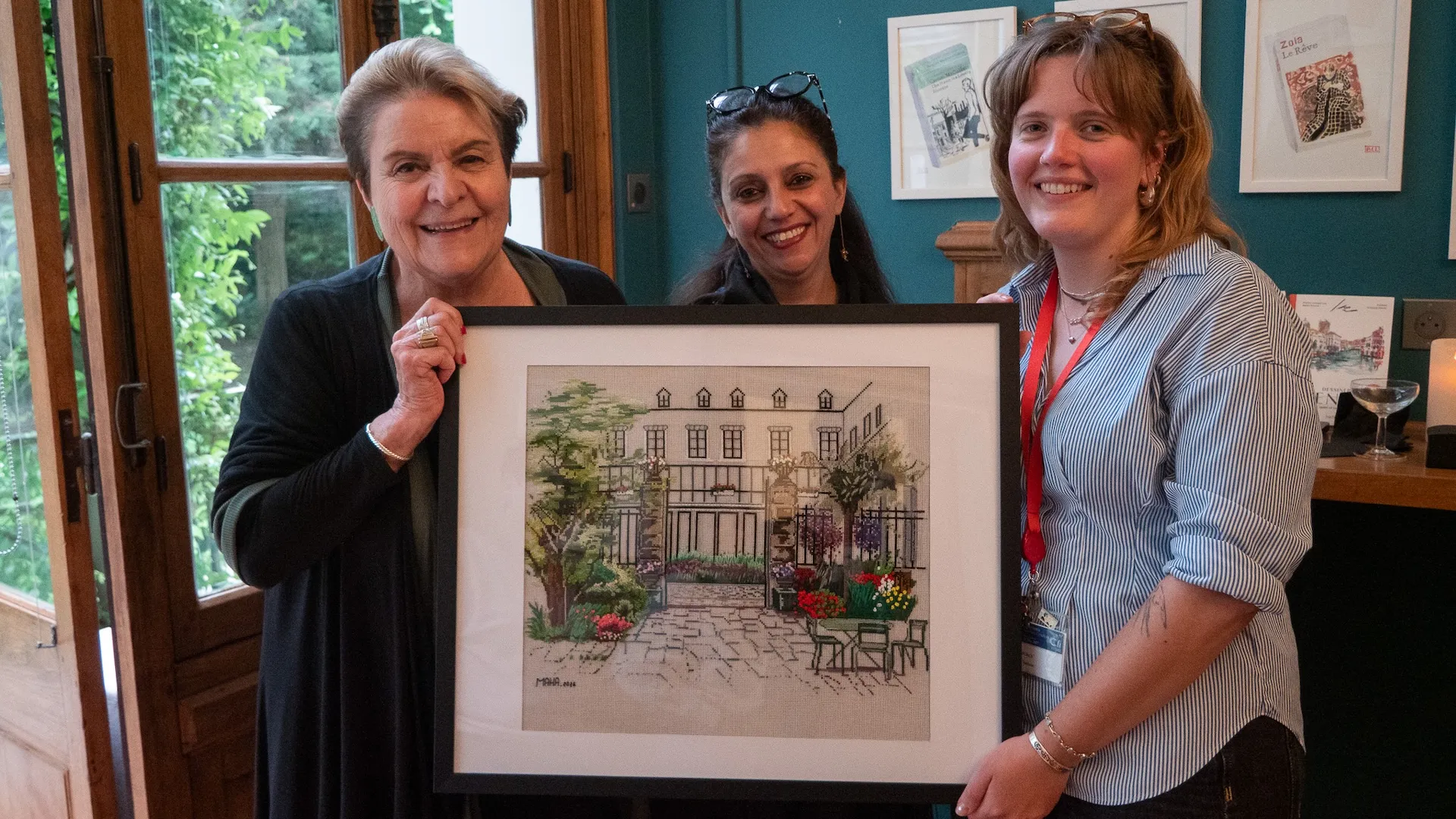
The framed piece resembles, at first glance, a detailed drawing: the familiar façade of Reid Hall, its wrought-iron gate, the courtyard's stone paving, and flower beds in bloom. A closer look reveals the stitches — thousands of them, placed by hand over more than one hundred hours completed in less than a week.
The work was created by Maha Al-Daya, a current Reid Hall Artist-in-Residence from Palestine. She worked in tatreez, a traditional Palestinian embroidery practice with roots stretching back centuries across the Levant. Characterized by counted cross-stitch geometric motifs and vivid color palettes, tatreez has long functioned as a marker of identity: patterns associated with particular regions, families, and occasions were stitched into garments and passed between generations.
Al-Daya is not the first artist to depict Reid Hall. Known as the American Girls' Art Club from 1893 to 1914, the building was, from its earliest years, home to a community of women artists, many of whom represented its gardens in paintings, sketches, and prints. An archive of these works documents more than a century of artistic engagement with the site.
The piece was presented to Charlotte Force during a gathering of colleagues and Reid Hall members. Brunhilde Biebuyck, Director of Reid Hall and the Columbia Global Paris Center, stood alongside Al-Daya as the framed work was handed over. Charlotte, who guided Communications at the Paris Center through years of events, publications, and initiatives, leaves with a portrait of a place she helped shape.
Maha Al-Daya is a current Reid Hall Artist-in-Residence, an initiative jointly supported by the Columbia Paris Global Center and the Institute for Ideas and Imagination.