Announcing Next Year’s Faculty Visitors at Reid Hall
The 2026 – 2027 Faculty Visitors at Reid Hall will conduct research at Parisian institutions, contribute to podcasts and videos, and take part in public programs at the Columbia Global Paris Center and Institute for Ideas and Imagination.
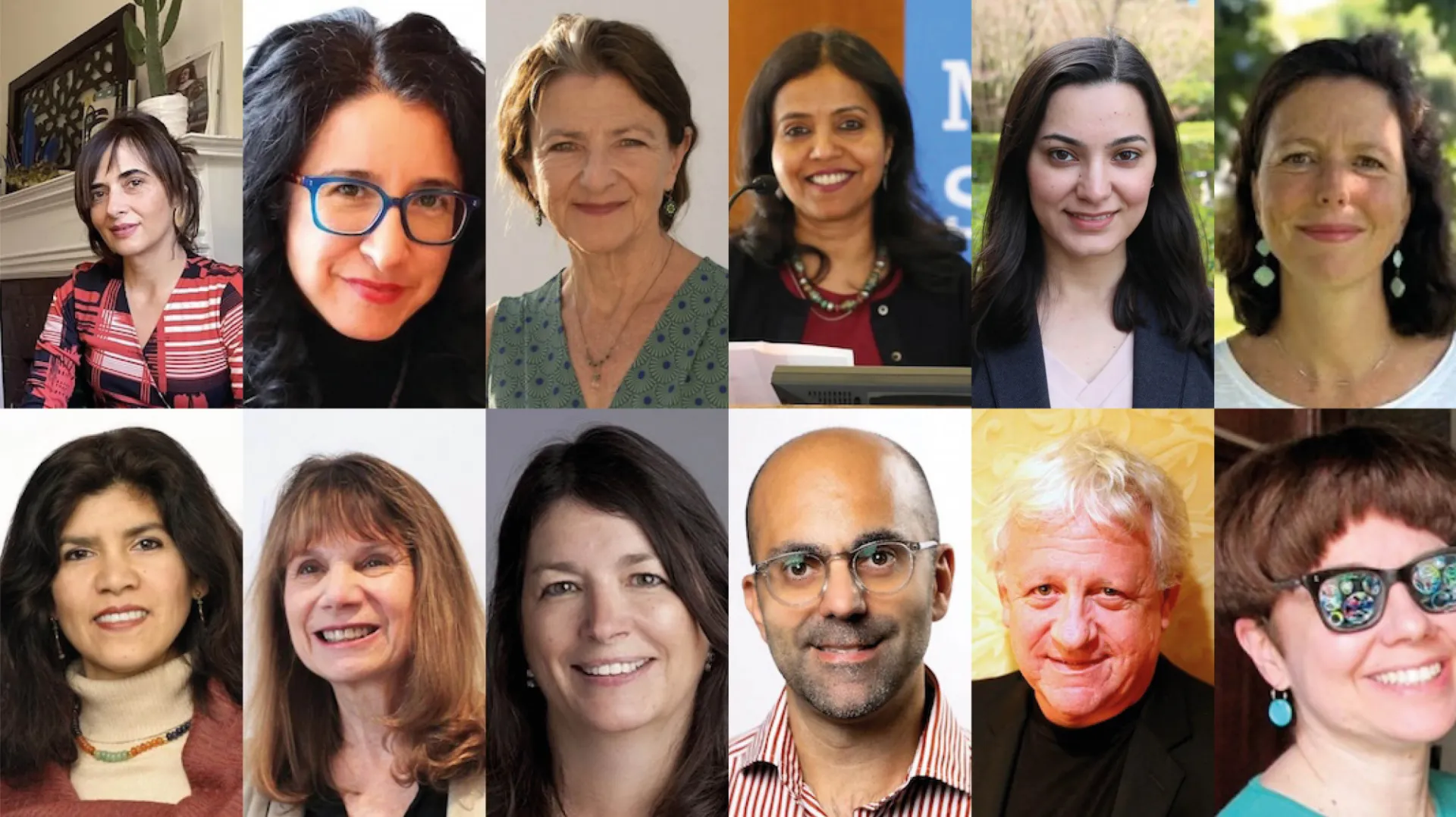
The 2026 – 2027 Faculty Visitors at Reid Hall will engage in a wide range of research and collaborations, spanning public health, journalism, art history, environmental humanities, and the history of science.
Over the course of their stays in Paris, they will work with world-class local archives, universities, and museums. They will also share their expertise globally, contributing to public lectures, the Columbia Global Paris Center’s Atelier podcast, and the Institute for Ideas and Imagination’s Library Chats video series.
The Visitors’ diverse projects deepen understanding of critical global topics, including public health outcomes, journalism and literature, historical art movements, and decolonial perspectives, all within the rich intellectual and historical context provided by Reid Hall.
Helen Benedict, Professor of Journalism at Columbia, focuses on refugees, the effects of war on civilians and soldiers, social injustice, and violence against women. Her work examines how journalists, writers, and artists can responsibly interview and portray vulnerable populations, particularly refugees and asylum seekers, without putting them at further risk.
In Paris, Benedict will work with French journalists and scholars, including those affiliated with Reid Hall Residencies (formerly Displaced Artists Initiative) and the Sciences Po journalism program, to develop cross-cultural ethical guidelines for covering refugees and migrants.
Ying Kuen Cheung, Professor in the Department of Biostatistics, is an expert in artificial intelligence and machine learning, with a focus on multivariable isotonic ("miso") classification and regression methods for cancer research. His work leverages monotonicity assumptions to improve statistical efficiency and prediction accuracy, with applications spanning cancer screening using multiplex assays, adaptive clinical trials for precision medicine, and predictive modeling using electronic health record data.
In Paris, Cheung will collaborate in person with Dr. Moreno Ursino at Inserm and participate in an international workshop on adaptive clinical trials, an area where his miso methodology has direct relevance. Using Reid Hall as a European base, he also plans short visits with colleagues at the Institute of Cancer Research in London.
Dr. Nicolino Valerio Dorrello, Assistant Professor in the Division of Pediatric Critical Care Medicine at Columbia University Vagelos College of Physicians and Surgeons, focuses on severe, progressive lung injury, one of the most common and devastating conditions he encounters in his clinical work. His research examines strategies to selectively remove defective lung epithelial cells and support the proliferation and differentiation of lung progenitors to restore healthy lung tissue.
In Paris, Dorrello will investigate current continuous renal replacement therapy (CRRT) practices at leading pediatric centers, including Bicêtre Hospital and Necker Hospital, with an eye toward developing shared protocols and educational initiatives. He will also engage with researchers at UMR 1272 Hypoxie & Poumon, a center studying lung injury and repair.
Stuart J. Firestein, chair of the Department of Biological Sciences at Columbia, runs a laboratory researching the vertebrate olfactory receptor neuron. Beyond his scientific work, he is a noted advocate for public understanding of science, having written for outlets like Wired, Huffington Post, and Scientific American, and authored the books Ignorance: How It Drives Science and Failure: Why Science Is So Successful.
In Paris, Firestein will draw on a newly rediscovered archive of papers by historian of science Derek de la Solla Price, recently uncovered at the Cité des Sciences et de l'Industrie and now housed at the Caphes Institute at ENS. Working with Prof. Matthias Girel at ENS, he will use these materials, including previously unpublished correspondence between Price and Robert Merton, to produce an updated edition of Price's influential 1960 book Little Science, Big Science for Columbia University Press.
Laurence Marie, a lecturer in the Department of French at Columbia, focuses on the history of emotions, theater, and disability studies in the eighteenth century, with a particular interest in the formalization of sign language for the deaf in 1770s France. Her current research examines the experiences and education of people born deaf in France and the United States since the eighteenth century, work that weaves together historical research on the long debate between sign language and oralism with a family history project drawing on her parents' own experiences as deaf individuals educated under France's oralist system.
In Paris, Marie will continue archival research at the Institut National des Jeunes Sourds, the Bibliothèque historique de la Ville de Paris, and the Bibliothèque nationale de France, while meeting with deaf history scholars including Andrea Benvenuto, Marion Chottin, Colas Duflot, and Didier Séguillon. She also plans to connect with SIEFAR to research deaf women in eighteenth-century France and with practitioners of narrative medicine.
Mary McLeod, Professor of Architecture at Columbia GSAPP, focuses on the history of the modern movement and contemporary architecture theory, with particular attention to the connections between architecture and ideology. Her research has long centered on Le Corbusier's urban proposals for Algiers, building on primary research she conducted in Algeria in the 1970s, including interviews with architects who worked alongside him.
In Paris, McLeod will examine previously unstudied archival materials at the Fondation Le Corbusier on Le Corbusier's housing, viaduct, and urban planning projects in Algiers, Tlemcen, Cherchell, and Nemours (now Ghazaouet), as well as his later sketch plans for cultural centers in N'Djamena (Chad) and Dakar (Senegal). This research will explore how these designs responded to local climate, materials, and building techniques, and how figures like Le Corbusier came to symbolize modernization in both colonial and postcolonial nations.
Manuela Orjuela-Grimm, Associate Professor of Epidemiology and Pediatrics at Columbia, leads CAMINANDO, a study examining diet, living conditions, and risk and protective factors for health in adolescents from Latin America settling in New York. Her research takes a pediatric approach, considering exposures to threat and deprivation across adolescence and the factors that help or hinder adaptation to life in a new country.
In Paris, Orjuela-Grimm will visit and observe at CAPSYS, a mental health care center for unaccompanied migrant minors led by psychiatrist Andrea Tortelli, whose patient population from Francophone sub-Saharan Africa offers a counterpoint to the Latin American youth in her own NYC-based study.
Deborah Paredez, Associate Professor of Writing and Chair of the Writing Program at Columbia's School of the Arts, is a poet and scholar whose work explores Latinx culture, memory, and performance, most recently in the critical memoir American Diva. Her current project, Encyclopedia of Secondhand Knowledge, is a cross-genre work of nonfiction that examines loss and reclamation through secondhand practices, drawing on Walter Benjamin's writings on collecting and capitalism alongside Tomás Ybarra-Frausto's theory of rasquachismo to explore objects ranging from Parisian flea markets to assemblage art and textile traditions of resistance.
In Paris, Paredez will revisit the Puces de Saint-Ouen and Puces de Vanves to complete research on the city's shopping arcades and secondhand markets, and to speak with artisans whose practice incorporates scraps and discarded materials.
Maureen E. Raymo, G. Unger Vetlesen Professor of Earth and Environmental Sciences and Co-Founding Dean Emerita of the Columbia Climate School, studies the history and causes of climate change in Earth's past, including the role of Himalayan uplift in driving global cooling and the onset of the ice ages. Her recent work has focused on reconstructing past sea level and ice volume during warm climate intervals to improve predictions of future sea level rise.
In Paris, Raymo will develop educational materials on nanoplastic pollution, drawing on three years of sampling work with colleagues at Mission Spiritus that has detected micro- and nanoplastic contamination in remote wilderness sites worldwide. She also plans to seek out specialists involved in the UN plastics treaty negotiations centered in Europe.
Alessandra Russo, Professor and Chair of the Department of Latin American and Iberian Cultures and Director of The Hispanic Institute, studies the theory, practice, and display of art in the early modern period, with particular attention to artistic dynamics within Iberian colonization. Her most recent book, A New Antiquity, examines how encounters with artifacts across the Americas, Africa, and Asia shaped the modern idea of art, while her current project explores the origins of museum curatorship through the work of a seventeenth-century Bolognese art custodian.
In Paris, Russo will collaborate with Alexandre Surallés at the Collège de France on a joint inquiry into how the early modern experience of the New World shaped the emergence of both art history and anthropology as disciplines. She also plans to continue developing A Visual Plurilingual Lexicon of Art Histories, a digital collective lexicon of art historical word-concepts.
Aziza Shanazarova specializes in the religious history of Islamic Central Asia and the Persianate world from the sixteenth to twentieth centuries. Her research examines female religious authority through the 16th-century Sufi master Aghā-yi Buzurg (The Great Lady).
In Paris, Shanazarova will conduct archival research at the Bibliothèque nationale de France on previously unstudied waqf deeds established by women in Islamic Central Asia from the 16th to 20th centuries, aiming to illuminate women’s legal and financial agency in shaping public life.
Kavita Sivaramakrishnan, Associate Professor of Sociomedical Sciences at Columbia's Mailman School of Public Health, studies the politics of health, medicine, and science in South Asia and the broader global South, with research spanning colonial-era Ayurvedic medicine, social histories of epidemics like the plague, and the global politics of aging. Her current work examines the history of consumption and disease risk in South Asia, alongside collaborative projects on heart disease and the making of medical expertise in India, and cultures of aging and cognitive decline in India and South Africa.
In Paris, Sivaramakrishnan will consult the Pasteur Institute archives for research on the afterlives of the plague in postcolonial Asia, and develop a new collaborative project with Joelle Abi-Rached on war, epidemics, and crisis in the Middle East and Asia.
Zoë Strother, Riggio Professor of African Art at Columbia, specializes in Central and West African art history with a focus on the twentieth and twenty-first centuries, publishing on Congolese art, masks and masquerade, photography, and the history of iconoclasm and restitution in Africa. Her work also examines European "primitivism" through figures like Sara Baartman, Carl Einstein, and Leni Riefenstahl, with current research centered on aesthetic emotions in Congolese art history.
In Paris, Strother will complete research on the publishing history of Leni Riefenstahl's photobooks of the Nuba peoples, using archives at the Institut Mémoires de l'édition contemporaine (IMEC), and continue work on the film Les statues meurent aussi and its outsized role in French debates over cultural heritage restitution. She also plans to examine African art objects from museum reserves with conservator Aurélien Gaborit at the Musée du Quai Branly and the Louvre.