Today’s wars are different.
In Gaza, Ukraine, Sudan, and elsewhere, civilians are killed, journalists are silenced, and humanitarian aid is blocked. The international laws meant to protect neutral actors, hold world leaders accountable and, ultimately, prevent humanity’s worst crimes from recurring, are routinely ignored. And while these tactics are not new, the scale, speed, and impunity with which they are deployed are.
How did we arrive at this new form of restricted access in crisis zones? And how can frontline journalists, humanitarian practitioners, and field researchers adapt to fulfill their duties under these new constraints?
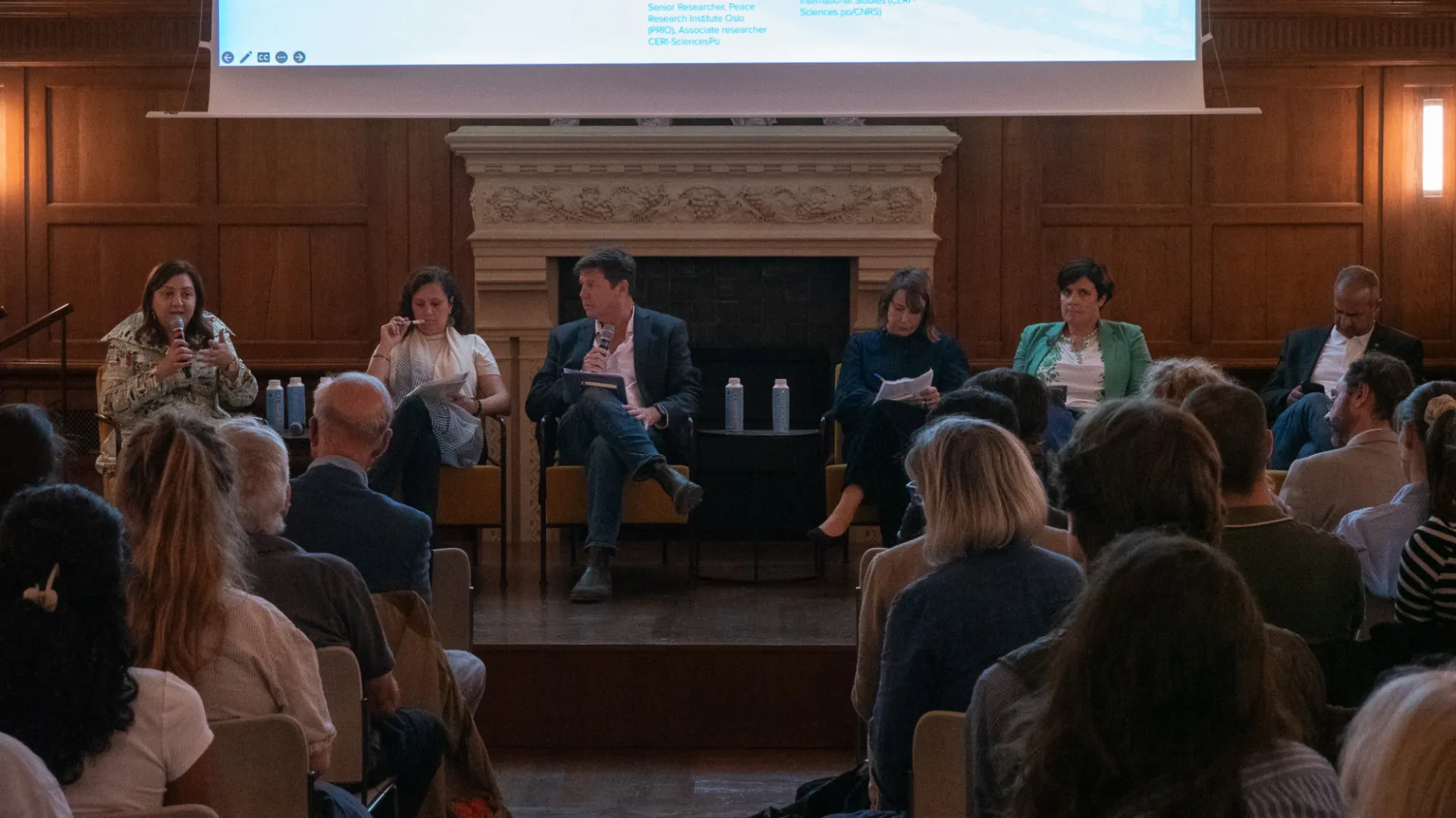
These questions were explored two weeks ago at Frontlines, a public conference held at Reid Hall for an audience of more than 200 in-person and online attendees. The event was co-organized by the Columbia Global Paris Center, the Columbia Global Amman Center, the French Red Cross Foundation, and Sciences Po CERI’s Groupe de Recherche sur l’Action Multilatérale (GRAM), with support from the Alliance Program.
After a series of introductory remarks by the organizing partners — each highlighting their organization's support for frontline workers — the event proceeded with three panels. The first focused on the perspectives of frontline journalists and humanitarian practitioners. It was moderated by J.C. Salyer, Professor of Anthropology and Human Rights at Barnard College and featured Nicoletta Antonini, Deputy Head of Delegation and Protection Coordinator for the International Committee of the Red Cross (ICRC) Regional Delegation in Paris, Adel Zaanoun, the head of Agence France-Presse’s (AFP) Gaza bureau, and Rawan Damen, Director General of Arab Reporters for Investigative Journalism (ARIJ). They discussed the legal protections granted to journalists and humanitarian workers under International Humanitarian Law, the ways these are being compromised on an unprecedented scale in Gaza.
The second panel, also moderated by Salyer, focused on the perspective of field researchers and featured Maria Gabrielsen Jumbert, senior researcher at the Peace Research Institute Oslo (PRIO) and associate researcher at Sciences Po-CERI, and Chiara Ruffa, professor of political science at Sciences Po-CERI. They provided historical and statistical context by tracing the rise in attacks on neutral actors over recent decades, and analyzed their causes.
For the final panel, Salyer invited the speakers to discuss solutions to these challenges. These included deploying frontline responders and witnesses on-site before conflict erupts, building a network of local fact-checkers in partnership with global media, and launching the Global Initiative for International Humanitarian Law to reaffirm state commitments to IHL.
To conclude, Salyer invoked Immanuel Kant’s famous ethical imperative as a powerful summary of human rights: “Act in such a way that you treat humanity, whether in your own person or in the person of any other, never merely as a means to an end, but always at the same time as an end.”