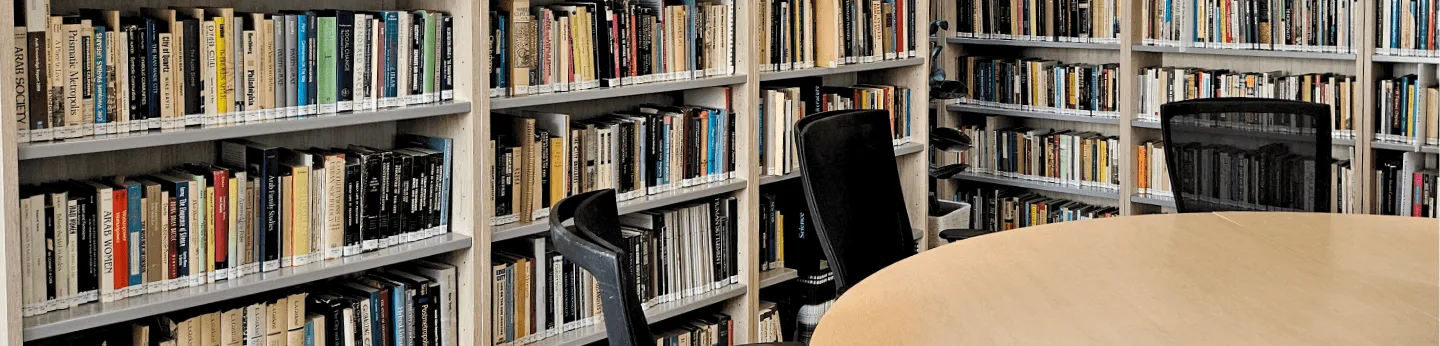
Our Reading Room
The Columbia Global Center Amman Reading Room, enriched by the generous gifts of the Janet Abu-Lughod, Michael Gilsenan, and Brinkley Messick Libraries, offers unique personal collections of books that explore a wide range of thematic areas, with a particular focus on the Middle East and North Africa region. These libraries serve as repositories of knowledge and gateways for intellectual exchange.
Browse the digitized titles online here. Public programming featuring the CGC Amman Reading Room will be listed under our events. The book collections are non-circulating and intended primarily for independent reading and research within the Center. View our guidelines for reference. If you wish to use the Reading Room, please fill out this form and wait for us to contact you to confirm your visit.
We invite you to learn more about Janet Abu-Lughod, Michael Gilsenan, and Brinkley Messick below.
Janet Abu-Lughod was a pioneering urban sociologist and historian whose work reshaped understandings of cities, globalization, and social change. Born in the United States, she held influential academic positions at various institutions, including Northwestern University and the New School for Social Research, where she joined in 1987 and retired as Professor Emerita in 1998.
Abu-Lughod's research focused on the dynamics of urbanization, particularly in the context of the Middle East and North Africa. Her seminal works, such as Before European Hegemony: The World System A.D. 1250-1350, Cairo: 1001 Years of the City Victorious, and Rabat, Urban Apartheid in Morocco challenged traditional narratives of urban development, drawing attention to politics and inequalities, and emphasized the historical interconnectedness of global cities. Abu-Lughod's interdisciplinary comparative approach and commitment to understanding the complexities of human societies continue to inspire scholars worldwide.
Michael Gilsenan, Professor Emeritus of Middle Eastern and Islamic Studies and Anthropology at New York University (NYU), has made significant contributions to diverse academic fields including anthropology, sociology, history, and urban studies. His research enriches scholarly discourse on cultural representation, narrative theory, and power dynamics within religious and social frameworks, particularly within colonial and post-colonial contexts. His early work, Saint and Sufi in Modern Egypt, explored the dynamics of Sufi orders amid state hostility in Cairo. This was followed by Lords of the Lebanese Marches, ethnographic research on violence, status, and power dynamics in Akkar. In Recognizing Islam, he wrote for a general audience, trying to suggest new ways of thinking about Islamic practices in different contexts through a focus on 'small moments, large implications'.
After teaching at University College London (1973-1984) and Magdalen College, Oxford (1985-1995), Gilsenan was invited to NYU in 1995 to establish a new department in Middle Eastern Studies, facilitating a shift in his research focus to the Hadhrami Arab diaspora in Singapore, Malaysia, and Indonesia. Although he retired in 2020, he is actively engaged in writing a study of capital and culture among people of Arab descent in Southeast Asia.
Brinkley Morris Messick III, Professor Emeritus of Anthropology and Middle Eastern, South Asian, and African Studies (MESAAS) at Columbia University, was renowned for his innovative approach to fieldwork in the Middle East and North Africa, his elaboration of the concept of the anthropologist as reader, his groundbreaking scholarship on Islamic law, his steadfast commitment to the Palestinian cause, and his dedicated mentorship of graduate and undergraduate students.
Fluent in Arabic, including Classical Arabic and Maghrebi and Yemeni dialects, Messick specialized in interpreting historical legal texts. His work analyzed the production, circulation, inscription and subsequent interpretation of Arabic texts, including regional histories, law books, and court records. He archived the records from Yemen as a living legal tradition, and sought to understand the relation of writing and authority, such as the local histories of record keeping. His years living in Ibb, Yemen, where he cultivated lifelong relationships, informed his scholarship on Islamic legal texts, written culture, and legal anthropology. His seminal works, including The Calligraphic State: Textual Domination and History in a Muslim Society (1993), which won the Albert Hourani Prize, Islamic Legal Interpretation (co-edited, 1996), and Shariʿa Scripts: A Historical Anthropology (2018), established him as a leading authority on these topics; one who bridged the disciplines of anthropology and history. From 1993 to 1995, he received a Fulbright (CIES) grant, and in 1995, he was awarded the John Simon Guggenheim Memorial Foundation Fellowship.
Messick joined Columbia University’s Anthropology Department in 1997, and became Chair of the Anthropology Department from 2004 to 2011. In 2010, he co-founded the Center for Palestine Studies at Columbia University to create an academic home for students and scholars interested in Palestine. Messick served as Co-Director of the Center from 2010-2015. Messick also served as Director of the Middle East Institute at Columbia from 2015-2024.