Welcoming David Petit, 2024-2025 Emerging Scholars Fellow at the Santiago Center
He will advance research on inequality, digital gaps, and social inclusion of older adults in Chile.
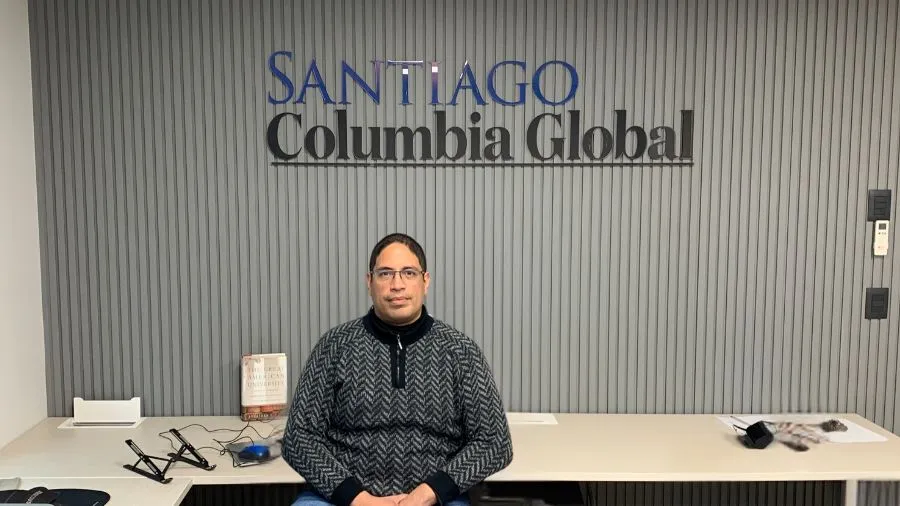
Columbia Global recently welcomed nine scholars from around the world to join the 2024-2025 cohort of the Columbia Global Emerging Scholars Fellowship Program. This initiative offers early-career scholars, who hold refugee status or have been forcibly displaced, the opportunity to enhance their research capabilities, expand professional networks, and support their reintegration into academia, focusing on the humanities and humanistic social sciences.
David Petit is one of the scholars selected to join the program. Based at the Santiago Center for the next year, he will focus his research on “Analyzing Inequality and Digital Gaps in Chile's Valparaíso Region and Exploring How Innovation, from a Historical-Social Perspective, Can Positively Influence Public Policies for the Social Inclusion of Older Adults.” He will be mentored by Ioana Literat, an associate professor of Communication, Media, and Learning Technologies Design at Columbia’s Teachers College.
David is an educator, researcher, and consultant. His interdisciplinary academic and professional experience allows him to connect research with public policy. In 2023, he earned his PhD at Universidad Católica’s History Institute with a dissertation titled “Three Revolutionary Clerics During South American Independence: 1810-1830.” This work offers a comparative Hispanic-American framework for studying historical-political processes. David holds a bachelor’s degree in political and administrative sciences (2009) and a specialization in international law and politics (2013) from the Universidad Central in Venezuela, his home country. His research in Venezuela focused on reconstructing Hispanic-American political thought, particularly using intellectual history and international law between the 18th and 20th centuries. His interests span applied research in the humanities, social sciences, democracy, innovation, and society.
“I am incredibly grateful to the Santiago Center and Columbia Global for this opportunity,” said Petit. “From both an academic and professional standpoint, it’s a perfect moment to dive into research I have been building on for years. This is not just a project—it’s a life goal. I’m driven by the opportunity to make a positive impact, no matter how small, and this gives me the tools to continue my work in public policy, innovation, and digital transformation for older adults.”
Petit sees this fellowship as the beginning of a longer-term project focused on “Inclusive Smart Cities” and addressing the challenges of an aging population. In collaboration with Universidad Viña del Mar, he began this work last year, and the Columbia Global fellowship now provides the structure and support to take the project forward. Petit envisions these studies informing solutions and public policies for aging populations, a critical issue in Chile, where older adults are expected to make up one-third of the population by 2050.
On a personal note, Petit is excited about contributing to the country he has called home for the past eight years. “Working directly with older adults over the years has been an enriching experience. For those of us trained in the humanities and social sciences, offering ideas to improve society is not just a responsibility, but a source of pride.”