AI RISING SERIES
This series explores the intersection of AI and society

Our new series explores the transformative role of AI by highlighting its real-world applications and cutting-edge research across sectors and advancing the dialogue on how AI intersects with society
It addresses critical questions: What are the ethical issues around AI? What will the future of work look like? How can AI be integrated in education?
By taking a comprehensive and interdisciplinary approach, the series aims to enrich the academic discourse and public conversation around the opportunities and challenges around leveraging AI for development.
Discussions
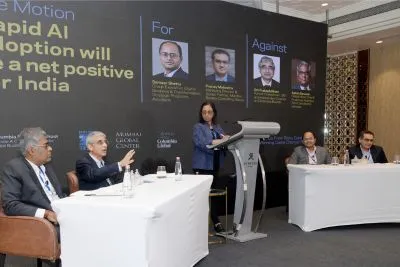
India Inc.: Can AI Go From Risky Gamble to Winning Game Changer?
In February, the Fourth Mumbai Forum hosted by Columbia Business School's Jerome A. Chazen Institute and the Mumbai Center brought together researchers, entrepreneurs, and industry leaders for an evening that moved between the frontier of AI research and the urgent realities of deploying it in a country of 1.4 billion. Professor Olivier Toubia of Columbia Business School opened with findings from the school's large-scale Digital Twins project — revealing that while AI-generated simulations of human behaviour show genuine promise for market research and personalisation, they currently function more like funhouse mirrors than true reflections, prone to stereotyping, homogenisation, and ideological bias. Entrepreneur Rajesh Jain followed with a grounded look at how layering behavioural and contextual data can transform brand-customer communication from generic to genuinely personal. The evening closed with a lively Oxford-style debate moderated by Gita Johar, Meyer Feldberg Professor of Business, Columbia Business School on whether rapid AI adoption will be a net positive for India — with Sameer Shetty of Axis Bank and Pranay Mehrotra of BCG arguing for the motion, and former SBI Chairman Om Prakash Bhatt and TCS's Satish Byravan arguing against. What emerged was less a disagreement about AI itself and more a pointed conversation about pace, governance, and who bears the cost when systems fail at scale — a debate the audience, by a narrow margin, left unresolved.
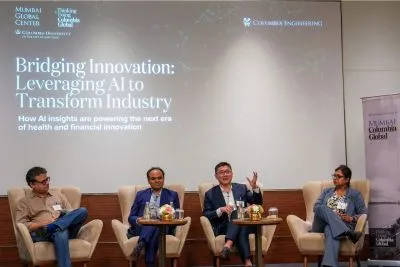
Bridging Innovation: Leveraging AI to Transform Industry
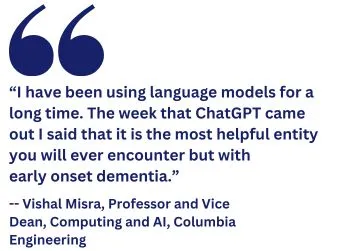
In February, the Center convened Bridging Innovation: Leveraging AI to Transform Industry, bringing together Shih-Fu Chang, Columbia Engineering Dean, Vishal Misra, Professor in the Computer Science and Electrical Engineering departments and as Vice Dean of Computing and AI, Dr. Wafaa El-Sadr, Executive Vice President of Columbia Global and leading industry voices to explore what it takes to move AI from the laboratory to real-world impact across healthcare and fintech.
Rizwan Koita, chairperson of the National Accreditation Board for Hospitals and co-founder & Director of the Koita Foundation, offered a grounded portrait of AI's promise and limits in Indian healthcare — from infrastructure gaps and affordability constraints to linguistic diversity and the near-absent digitisation of clinical records — arguing that cracking this market could unlock scalable solutions for much of the developing world.
On the research front, Dr. Elham Azizi explored how AI is advancing cancer care through digital biology, while Dr. Sunil Agrawal demonstrated how robotics and AI are reshaping neurorehabilitation for patients with stroke, Parkinson's, and spinal cord injuries. In finance, Prof. Junfeng Yang warned of AI vulnerabilities including hallucinations, deepfakes, and automated fraud, and Prof. Baishakhi Ray examined the challenges of deploying AI within highly regulated financial environments. Fractal co-founder Srikant Velankani rounded out the evening by making the case that organizations must move beyond automation to fundamentally reimagine their processes, technology investments, and workforces — with responsible deployment and workforce transformation as essential, not optional.
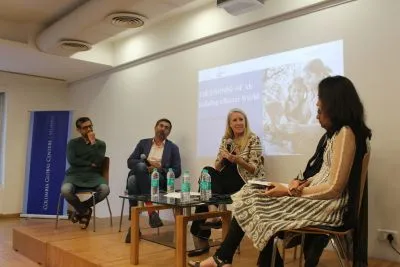
Building a Better World
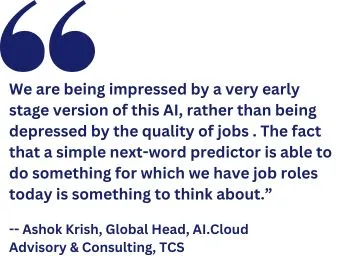
Our 'AI in Development' series kicked off with a discussion on the far-reaching impact of AI across sectors such as agriculture, healthcare, education, finance, and conflict prevention. 'The Promise of AI: Building a Better World' held on July 9 featured Ashok Krish, global head of consulting AI, TCS, Sashikumar Sreedharan, chief operating officer at Google Cloud Asia Pacific, and Kushe Bahl, partner and lead at McKinsey and Company. The event emphasized the need for ethical frameworks, contextual regulations, and cultural adaptability. The panel established that AI serves as an augmentative tool rather than a replacement and requires significant cultural shifts within organizations to preserve core values while becoming more agile.
Read more

AI Change-Makers
The second in the series was a fireside chat with Vishal Misra, Professor and Vice Dean of Computing and Artificial Intelligence at Columbia Engineering, and Harsh Jain, CEO of Dream Sports. In collaboration with Dream Sports and Tech Entrepreneurs Association of Mumbai (TEAM), the event provided a platform for these industry leaders to share insights into their entrepreneurial journeys and the evolving role of artificial intelligence (AI) in sports, business and academia. The event emphasized that AI should be viewed as a tool for solving genuine problems rather than a trend to chase, encouraging aspiring entrepreneurs to focus on areas where AI can make a meaningful contributions.