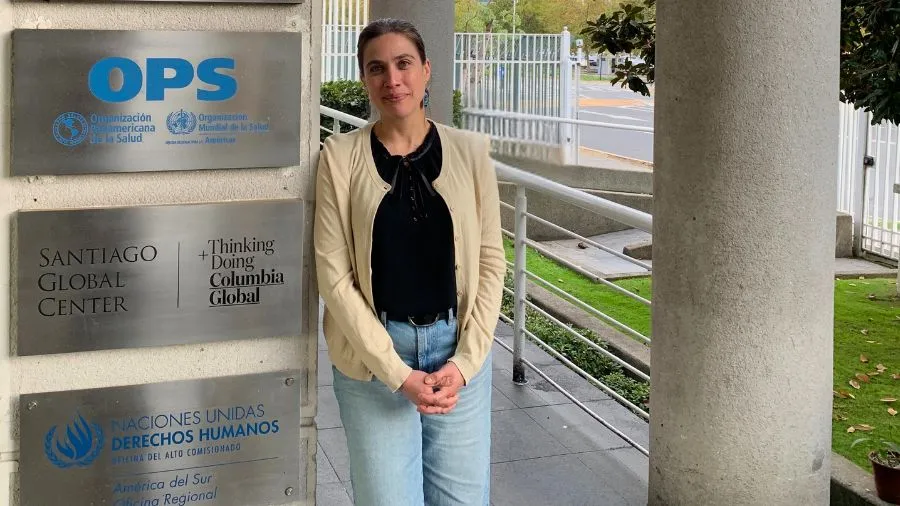
With Santiago’s buzzing buses and expanding electric fleet as her backdrop, Ariana Salas-Castillo, a postdoctoral researcher at the Columbia Climate School, arrived in the Chilean capital to investigate one of its most pressing urban questions: why, despite major public investments and inclusive reforms, are we not seeing more significant and proportional shifts in transportation patterns?
Shortly after landing, she visited the Santiago Center, where she met the team supporting her research. Her project examines the political economy behind transportation reforms in Latin America, using Santiago and Bogotá as comparative case studies.
In recent years, Santiago has gained international recognition for its innovative transport policies. The city operates a massive electric bus fleet, has introduced training programs for female drivers, and is piloting participatory planning strategies in underserved areas. Yet, as Salas-Castillo notes, these progressive efforts have not yet yielded the expected results.
“Why is public bus transportation in Santiago not serving its climate and social purposes despite all the progress made?” she asks. “This project, which builds on my dissertation research on public bus transportation reforms in Latin America—with a focus on Santiago—aims to answer this question by examining the public and private policies implemented over the last decade.”
Rather than questioning whether emissions have fallen—indeed, they have—Salas-Castillo’s research focuses on why changes in outcomes such as ridership, congestion, and private vehicle use have not been more transformative.
During her stay, she is conducting interviews with public officials and academics and analyzing policy outcomes in both cities.
“I’m currently visiting Santiago as part of the Scholar-in-Residence grant funded by Columbia Global. During these weeks, I’ve been interviewing policymakers and scholars and collecting data on transportation and mobility,” she explained. Her broader goal is to deepen the understanding of transportation’s role in climate resilience, public health, and social justice across the Global South. She is also holding conversations with researchers and decision-makers at local universities to lay the groundwork for future collaborations.
“I’m deeply thankful to the Columbia Global Center in Santiago for allowing me to have this visit in a city that feels more and more familiar,” she added.