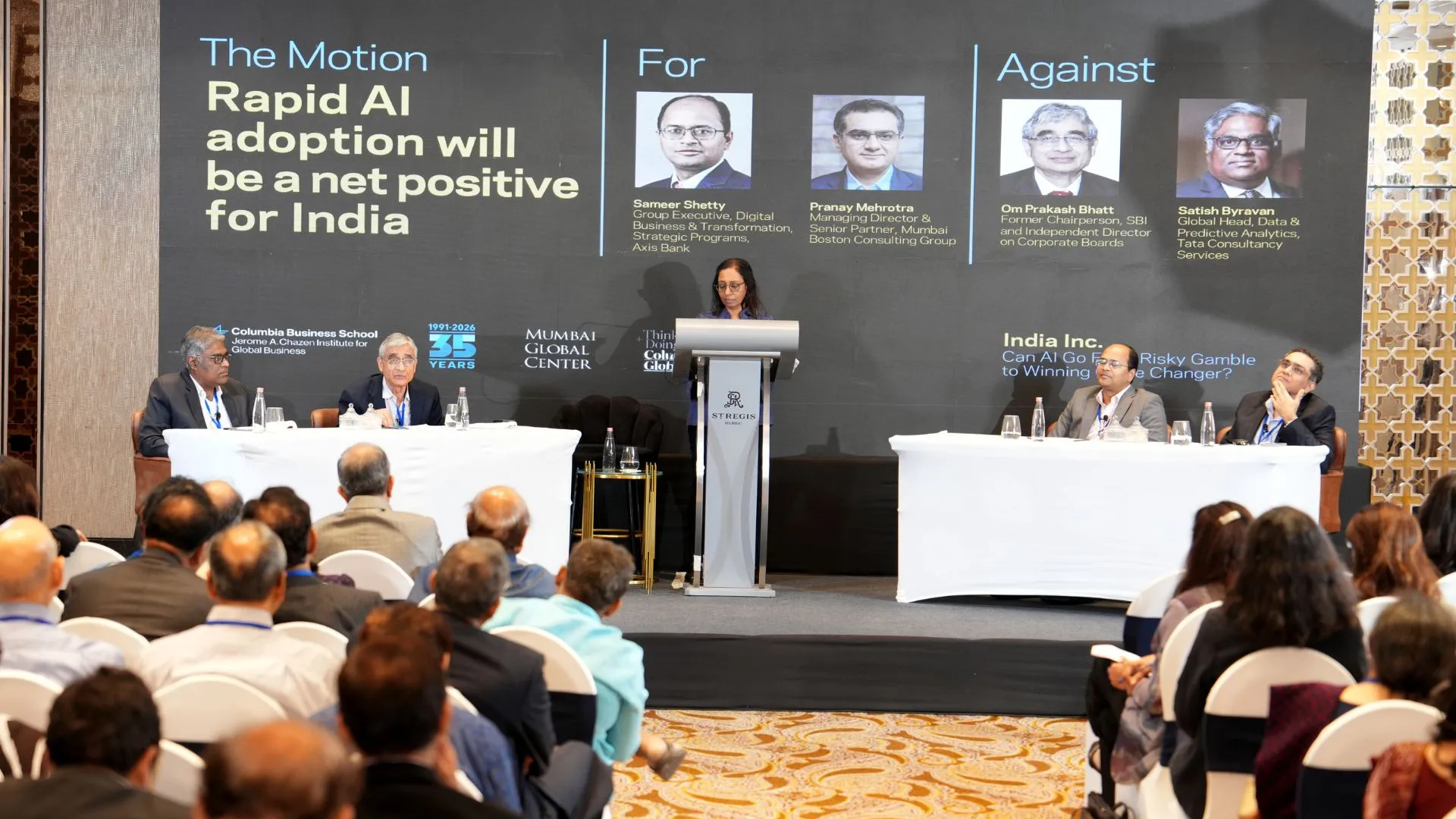
The Columbia Business School's Jerome A. Chazen Institute and Columbia Global Center Mumbai’s India forum titled, Can AI Go From Risky Gamble to Winning Game-Changer? explored the promise and pitfalls of digital twins —AI-generated doubles that simulate individuals’ behavior—are quickly reshaping how businesses engage with their customers. A participatory debate weighed rapid AI adoption's net benefits for India, highlighting gains in agriculture and healthcare against risks like errors at scale and language inequities, with consensus on paced implementation.
Here are the key takeaways from the event:
Digital Twins Keynote (Prof. Olivier Toubia, Columbia Business School; Rajesh Jain, Netcore Cloud)
Columbia's Digital Twins Initiative built thousands of open-source AI-generated consumer profiles from 2,000 real U.S. respondents across 36 studies. While they enable faster iteration, Toubia said that currently the twins act as "funhouse mirrors," distorting behavior via five biases—stereotyping, homogenization, representation bias (better for high-income/education), ideological skew (pro-tech/human), and hyper-rationality. Jain said that layered personalization (demographics to nano-moments) can boost retention and save 70% of budgets currently wasted re-acquiring customers.
Debate - Rapid AI Adoption Net Positive for India?
For (Sameer Shetty, Axis Bank; Pranay Mehrotra, BCG):
- Urged responsible, not slow, adoption to avoid leaving vulnerable behind. AI, they argued, is not a luxury — it's a leapfrog opportunity India cannot afford to miss.
- Made a compelling case rooted in India's structural gaps across health, education and agricultural sectors. They argued that India’s 1:800 doctor-to-patient ratio (vs. 1:400 in China) demands AI. One AI tool screens 20 million for TB with 30% better detection, reducing diagnosis from 3 weeks to 1 hour. Similarly in education, AI can personalize learning for 3.3 million students in single-teacher classrooms and can aid farmers in getting more value from their produce (currently they are capturing only 30–35%). And India's Digital Public Infrastructure (Aadhaar, UPI) proves we can build tech that democratises rather than concentrates benefits.
Against (Om Prakash Bhatt, ex-SBI; Satish Byravan, TCS):
- Advocated selective, sequenced development over speed. Highlighted that at India's scale, even a 1% AI error rate isn't a rounding error — it's millions of lives.
- Highlighted the real harms of AI due to lack of a legal accountability framework, no audit mechanism, no recourse.
- Cited examples such as Predatory AI-driven lending trapping lower-income Indians in debt; people forming romantic/spiritual AI bonds; LLMs favoring English and worsening divides in a multilingual nation. Like failed smart cities, AI risks flashy but ineffective rollouts. Prioritize selective, risk-aware sequencing over speed.
Broader Implications Raised in Q&A
- Manipulation: Influencer twins (e.g., Ariana Grande) could be deployed to shape behaviour at mass scale, raising serious ethical questions about persuasion.
- Ownership: Leading tech giants likely already hold de facto twins of most users. A Columbia MBA student has built a startup enabling individuals to own and monetise their own twin.
- Politics: Digital twins technology originated in political science and is already being used for election forecasting — one company claimed to predict a New York City result to within 2,000 votes.
- Mental Health: Early evidence suggests conversing with a twin from an opposing political viewpoint can reduce polarisation — but there are also concerning signs of negative mental health impacts from deep LLM relationships.
Despite the debate format, both sides found more common ground than division. No one in the room argued India should opt out of AI. Moderator Gita Johar, Columbia Business School concluded that the debate showed both the promise and risk of AI adoption and that the issue is not AI vs. no AI, but how India governs and sequences AI adoption.