Columbia Journalism School, UDP Hold Inaugural Winter School
Two prominent J-School professors visited Chile to teach contemporary journalism in covering climate change.
Two prominent Columbia Journalism School (J-School) professors visited Chile during two weeks in June to teach the course “Innovation, Data and Visual Narratives in Contemporary Journalism” in reporting on climate change, combining theory, case analysis, and cutting-edge practices.
The course – dubbed a “winter school” owing to the season when it was offered in the southern hemisphere - was organized by the J-School, Universidad Diego Portales’ (UDP) School of Journalism, and the Columbia Global Center in Santiago. Thirty journalists participated, from advanced journalism students to reporters with years of experience, mostly from Chile but also coming from Argentina, Bolivia, and Uruguay.
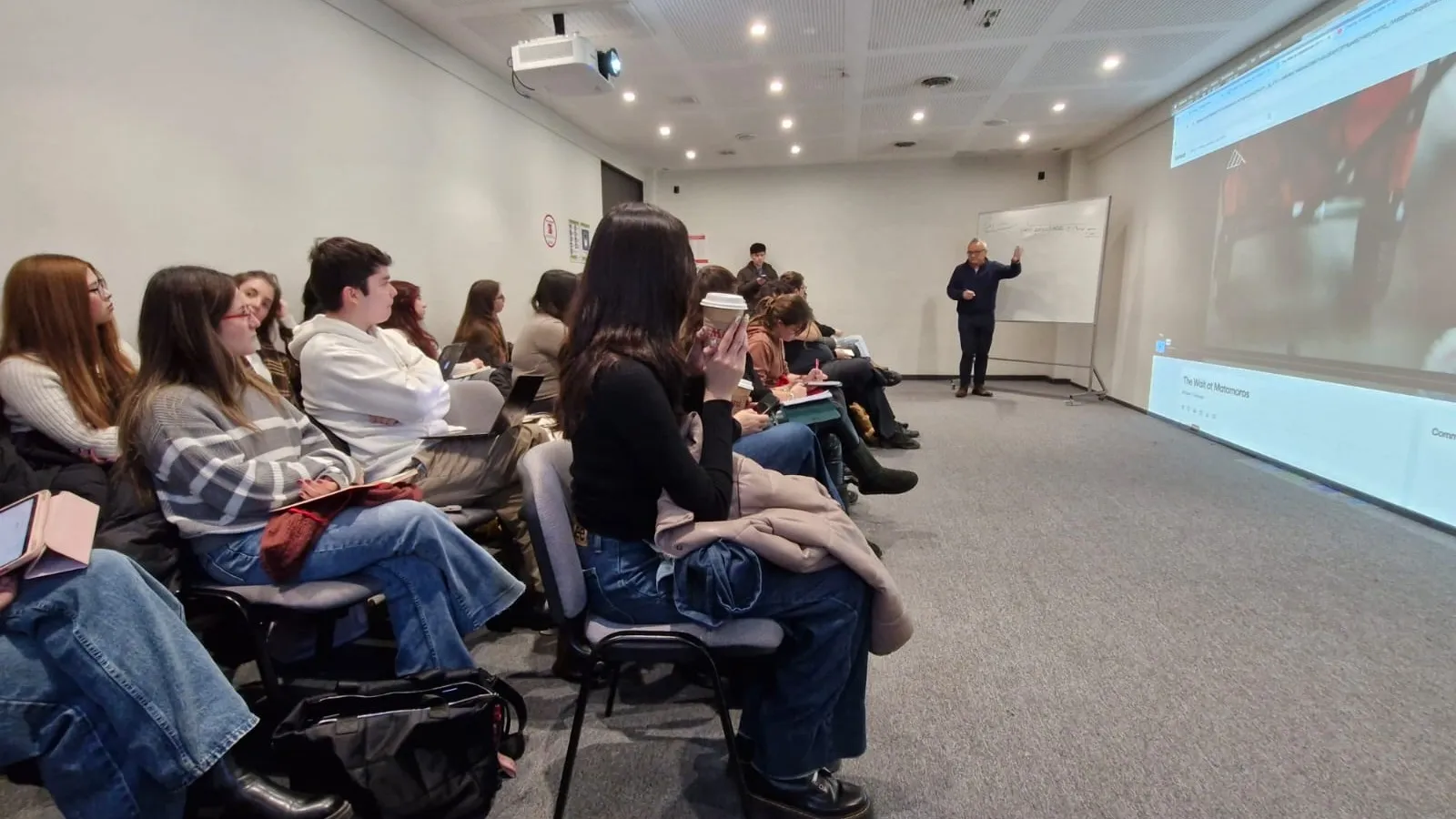
During the first week, journalist and documentary filmmaker Duy Linh Tu - the J-School’s Dean of Academic Affairs and Professor of Professional Practice, who teaches reporting and video storytelling courses – focused on visual narratives in contemporary journalism through discussions, academic teachings and practical exercises.
During Tu’s class, participants learned to define how and when video reporting – which often carries a higher cost than traditional reporting – can be justified. They focused on how angles and frames are important in both still photos and videos, how to represent intangible subjects like “culture” or “climate” in video, putting together scenes, and defining the ingredients in telling an attention-grabbing, well-developed story in solid journalistic practice, using easily attainable tools like apps and cell phones.
Course participants viewed and dissected a number of Tu’s videos, including one produced for Scientific American on how an Indigenous community is losing its homeland to saltwater encroachment resulting from climate change along the Louisiana Coast. They then put their tools and newly acquired knowledge to use in producing short videos.
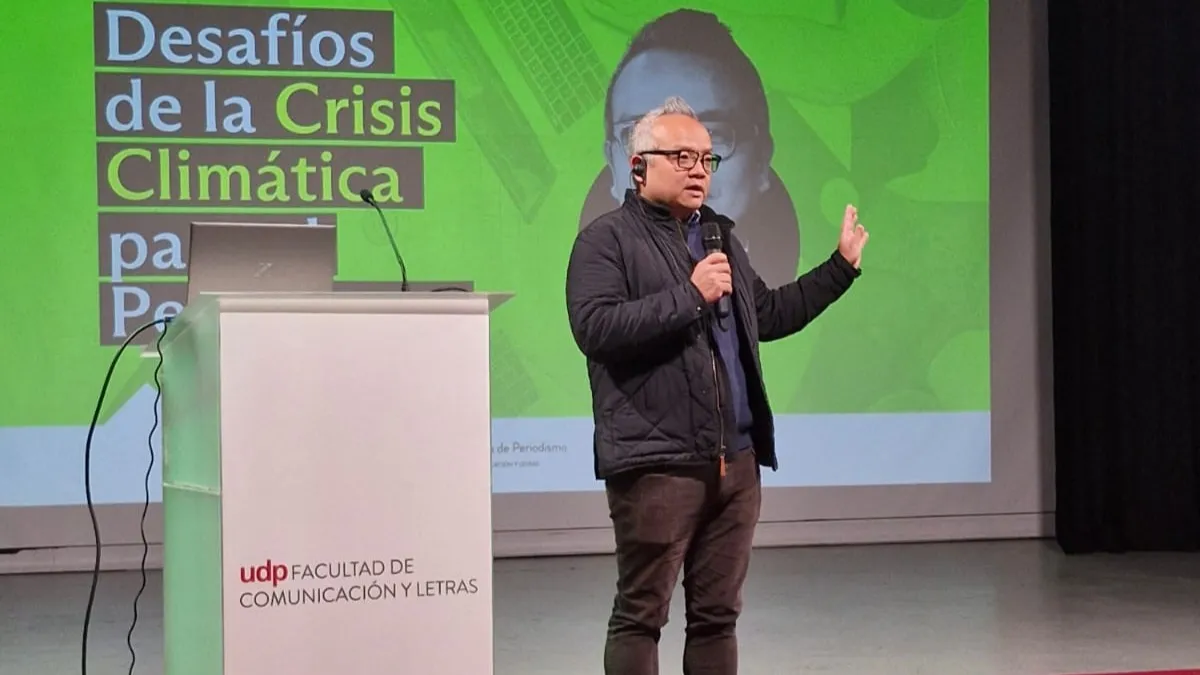
Tu ended his week by giving a public talk on “The Challenges of the Climate Crisis for Journalism” at the UDP television studio, attended by students, professionals and professors, where he showed another one of his videos, “The Wait at Matamoros,” which reviews the plight asylum seekers suffer as they wait to be granted asylum in the United States.
“One of the reasons why this trip is important to me personally, and to Columbia University in general, is because right now, more than ever, journalism is under threat around the world - both financially in terms of business models, and because of government authoritarianism,” Tu said during his presentation.
“I wanted to travel here because journalists are stronger when we come together; we are stronger when we share ideas, when we share networks and when we learn from each other. I've been doing classes here for a week, but I've learned as much as I've taught, for which I'm very grateful,” he added.
During the second week of the winter school, Mark Hansen, Professor of Journalism and Innovation and Director of the Brown Institute for Media Innovation, focused on Data, Journalism and Innovation. “I spent the week teaching data journalism to a group of amazing journalists and future journalists. We addressed different issues related to climate change, specifically in Chile. The students were incredible and it was great to work with them,” he said.
During his week in Santiago, Hansen invited guest speakers to address different areas of climate change. Guests included journalist and J-School alumna Muriel Alarcón, journalist and director of the production company Endorfinas, Andrea Obaid, Climate Central experts Andrew Pershing and Bernadette Woods Placky, disaster risk management center Cigiden’s Katherine Campos, Universidad de Chile communications professor Karla Palma, the executive director of environmental NGO FIMA, Ezio Costa, and Universidad de Valparaíso civil engineer and specialist in oceans, Patricio Winckler.
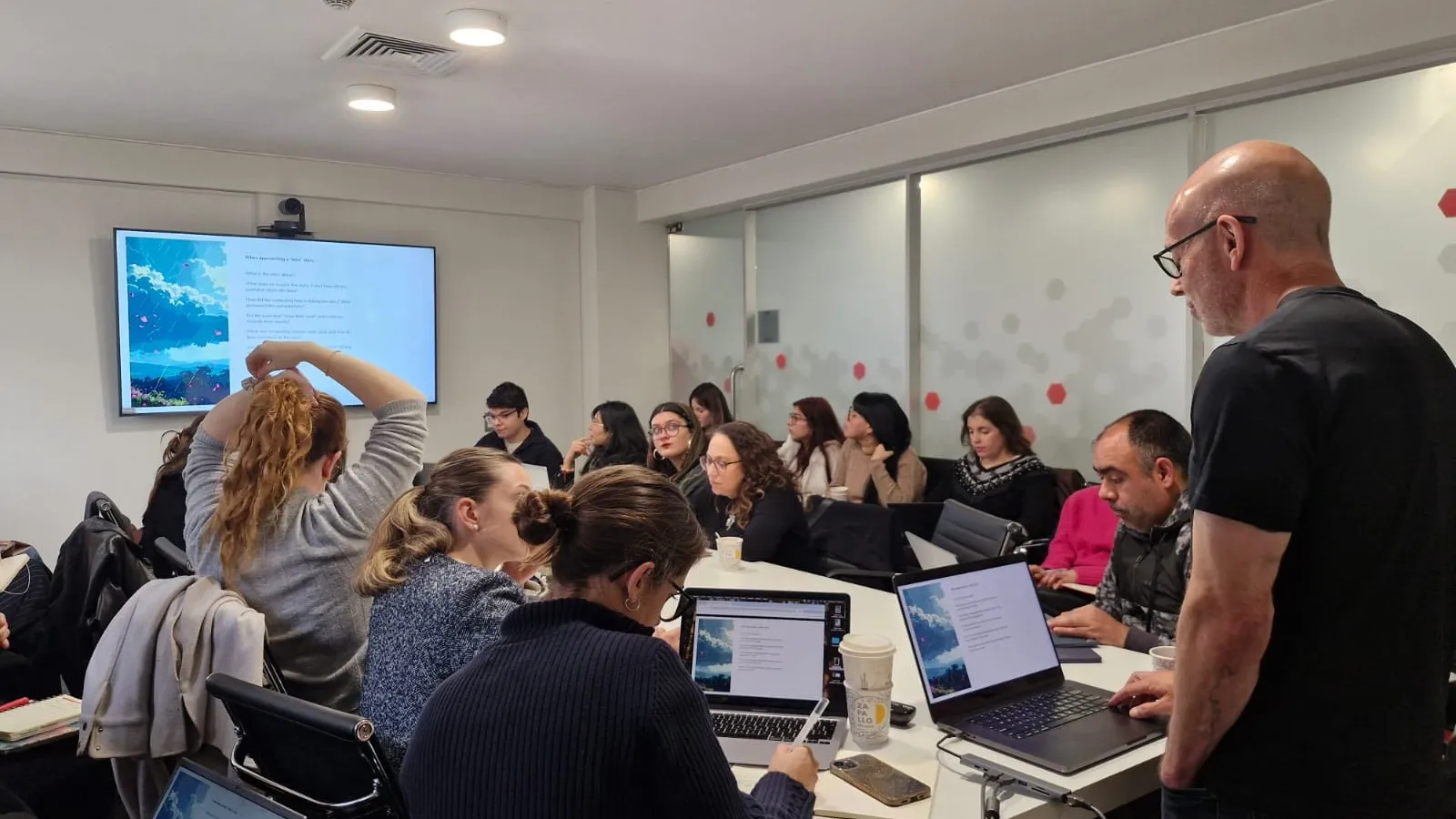
Woven in between the meetings with experts, Hansen reviewed data analytics and showed how the Python programming language could be employed to review large data sets. He used data covering the historical temperatures of four cities in Chile to evaluate days of higher-than-usual heat in those cities.
Class participants were thankful for the opportunity to expand their horizons in their coverage of climate change.
“The Columbia-UDP Winter School gave me real tools to narrate the climate crisis with data, rigor and humanity,” said Ana Arriagada, non-resident fellow of the Atlantic Council, co-founder of ElSoberano.org and professor at the UDP School of Journalism.
“At the intersection between climate change and journalism lie fundamental challenges: from ethics and the responsibility to avoid techno-solutionist coverage [which presents technologies as a solution to social problems], opting for community-centered narratives, to the urgency of addressing the integrity of environmental information and the mental health crisis among those of us who cover a topic marked by the catastrophic impacts of human action on our ecosystems,” she said. Of course, there is also the challenge of making scientific information accessible to all people, whose lives will be impacted by an emergency that we have been unable to address in a significant, effective way.”
“The school was an intense and stimulating induction,” Arriagada added. “In just two weeks, I acquired tools to cover environmental stories with the power of research and data visualization, as well as training in multimedia narratives that allow more people to become informed and understand the importance of community action in the face of this crisis… In addition, I will be able to share what I have learned and amplify this with my undergraduate students at the UDP School of Journalism, convinced that we need more journalists trained to tell stories from evidence, empathy and collaboration.”
She also highlighted the generosity of professors Hansen and Tu; the quality of the guests they invited to help connect that learned with real-life situations, as well as “their ability to leave us on track to continue exploring, learning, and strengthening our coverage with greater impact.”
Journalist and content strategist Candela Abalos also underlined the professors’ intensive training, the involvement of top-notch speakers, and the introduction of practical tools for reporters to be better equipped to cover climate change. “In my still short professional career, I understand that if I want to be consistent with my vision of journalism as a service, I must constantly commit to my academic and professional training. The UDP-Columbia School of Journalism was a great step on that path: it helped me expand networks, open doors to collaborative journalism and solidify the foundations to practice this profession that I choose every day with more conviction,” she said.
In turn, journalism graduate Carolina Silva called the winter school very enriching. “Meeting Duy and Mark and understanding their way of seeing the world, who presented new angles that I did not imagine, made this time one of learning that I will apply in the professional practice of journalism,” she said.
“It was clear that all the participants wanted to be there. They were interested in the subject and, like me, rethought how to do journalism in the digital and data age, thanks to the new techniques learned from Duy and Mark,” Silva noted. “It was a great experience!”
This groundbreaking collaboration between J-School, UDP, and the Santiago Center will continue to bear fruit. In October, a group of UDP Journalism students and professors will travel to New York to visit the J-School, participating in classes, meeting professors, and getting to know journalistic icons such as CNN and the NY Times. Further, the three parties will work together to define collaboration on a course for UDP and Columbia University students to learn how to film, edit, and report on climate change.
“It is no easy task for two universities and a center to collaborate, but the stakes are too high to not try. Starting next year, I hope to pilot a class where my video journalism students will partner with a select group of Diego Portales students for a semester-long course,” Duy said.