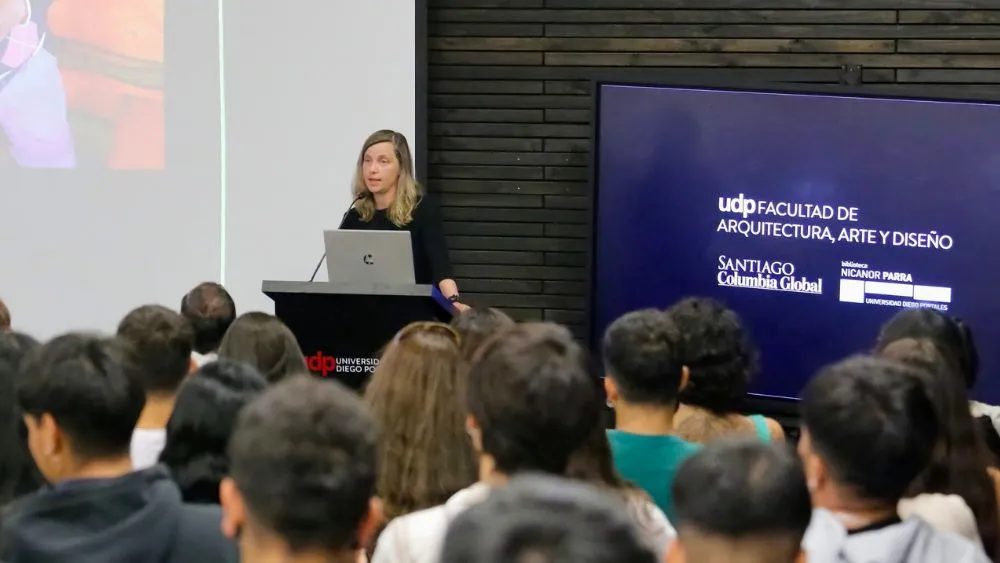
Kate Orff, director of the Urban Design Master’s program at Columbia’s Graduate School of Architecture, Planning and Preservation (GSAPP), founder of SCAPE studio, and a global leader in landscape architecture, urban design, and climate adaptation, is widely recognized for her innovative, collaborative projects that integrate biodiversity, resilient infrastructure, and social change. In 2017, she became the first landscape architect to receive the prestigious MacArthur Genius Grant for her work in designing adaptive, resilient urban habitats that empower communities to steward their ecological environments. In 2020, she was named Urbanist of the Year by The Architect's Newspaper and in 2023, she was named to the TIME 100, the magazine's annual list of the most influential people in the world.
Orff was in Chile to lead the workshop “Earth Studio: Landscape of Repair,” a collaborative initiative among GSAPP, the Columbia Climate School, and Universidad Diego Portales’ (UDP) School of Architecture, Art and Design (FAAD). The project explores new approaches to ecological restoration within urban contexts by integrating sustainable solutions into city planning.
During her visit, the Santiago Center and UDP co-hosted two public events exploring the intersection of design, energy, and environmental justice. On March 17, the seminar “¡Alto Voltaje! Paisaje, Energía e Industria en el Valle del Aconcagua” analyzed the impacts of the energy transition in communities affected by extractive activities. Over three thematic panels, experts discussed environmental justice and extractivism; energy transition and landscape; and design responses and representation.
Then, on March 20, Orff participated in the third session of the Res Publicae conversation series organized by FAAD UDP. Titled “Design at the Land-Water Edge as a Space of Ecological, Social, and Political Negotiation,” the session explored how landscape architecture can address climate uncertainty while fostering social life in urban settings. Her presentation was followed by insights from FAAD dean Alejandra Celedón and professor Sebastián Delpino (GSAPP’08).
Orff’s visit offered a valuable opportunity to reflect on the vital role of urban planning in advancing environmental justice and sustainable development.Passionate about reconfiguring cities to respond to profound global changes, she emphasized the importance of considering energy contexts in urban design. “The organization of cities cannot be analyzed without considering the energy context. As we transition from fossil fuels to renewable energy, minerals like copper and lithium become essential for storage systems—and Chile is at the center of this new energy economy,” she stated.
In a recent interview with El Mercurio, Orff highlighted the long-standing challenges in urban planning that exacerbate climate risks, such as the division of coastal dunes by roads, and called for large-scale ecosystem restoration to improve urban resilience. She also stressed that local-level planning often falls short in addressing systemic issues, advocating instead for an integrated approach that balances urban development, sustainability, and climate change mitigation.