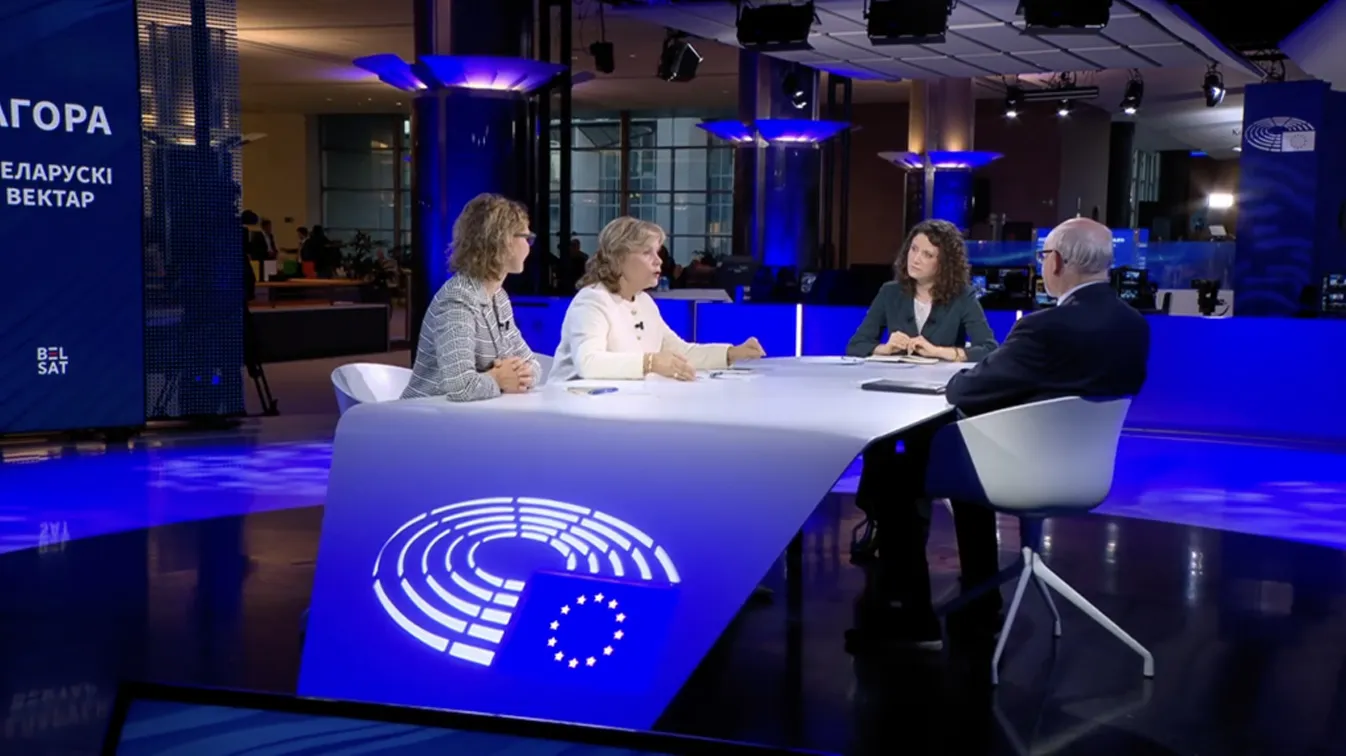
During her residency at Reid Hall, Hanna Liubakova — a Belarusian journalist and political analyst — is hosting a new program that raises urgent questions about Belarus in the halls of the European Parliament. "Agora. Belarusian Vector," produced by Belsat and broadcast monthly, convenes members of the European Parliament alongside Belarusian experts for substantive, English-language discussions on Belarus and its place in European geopolitics. Two episodes have now aired, and the series is already staking out an important space in the conversation about European democracy, accountability, and free press.
Watch episode one here and episode two here.
The premise of "Agora" is as clear as it is necessary: too few voices are making the case for Belarus at the international level. As Liubakova explains it, she spent years writing primarily for English-language publications with the goal of expanding knowledge about Belarus among foreign audiences, and "Agora" extends that mission into a new format. Each episode gives European parliamentarians and policymakers the opportunity to weigh in on Belarus — and gives Belarusian audiences a window into how Europe sees them. "There aren't enough voices at the international level," she says. "So I decided to dedicate my time to this."
The first episode focused on the fourth anniversary of Russia's full-scale invasion of Ukraine, with particular attention to Belarus's role as co-aggressor and the risk that the country is fading from European political attention. Guests included MEP and former Lithuanian Defense Minister Rasa Juknevičienė and Polish MEP and former European Commissioner Janusz Lewandowski, alongside Belarusian expert Hanna Stähle.
Liubakova pressed her guests on the divergence between American and European policy toward the Lukashenko regime, the unfinished business of sanctions, and what it would take to keep Belarus visible on the European agenda. The episode surfaces a tension that runs through all of Liubakova's work: as she puts it, "against the backdrop of events in Ukraine, Gaza, Iran, and Africa, covering Belarus has become even more difficult — but we must do this to dispel the notion that everything has calmed down."