Honoring Donor Families and the Many Lives of the Heart
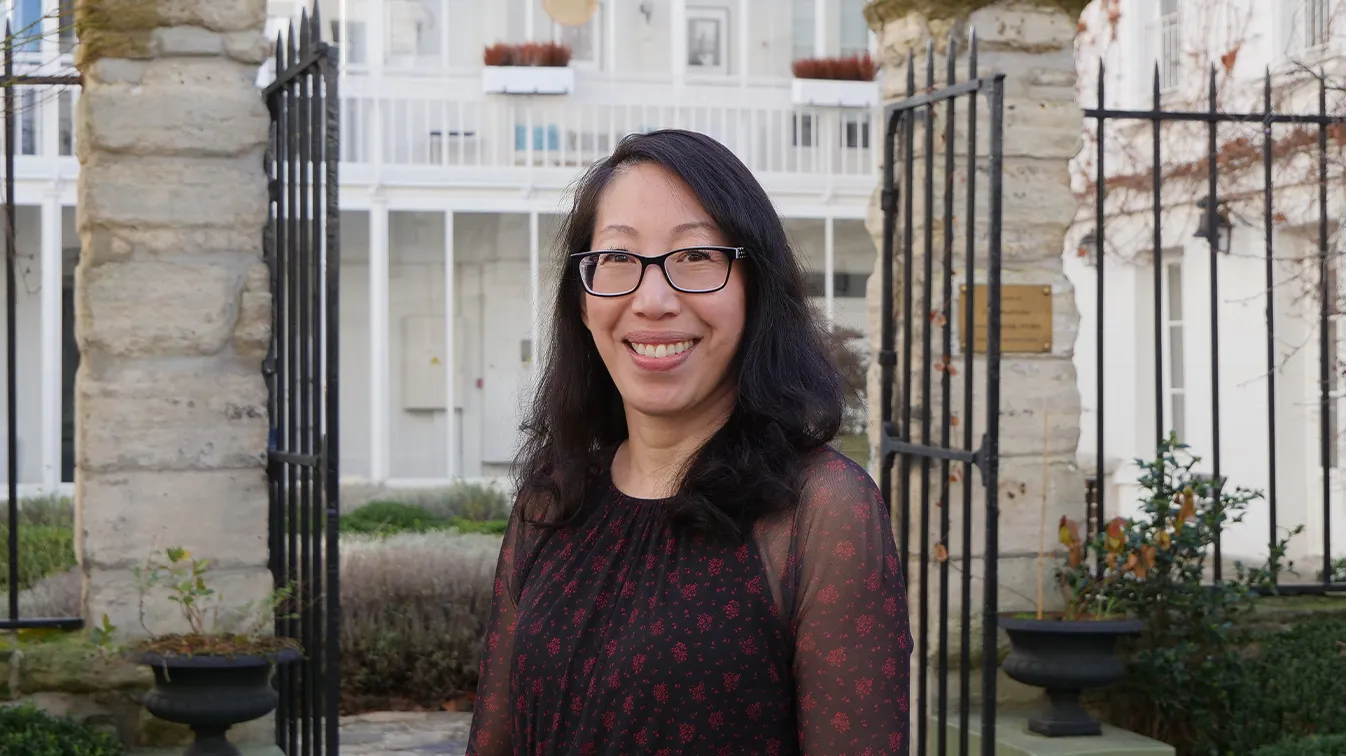
Dr. Teresa Lee is an Assistant Professor of Pediatric Cardiology at Columbia University Irving Medical Center, board certified in pediatrics, pediatric cardiology, and clinical genetics, with advanced training in heart failure and transplantation. As a physician-scientist, her research focuses on identifying novel genetic causes of cardiomyopathy in children, supported by a National Heart Lung and Blood Institute K23 Award and a Children's Cardiomyopathy Foundation Research Grant. She visited Reid Hall in February 2026 as part of the Faculty Visitorship Program co-sponsored by the Columbia Global Paris Center and the Institute for Ideas and Imagination.
—
For a physician-scientist whose days are structured around the relentless rhythm of clinical care — one patient, one case, one transplant after the next — the prospect of two weeks of uninterrupted time in Paris felt, at first, almost implausible. "I just kind of laughed it off," recalls Dr. Teresa Lee on first hearing about the Faculty Visitorship Program from her cousin Anna Paulina Lee, formerly a professor of Latin American and Iberian Cultures at Columbia, who had been a Fellow at the Institute for Ideas and Imagination. "I thought, they're not going to want someone like me. What I do is so different." Yet, she did apply and she did come to Reid Hall.
Dr. Lee came with a project rooted at the intersection of her clinical work and a long-held passion for writing and storytelling. The catalyst was a book: French author Maylis de Kerangal's Réparer les vivants, a novel that traces the intertwined lives converging around a single heart transplant. "As a doctor and a transplant cardiologist, I focus 99.9% on the patient in front of me," she explains. "That book inspired me to think about all the other people in that story — and especially the part that no one really speaks about."
That part is the donor family.
In pediatric heart transplantation, there are no living donors. A child can only receive a heart because another family, on what Dr. Lee describes as the worst day of their lives, chose to give. "The weird thing," she reflects, "is that you can only save your patient by the death of another person's patient." She describes the strange moral weight of hoping for a donor — knowing what that hope requires. The full weight of that reality is borne quietly, largely invisible in the medical literature and in public discourse. One parent of a patient she cares for put it plainly: "On your worst day, you could think of somebody else." It is that act of generosity — and the people behind it — that she came to Paris to write about.
Her visitorship project took the form of a written essay and a podcast recorded at Reid Hall, exploring this paradox at the heart of transplant medicine. The piece centers not on the recipient, nor on the surgical team, but on the donor families whose sacrifice makes everything else possible. "I wanted to honor them," she says simply. It is the first in what she envisions as a series, each exploring a different dimension of the transplant ecosystem — the patients, the physicians, the waiting, the ethics — rendered in language accessible to readers far outside medicine.
Listen to the Atelier episode “Repairing the Living, Honoring the Empty Spaces with Teresa Lee”
This turn toward narrative medicine has been years in the making. Trained initially in communications before pivoting to the biological sciences and then to medicine, Dr. Lee never fully set aside her love of writing. Over time, the discipline of scientific grant writing sharpened her craft, and she began composing short essays — observations jotted on her phone while waiting for the subway, fragments assembled during rare quiet moments between clinical duties. "I realized that you don't wait to be inspired and then write," she says. "You write, and you become inspired."
Conversations with the Institute's fellows — artists, scholars, writers — surfaced unexpected common ground. Attending a work-in-progress presentation by one of the fellows, she found herself moved by ideas that resonated deeply with her own work, despite the vast difference in their fields. "It's all human connection," she says. "It's all telling a story."
A visit to Necker-Enfants Malades Hospital added a scientific dimension to her stay. One of the world's oldest and most celebrated children's hospitals, Necker provided a vivid window into how transplant medicine is practiced differently across cultures and healthcare systems — among other things, Dr. Lee learned that in France, children under one year of age are not placed on the transplant waiting list, a policy she found both surprising and thought-provoking. More concretely, her conversations with Dr. Damien Bonnet, the chief of the hospital's pediatric cardiology division, opened the door to potential research collaboration in large-scale genetic sequencing and its relationship to pediatric cardiomyopathy — precisely the terrain of her lab work in New York. In rare disease research, she notes, sample sizes are always a limiting factor. "You just never have enough numbers, so you always need to collaborate." That collaboration, made possible through Reid Hall's network, is now actively in development.
Her time in Paris also seeded an unexpected line of inquiry. Long intrigued by the fact that cardiology's emblem has always been the stylized cartoon heart — never the anatomical organ used by other specialties — Dr. Lee became curious about how the heart came to be imbued with emotion, memory, and identity across cultures and centuries. A curated tour of Paris's cultural sites, from the Louvre museum to the Sacré-Coeur basilica, tracing representations of the heart from ancient Egypt to the present day, laid the groundwork for a future project she describes with evident excitement. "I almost feel like if I had gone into the humanities, this would have been my thesis," she laughs.
She is eager for colleagues at the medical center to know that Reid Hall's doors are open to them. "I want people from STEM disciplines to know how welcoming it is here, so that they can apply," she says. "I feel so grateful for this experience that I want my colleagues to have it too." What she found — the protected time, the cross-disciplinary community, the connections to Paris and to Europe — is not something that could have been replicated anywhere else. "Even if I had gone and sat on Columbia's main campus," she reflects, "it wouldn't have happened."
Dr. Lee leaves Reid Hall with a podcast recorded, an essay underway, a research collaboration in the works, and, by her own account, a renewed sense of why she entered medicine in the first place. "You forget," she says, "because it gets so busy. But the reason a lot of us went into medicine was because of the human aspect."