The M.A. in History and Literature Welcomes a New Cohort to Reid Hall
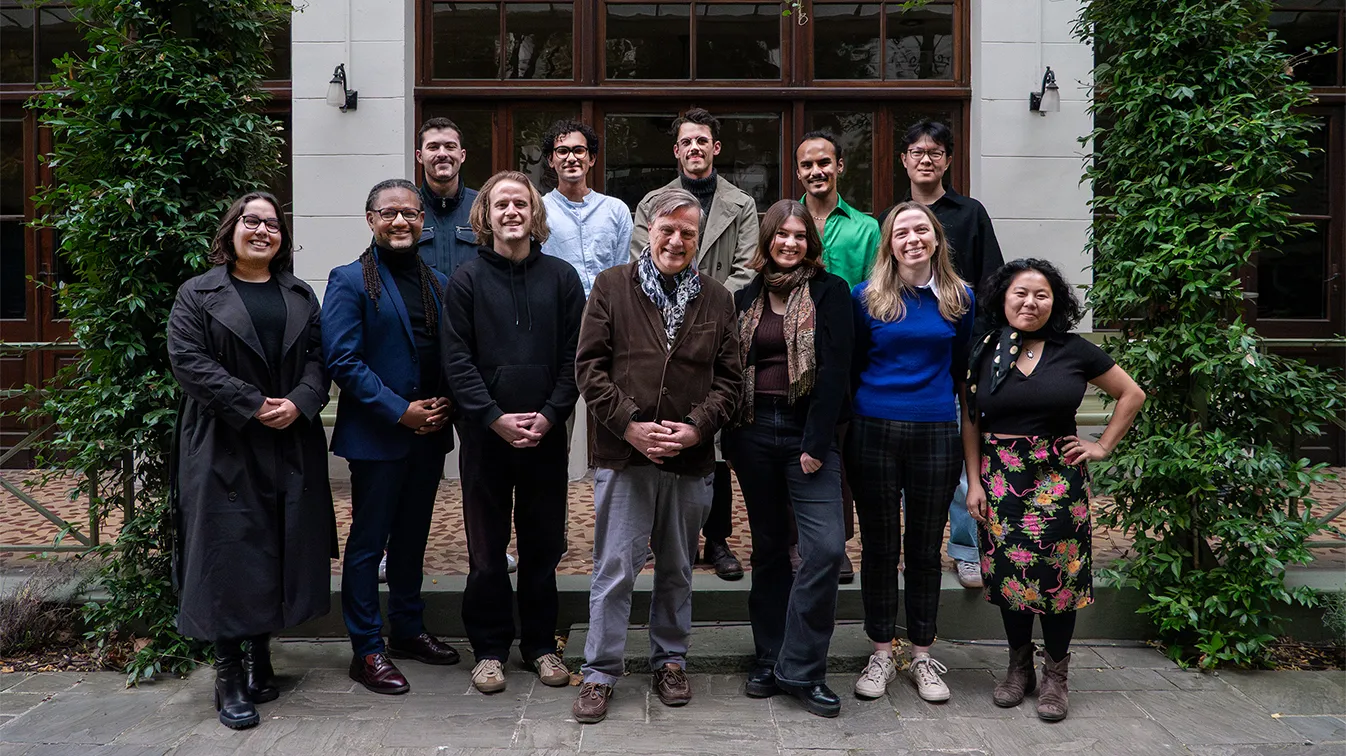
The M.A. in History and Literature (HiLi) is Columbia University’s only graduate program conducted entirely in Paris, housed at Reid Hall—Columbia’s intellectual and cultural home in France. This fall, the program welcomed nine students from around the world for a year of research and study culminating in an M.A. thesis supervised by both visiting Columbia faculty and an advisor from a leading French graduate school.
Meet the 2026 Cohort
Juno Adams earned her undergraduate degree from Sarah Lawrence College, where she studied theater, languages, history, and literature. Since graduating in 2020, she has taught in New York, Andalusia, and Paris. Her research explores the vibrant world of literary and social salons as centers of sociability, gossip, and performance. She hopes to look particularly at American expat salons in early 20th century Paris, focusing on the customs and performance of social norms amongst the elite.
Duncan Allen studied architecture and anthropology at Bennington College. In 2022–2023, he lived in Normandy, teaching English and German. Now based in Paris, he is writing his thesis on the works of Thomas Mann. His research focuses specifically on Mann’s novel, The Magic Mountain, and the experience of time as it is experienced structurally and phenomenologically within the text.
José Almazan completed his undergraduate studies in Poitiers, France, where he majored in Lettres contemporaines (French Literature) and Anglophone Literatures, Languages, and Cultures. His research interrogates the question of the micro-canon as it pertains to immigrant literature, particularly focusing on Mexican-American literature and how those texts fit into and change the face of the larger American literary canon.
Nicholas Bartlett earned his B.A. in History and French from the University of Cambridge and has worked as a journalist in London and Dakar. His research this year will examine the aesthetic influence of Balzac and Zola on the literary style of Ousmane Sembène, considering in particular the depiction of the classe ouvrière in Zola’s Germinal (1885) and Sembène’s Les Bouts de bois de Dieu (1960).
Victoria Isuani graduated summa cum laude from Tufts University in 2025 with a double major in English and French/Francophone Literary Studies and a minor in Art History. She spent the spring of 2024 in Bordeaux through Middlebury College’s School in France. Her research this year centers on the epistolary novel and questions of trust, particularly focusing on the anglophone context and looking at Jane Austen’s posthumously published epistolary novella, Lady Susan.
Siddhartha Minhas graduated from Simon Fraser University in Vancouver with a joint major in French and English Literatures, a minor in Global Humanities, and certificates in Hellenic Studies as well as Medieval and Renaissance Studies. His research investigates how medieval travel guides describing the Far East—such as those attributed to “Sir” John Mandeville—influenced early modern European thought and colonialism, shaping the Western imagination of the “foreign” and the “strange.”
Christian Raible earned his B.A. in Psychology with a minor in History from Wake Forest University in 2025. He is interested in extending his exploration of Middle Eastern history, turning his focus towards the 20th century and the Algerian War. He is particularly interested in focusing on questions of military history, and exploring connections between military strategies used during World War II and those implemented by the French military in Algeria.
Elizabeth Siwica graduated from Florida Atlantic University with a bachelor’s degree in History in 2019, followed by a Master’s in Global, International, and Comparative History in 2023. Her work focuses on the postwar period of decolonization in French West Africa. This year, she is focusing her investigation of labor practices, collective action, and the evolving nature of the French Empire within the context of labor movements in mid-20th century Côte d’Ivoire.
Carl Wang completed his B.A. in Literature and French and Francophone Studies (with Honors) from Hamilton College in December 2024. His undergraduate thesis examined James Joyce’s Ulysses. For his M.A. research, he explores the concept of responsibility—active versus passive—in the dramatic works of Samuel Beckett and Jean-Paul Sartre.
Columbia Faculty in Paris
Professor Pierre Force, a member of Columbia’s French and History departments, helped establish the HiLi program 15 years ago. Though administrative obligations limited his teaching in Paris, he first joined the program in Spring 2019 and is now teaching in it for the second time this semester.
Being based in Paris also allows Professor Force to pursue archival research at the Bibliothèque nationale de France and other regional collections. He is writing a biography of Henri-Joseph de Tréville (1641-1708), who was considered a brilliant mind by his contemporaries but never published anything during his lifetime. He did leave some letters, which Professor Force discovered at the BnF. The biography will accompany the first critical edition of Tréville’s letters.
This semester, he teaches one of the program’s core courses, “French America, 1534–1804.” Previously offered on Columbia’s New York campus, the course takes on new significance in France itself, examining the French Atlantic World from the exploration of Canada to the Louisiana Purchase and Haitian Independence.
Students explore the intersections of war and trade, intercultural negotiation, slavery, and the shifting meanings of race. By following the history of French colonization in North America and the Caribbean, the class offers new perspectives on the history of the Western Hemisphere—and on U.S. history—through encounters among Europeans, Native Americans, and Africans. Topics include the strengths and weaknesses of French imperial control, the dynamics of Native relations, the prosperity and fragility of the plantation system, and how evolving ideas of race and citizenship shaped the emerging United States.