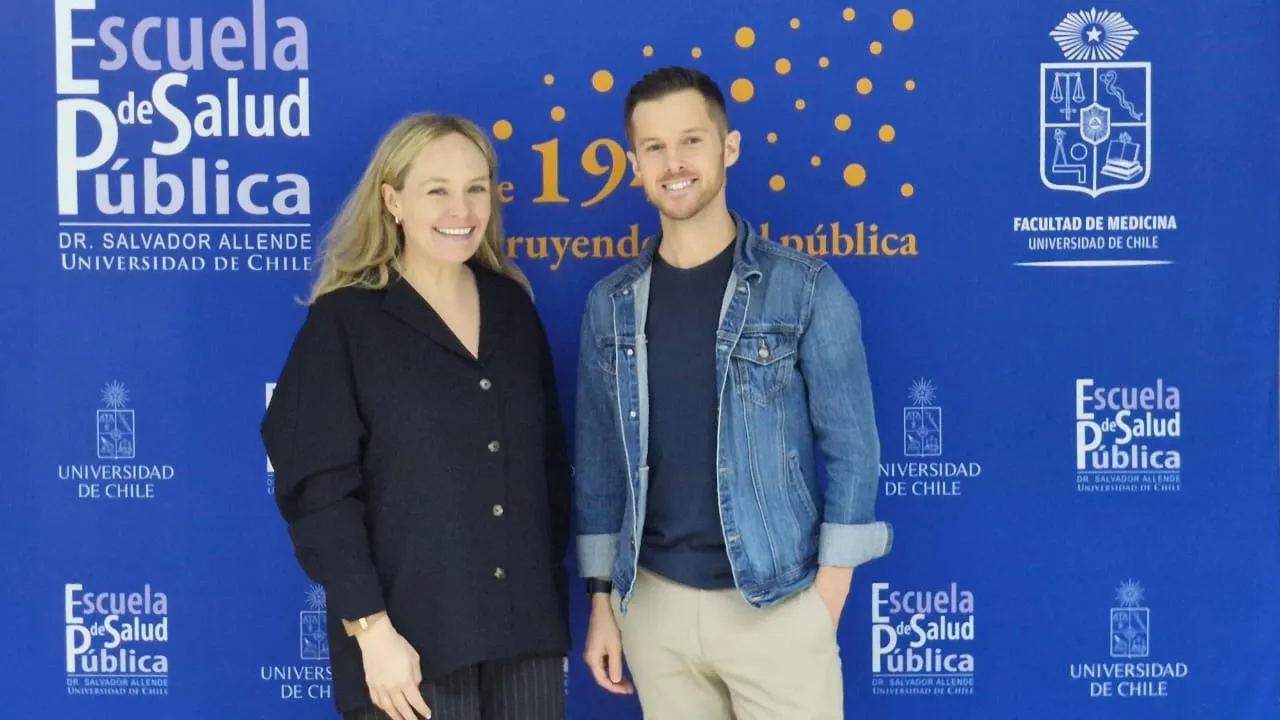
Daniel Giovenco, Assistant Professor in the Department of Sociomedical Sciences at Columbia’s Mailman School of Public Health, spent two weeks in Chile to study how national tobacco control strategies shape health disparities in Chile and the U.S.
Giovenco is one of four scholars who traveled to Chile under Columbia Global’s inaugural Scholars-in-Residence program, where Columbia faculty members and researchers were selected for immersive residencies at Global Centers located around the world. His research focus was entitled “Advancing Global Tobacco Control Policy: A Comparative Study of Chile and the United States,” and he was joined in Chile by Torra Spillane, Mailman Research Manager who also specializes in tobacco control, substance use, cannabis, and public health.
“During my two-week residency in Chile, organized by Columbia Global Centers Santiago, I engaged with leading public health researchers, physicians, and educators across six major academic institutions to exchange insights on tobacco control and substance use policy between countries,” Giovenco said. “At each institution, we also discussed national public health surveillance systems and opportunities for academic collaboration. A highlight of the visit included delivering a guest lecture at Universidad Católica on New York City’s policy to reduce tobacco retailer density.”
His residency included field observations of nicotine and cannabis retail and use, as well as a series of in-depth meetings and discussions with Chilean faculty and students. Meeting topics included secondhand smoke exposure in social venues, tobacco harm reduction in psychiatric populations, development of smoke-free campus policies, and emerging trends in cannabis and nicotine use among young adults.
Another area of interest for the researchers is electronic cigarettes, also known as vapes. Currently classified as pharmaceutical devices, Chile is slated to allow their sale as consumer products, which raises important questions about the role these lower-risk nicotine products could play in mitigating the country’s smoking epidemic.
Chile makes for an interesting case study because, despite adopting nearly all World Health Organization recommendations to reduce tobacco demand, the country continues to face alarmingly high smoking rates: one in three Chilean adults currently smoke—the highest prevalence in Latin America. According to Giovenco, the case warranted in-field research to help better understand the situation.
“This immersive experience offered valuable perspectives on the distinct yet overlapping social, political, and cultural contexts shaping substance use in Chile and the U.S.,” he noted.
The visit was invaluable in that it laid the foundation for future cross-national research partnerships and globally-informed scholarship, Giovenco added.