Reimagining Health Care Ecosystems
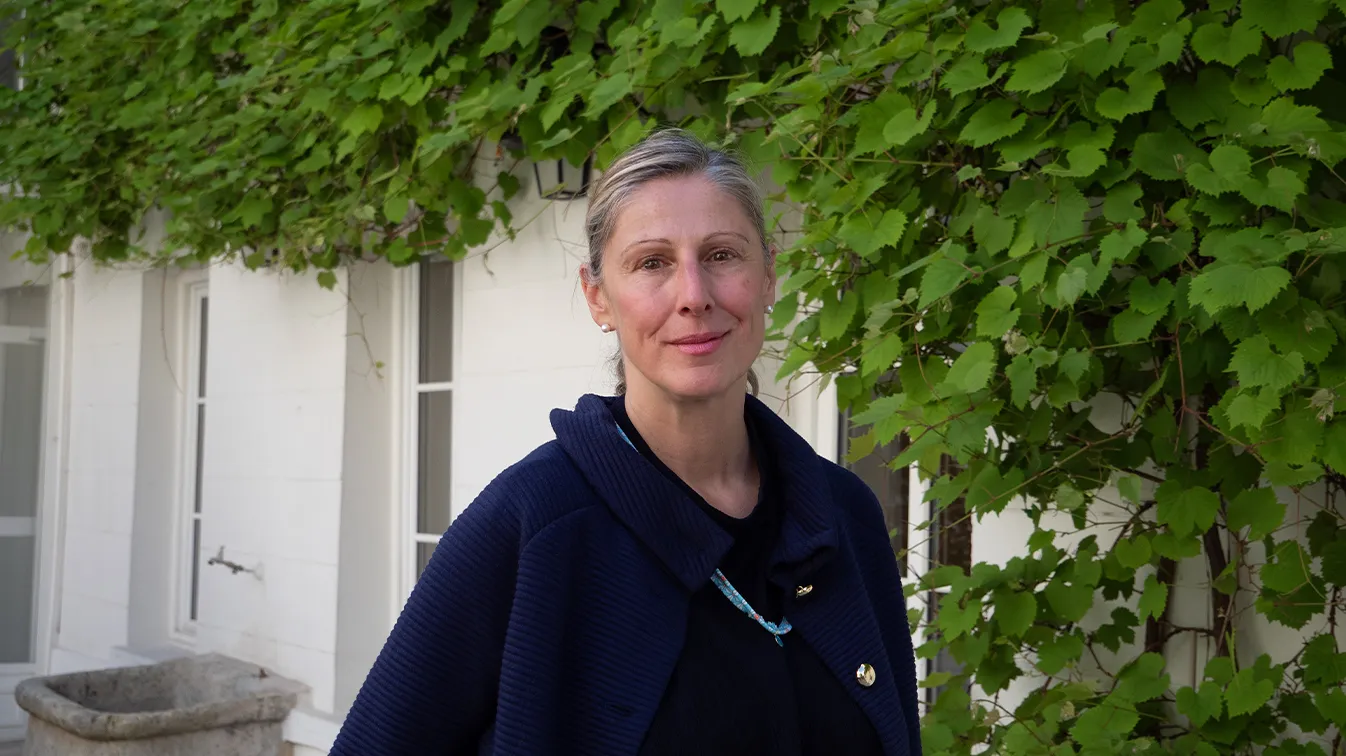
A pediatric hospitalist at Columbia University Irving Medical Center, Dr. Mirna Giordano has over a decade of experience in surgical co-management of pediatric neurosurgical patients. Her clinical research focuses on opioid-sparing multimodal analgesia. She serves as Chair of the Opioid Crisis Committee at AAP Chapter 3, as a Steering Committee member with the NYC Collaborative of Pediatric Hospitalists, and on the Executive Council of the Pediatric SIG at SHM. She visited Reid Hall in April 2026 as part of the Faculty Visitorship Program co-sponsored by the Columbia Global Paris Center and the Institute for Ideas and Imagination.
Dr. Mirna Giordano came to Paris with a question that had been quietly forming for some time: what can the French system of pediatric surgical care teach the American one, and vice versa? In an era of shrinking resources and mounting pressure facing clinicians on both sides of the Atlantic, she wanted to move beyond the familiar boundaries of her own institution and see, firsthand, how colleagues elsewhere were meeting the same challenges. "I know the American system," she explains. "But in the current atmosphere of funds being cut and immigrant care being threatened, we must be more creative." Over the course of two weeks, she visited two major pediatric centers at Bicêtre and Necker hospitals, observing how teams communicate, how protocols are built, and how patients move through the system. What she found was equal parts familiar and surprising.
She was particularly struck by how little the French system relies on opioids at discharge. Where Giordano has spent years developing opioid-sparing protocols in the U.S., France has largely solved the problem by not prescribing opioids for home use at all. The tradeoff is longer inpatient stays, with their own costs and complications. Meanwhile, the pressures facing trainees were strikingly universal: the same sense of overwhelm, the same mismatch between growing patient complexity and unchanged staffing levels. Neither system has it entirely right, and the comparison itself is the point.
Her visit was the first step of a structured research project. This summer, Hortense Citanna, a bilingual premed student at the Lycée français in New York, will travel to Normandy to establish connections at regional pediatric centers, extending the network beyond Paris to understand how care looks outside the major academic hospitals. She and Dr. Giordano have already developed a bilingual questionnaire. The longer-term ambition is a comparative study drawing on interviews with a hundred or more providers on both sides of the Atlantic, identifying key areas where the French and American systems can learn from each other, whether on protocol design, technology and AI-assisted order management, workforce structure, or the oversight of controlled substances.
The longer-term ambition is genuinely international. "My ultimate idea," she says, "is of a world in which we would know what doesn't work in certain ecosystems, which might allow us to imagine a different one."
The collaboration doesn't stop with this qualitative study. Dr. Jane Bregier-John, a colleague at Bicêtre, suggested a series of virtual lectures: a kind of transatlantic grand rounds, bringing American hospitalists and their French counterparts into the same room via Zoom. Giordano's response was immediate: she could think of ten colleagues to invite without effort. "Who knows how many hundreds of people those learning points can reach," she says.
She was met, throughout her visit to Paris, with remarkable openness. At both hospitals, colleagues including Dr. Luca Pio, Dr. Pierre Tissières, Dr. Christophe Chardot, Dr. Mehdi Oualha, and Dr. Laurent Dupic welcomed her into their wards, operating rooms, and conversations — the kind of access that turns a visit into a collaboration.
The takeaway is the wellspring of creative thought that becomes possible when a clinician is, however briefly, relieved of the relentless forward motion of clinical life. Giordano describes her time outside of hospital visits spent writing, reflecting, and generating not only research ideas but something closer to wonder. She found herself moved by encounters with patients who were not hers to treat, freed from the ownership and urgency that normally structure every bedside interaction.
Reid Hall has educated and hosted women artists and researchers since 1893—a period when the idea of an educated woman, let alone a working one, was far from a social norm—and Giordano felt that history as something more than backdrop. "These walls somehow make me have a little extra responsibility to those who have gifted this space and invested in this space," she said. "I feel like I was gifted so much. There was not a fraction of this I had imagined when I put in my application." She left with gratitude for what the space had made possible, anticipating future generations who will contribute to the work of improving global health. It was a fitting place to be reminded that medicine has always advanced by imagining what doesn't yet exist.