Santiago Center’s First Grant Recipient Embarks on Field Research in Southern Chile
Based at the Villarrica campus of Universidad Católica, Columbia grad student Vanessa Fiuza is working with Mapuche communities.
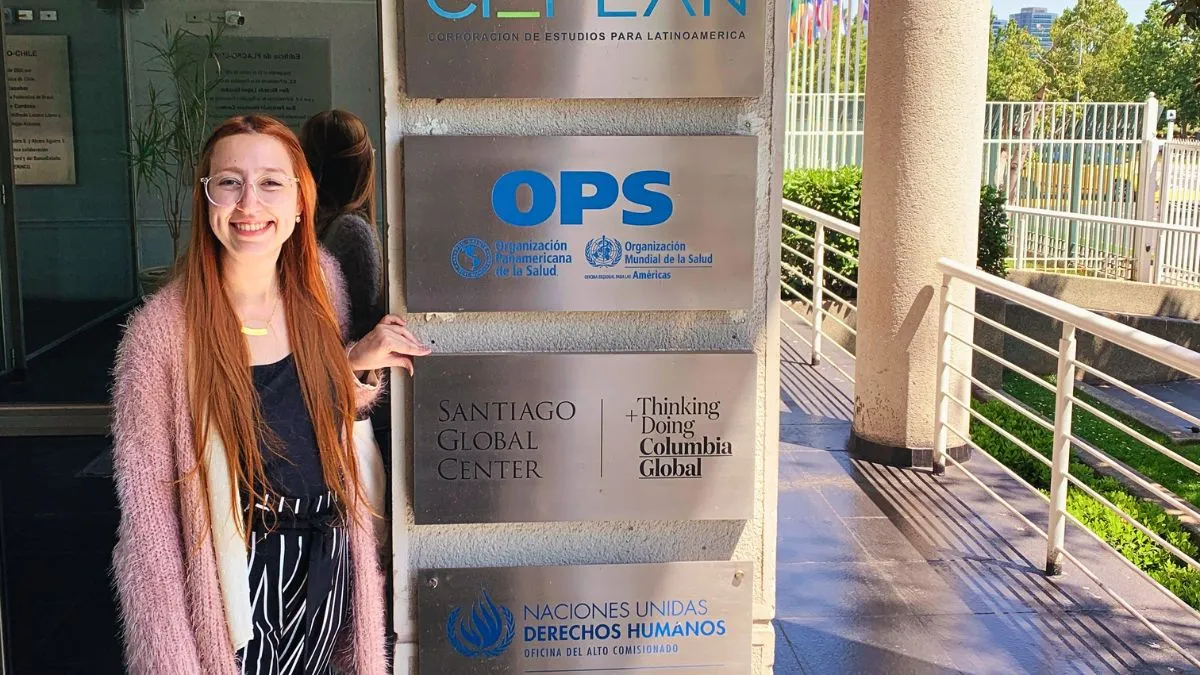
Vanessa Fiuza, a Brazilian student in the MA in Human Rights at Columbia’s Institute for the Study of Human Rights, recently arrived in Chile to begin a three-month research journey as the first recipient of a newly established research grant awarded by the Santiago Center. This award allows Columbia postgraduate students to conduct research at one of the research stations hosted by Universidad Católica across Chile, a program that launched following the signing of a Memorandum of Understanding between Columbia and Universidad Católica in late 2023.
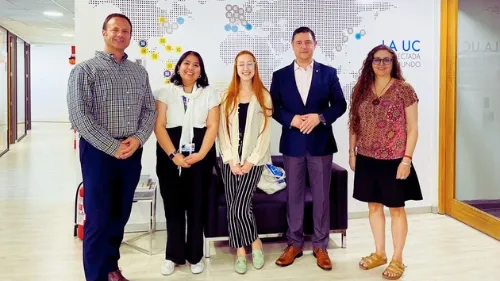
Vanessa arrived in Santiago on October 24, where she met with the Santiago Center team and representatives from UC’s global mobility team, Javiera Ballesteros (coordinator of Special Programs, Internships, and International Exchanges) and Cristián Bonilla (head of Study Abroad and International Internships) and Francisca de la Maza, social anthropologist and academic at UC’s Institute of History, who will act as Vanessa’s mentor during her research. The following day, Vanessa headed to the south of the country, where she settled in Villarrica to begin her work at UC’s Local Development, Education, and Interculturality Center, located 760 kilometers south of Santiago.
Reflecting on her motivation for applying, Vanessa described the experience as a rare chance to bridge her interests in women’s rights, Indigenous rights, and climate issues with on-the-ground fieldwork. “As an advocate for women’s and Indigenous rights, this grant offers a unique chance to blend my passions with field experience,” Vanessa expressed. “Working directly with the Mapuche Indigenous Community alongside Professor de la Maza will be personally transformative, and the professional growth will follow naturally.”
Vanessa’s research focuses on capturing the perspectives of the Mapuche community, particularly Mapuche women leaders, regarding their ties to land, nature, and ancestry. Through in-depth family interviews and community visits, she is assisting UC in creating an Informe Antropológico (Anthropological Report) incorporating a gender-focused perspective. “I’m especially interested in how Mapuche women leaders perceive their connections to land, nature, and ancestry,” Vanessa shared, “which adds depth to my studies of Latin American Indigenous perspectives and Ecofeminism, a theme I am exploring in my thesis on Amazonian women.”
Vanessa’s work is a continuation of her previous experience with the Quechua community in Cusco, Peru, where she researched gender-based violence issues in 2017. “This research feels like a natural step in broadening my understanding of Latin American First Nations, women, and climate issues,” she remarked.
As Vanessa looks toward completing her final semester, she is already considering how this experience will shape her future career. “This opportunity is truly invaluable,” she reflected, “especially with the potential for a published Informe Antropológico. I hope to deepen my expertise in Latin American women’s rights, Indigenous rights, and climate, whether through a PhD or professional work in international organizations. As a writer, this experience will inspire my future publications.”
In the coming weeks, the Santiago Center will publish the second call for applications, inviting Columbia graduate students interested in field research to apply for grants to work at one of Universidad Católica’s research stations in Chile. This opportunity will enable students to conduct research in Chile during the northern-hemisphere summer of 2025.
Image Carousel with 3 slides
A carousel is a rotating set of images. Use the previous and next buttons to change the displayed slide
-
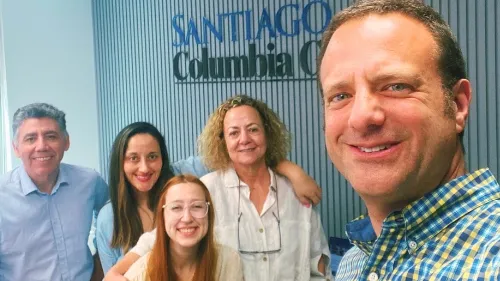
Slide 1: Vanessa and the Santiago team Antonio, Carla, Vivi and Chris.
-
Slide 2: Vanessa, Chris and UC’s global mobility team.
-
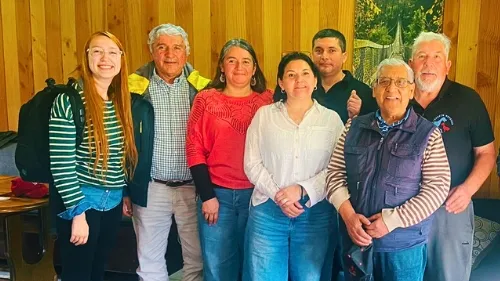
Slide 3: Vanessa at the Julián Collinao Indigenous Community of Relicura in Pucón.