Santiago’s Glaciers are Melting. Researchers Move to Action-based Solutions
Columbia and Universidad Católica will introduce an interdisciplinary course challenging students to find solutions to a dwindling water supply.
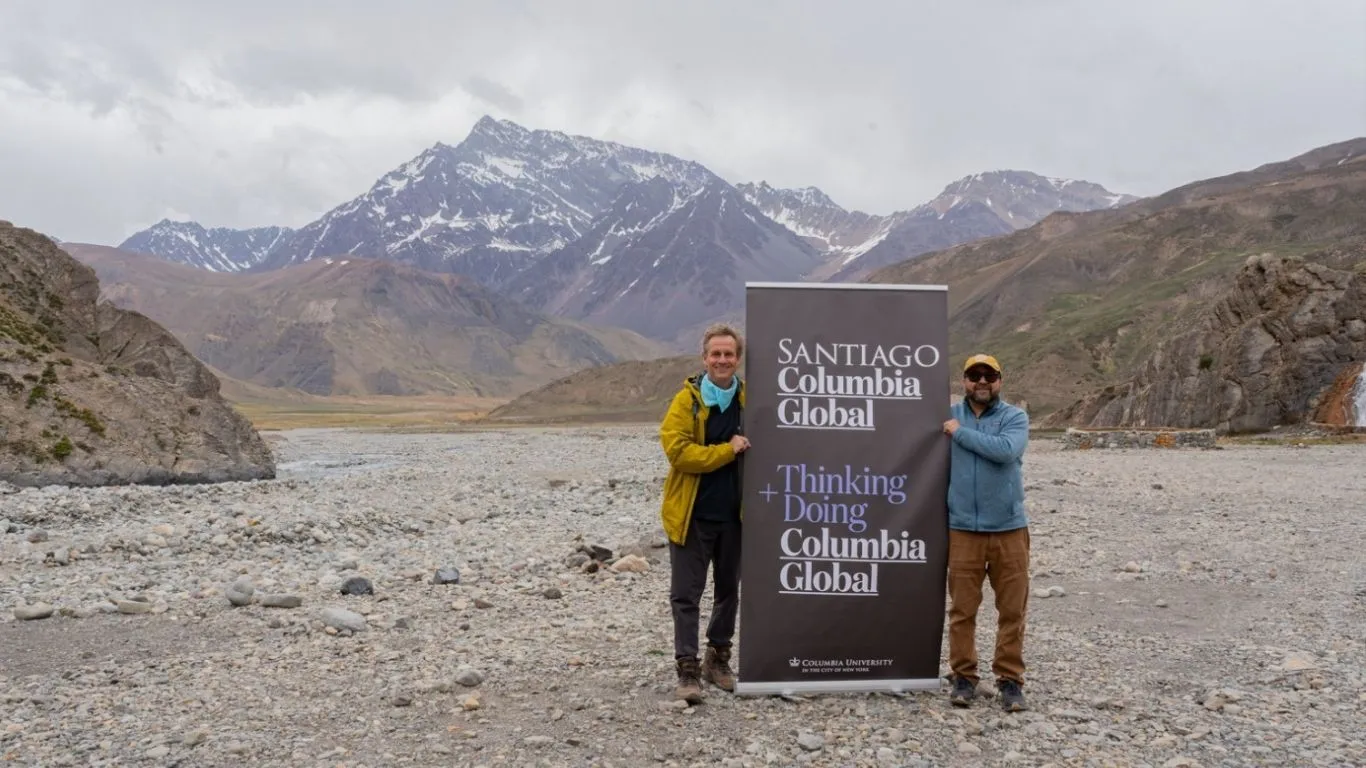
Glaciers have been the subject of scientific interest for decades, helping researchers reconstruct Earth’s climatic past. But in central Santiago, that work has taken on a more immediate urgency: understanding how glacier melt could shape the future of water security for its more than 7 million residents, plus the agriculture and industrial businesses built up around the city.
That urgency is at the center of a growing collaboration between scientists from Columbia University and Pontificia Universidad Católica de Chile, who are now turning their attention from Patagonia’s ice fields to the glaciers above Santiago.
For Joerg Schaefer, a glaciologist whose work has spanned mountain glaciers “literally everywhere,” the shift reflects a broader evolution in the field. What began as paleoclimate research - using glaciers as records of past climate - has become increasingly focused on the present and future.
Schaefer is a Lamont Research Professor, Director of Lamont-Doherty Earth Observatory’s Cosmogenic Nuclide Group, a faculty member of the Department of Earth and Environmental Sciences (adjunct professor at DEES), and a senior fellow of the Center of Climate and Life at Columbia University. His key interests include how glaciers and ice-sheets respond to past and modern warming, how changing ice and related hazards, such as tsunamis and glacial lake outburst floods, impact the environment and society, and how science can assist in developing solutions for these climate-related challenges.
Glaciers: Bellwethers in a Warming World
“Mountain glaciers are extremely sensitive to small changes in climate,” he explained. “They’re the most sensitive recorder of past climate that I know.”
That sensitivity, once useful primarily for reconstructing ancient climates, now offers critical insights into how quickly glaciers may retreat in a warming world. And in Santiago, that retreat carries direct consequences.
“Here it’s water,” Schaefer said. “Those glaciers are basically the water tower of Santiago, and the water tower is getting smaller very quickly.”
For now, the meltwater remains sufficient. But the concern is what comes next.
“At the moment there’s still enough melt in water,” he said, “but at one point there may be nothing left.”
His colleague Esteban Sagredo - a Chilean geologist and professor at Universidad Católica’s Institute of Geography, whose expertise lies in Patagonia - said their understanding of glacial history has sharpened the reality of what is happening now.
“The more we understand the past,” he said, “the more we understand that we are living in a global crisis, a glacial crisis.”
While Patagonia does not yet face immediate water shortages, central Chile presents a starkly different picture. There, glaciers are in what Sagredo described as “critical condition,” with millions of people depending on their runoff.
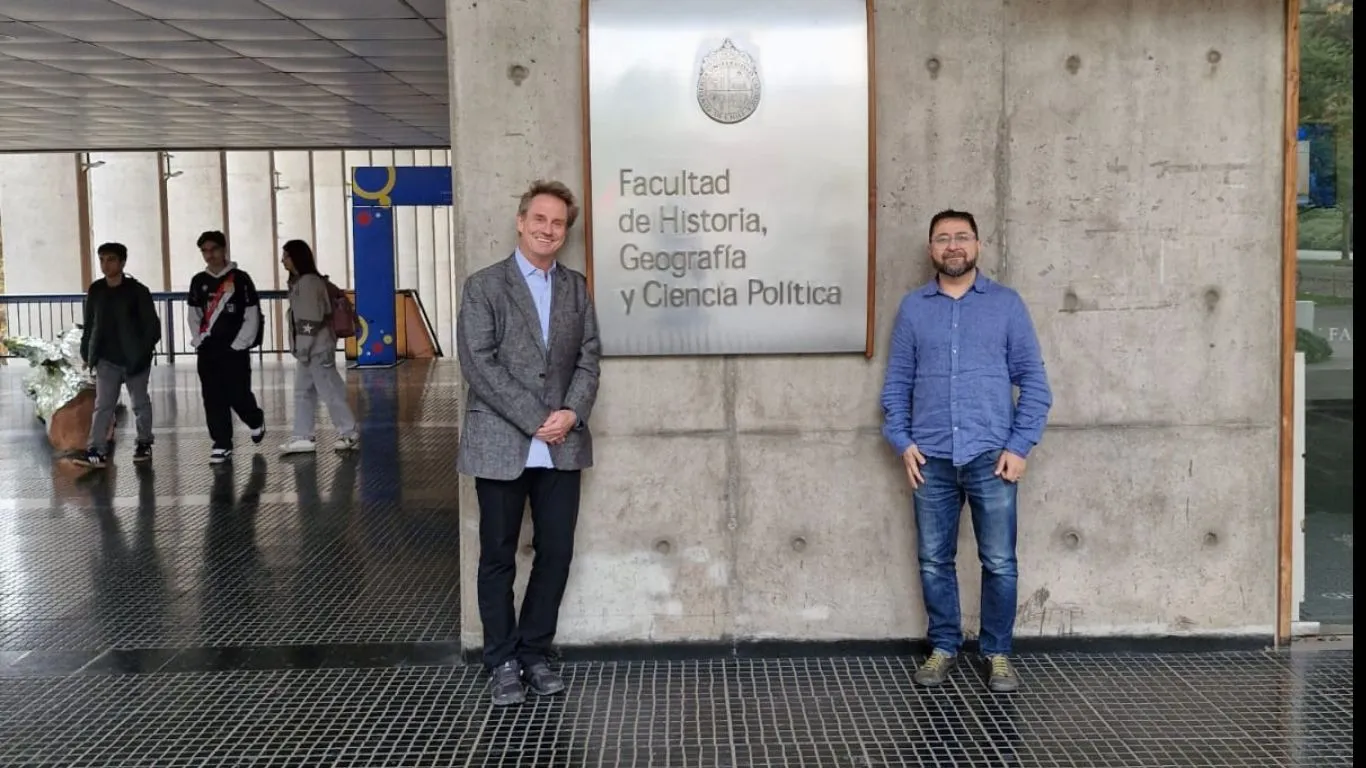
How the Partnership was Forged
The stakes became clear to Schaefer during his first visit to Chile about five years ago. Driving with Sagredo through Cajón del Maipo in the Andes foothills above Santiago, he was struck by the limited scale of the watershed.
“Are you telling me that all the water of Santiago comes from there, from that little river?” he recalled asking.
“Yes,” was Sagredo’s answer. That moment helped crystallize the need for action.
But for the scientists, the problem is not only environmental - it is deeply political and social.
Schaefer argues that while glacier loss is difficult to stop in the short term, the way water is distributed in Chile is far more within human control.
“The further you go down the river,” he said, “you recognize that all the human decisions on how water is distributed can be drastically improved.”
He points to agriculture as one major pressure point. “There’s too much water going to agriculture,” he said, while stressing the goal is not elimination but efficiency. Even a small reduction of water consumption in the sector could make a major difference, he argues.
Sagredo believes one of the biggest barriers is public perception. In Santiago, water supply has remained a constant, creating a sense of permanence.
“You open the tap, and the water flows,” he said. “It has never stopped flowing ever.”
That uninterrupted access has created what he sees as a dangerous lack of awareness. In other South American cities, he noted, interruptions in water supply have become common over the past decade. In Santiago, even brief outages trigger public outrage.
“We’re so entitled to water, electricity, everything,” he said.
An Academic Course to Address the Issue
The scientists believe that both awareness and solutions must come through education, collaboration, and policy.
Next spring, the two researchers will launch a pilot educational program in Santiago, funded by Columbia Global and coordinated with the Santiago Center, to examine how the city’s water is used and distributed. The class will combine fieldwork on the glaciers above Santiago and bring together students from Columbia and Universidad Católica.
Students will not simply observe; they will be asked to propose solutions.
“The final report in this class will definitely not be to summarize and describe what you lived through,” Schaefer said. “It will be totally action-based.”
The course is designed as explicitly interdisciplinary, involving geographers, physicists, lawyers, engineers, and potentially artists. That reflects the scientists’ staunch belief that academia must move beyond simply producing knowledge.
“We have to get out of this academic shell,” Schaefer said. “That period is over.”
That interdisciplinary approach, they argue, will be especially critical as new pressures emerge such as expanding mining operations and the rise of AI infrastructure - both highly water-intensive sectors. As data centers proliferate around Santiago, Schaefer warns that demand could “explode,” making the city’s water future even more precarious.
Time is Running Out
For now, the glaciers above Santiago continue to melt, feeding the rivers below. But the scientists see a narrowing window to rethink how that water is valued, distributed, and protected.
The crisis, brought on by human-driven climate change, may be unavoidable. However, what happens downstream, they argue, is still very much a human choice.