Seeds Across Generations: The Neuroscience of Inherited Memory
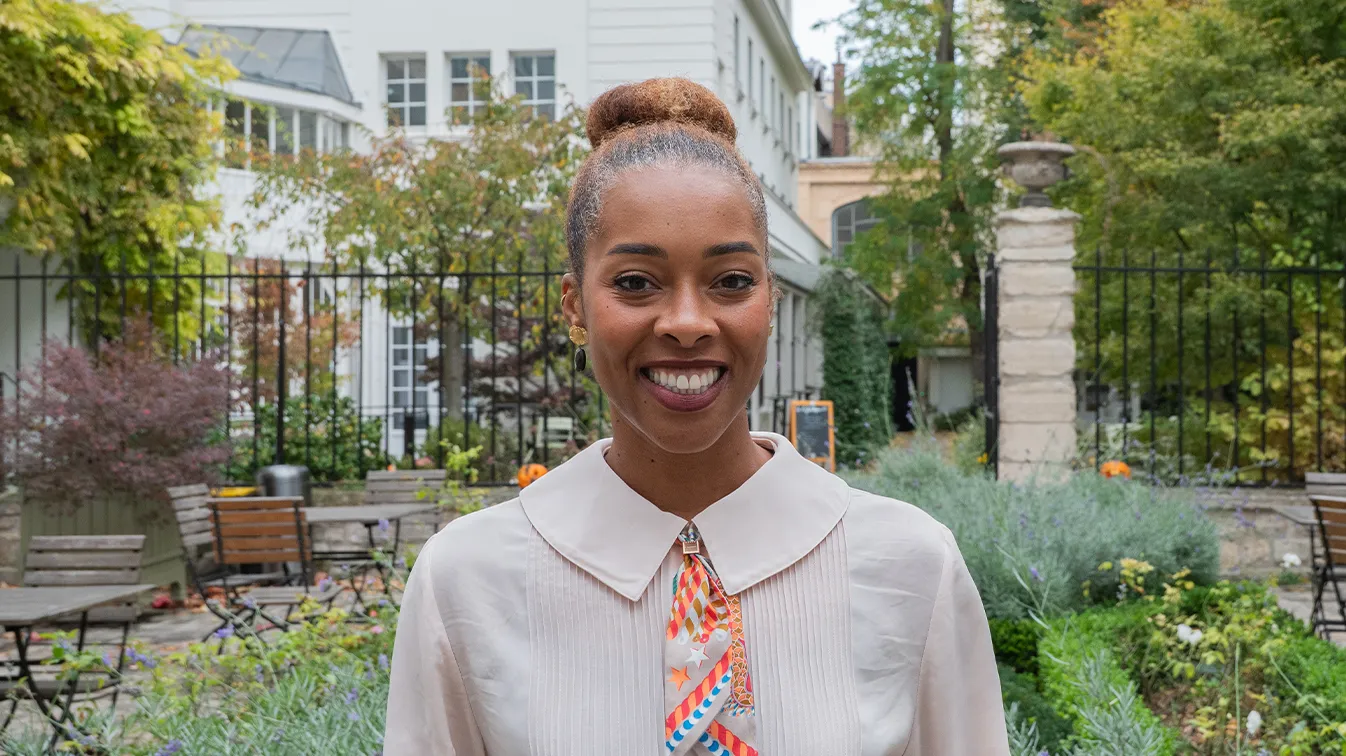
Dr. Bianca Jones Marlin is an Assistant Professor at Columbia University's Zuckerman Institute, where her research investigates transgenerational epigenetic inheritance — how learned experience in one generation becomes encoded in the biology of the next. Her work combines neural imaging, behavior, and molecular genetics to explore how parental trauma and memory shape the brains of offspring, with profound implications for mental health and generational healing. She visited Reid Hall in October 2025 as part of the Faculty Visitorship Program co-sponsored by the Columbia Global Paris Center and the Institute for Ideas and Imagination.
—
For most researchers, international collaboration lives in the gaps between full schedules — a Zoom call across time zones, a shared Google Doc, and the slow accumulation of emails. For Dr. Bianca Jones Marlin, whose work investigates how trauma and memory are passed from one generation to the next, her visit to Reid Hall offered something categorically different: the chance to be in the same room, in the same city, working through ideas in real time. "It really is impossible to do from overseas," she says. "We both have busy jobs, we jump on a Zoom, but it really doesn't allow you to brainstorm and understand each other's work in space."
That proximity proved generative in ways that extended well beyond what she had originally anticipated. Dr. Marlin arrived with one project in mind and left with three — and a plan to return.
The first and most developed of these is TRANSMIND, a collaborative project with Gisela Vetere, a neuroscientist colleague at ESPCI Paris, located just steps from Reid Hall. The project investigates how imagined sensory experiences — what Dr. Marlin calls "fictive memories," generated via optogenetics — might be biologically encoded and inherited across generations, linking imagination, trauma, and brain plasticity in ways that could reshape our understanding of mental health and intergenerational healing. Advancing this work required more than a conversation with her collaborator. It required immersion in the lab itself — meeting the graduate students and postdoctoral researchers conducting the day-to-day science, understanding their techniques and capabilities, and giving them a window into her own work in return. "The science is always active, it's alive," she explains. "Meeting with the people who are doing the work was essential." That mutual understanding, she notes, simply cannot be replicated on a screen.
The second project grew directly out of the first. Together with her ESPCI collaborator and a potential donor interested in science communication, Dr. Marlin piloted the concept for a podcast that would bring scientists into dialogue across disciplines and languages. The test recording — conducted at Reid Hall — revealed as much about the challenges ahead as about the possibilities. Pace, register, jargon, the dynamics of speaking across language backgrounds: all of it became visible in ways it hadn't before. "I'm a New Yorker, I'm a fast speaker," she laughs. "There may be people for whom English is their third language." The pilot didn't need to be perfect; it needed to be instructive. It was. The project is now in search of funding.
The third project was, in her words, a gift of connection. Through the Institute for Ideas and Imagination, Dr. Marlin was introduced to Dr. Germano Cecere, a researcher whose work on epigenetics in worms appeared to intersect remarkably with her own mouse-based research. The two spent hours in conversation, mapping the terrain they share. "We were digging into science and realizing how much our work overlaps," she recalls. The collaboration is now in motion, though it is still, she acknowledges, in an early stage. What it needs most is what Reid Hall gave her in the first place: time. "I need another period of time to talk with him and get further in those steps," she says — which is partly why she is already planning a return visit.
Alongside these three projects, Dr. Marlin also delivered a public talk during her stay, bringing her research to an audience that included Institute for Ideas and Imagination fellows, Columbia and Smith College students, astrophysicists, and colleagues from other fields far removed from neuroscience. For a scientist who has spent years in what she affectionately describes as "some dark basement somewhere, just us, a microscope, a mouse, and a hope and a dream," the response she received at Reid Hall was something she clearly treasures. Fellows working in photography, music, and the arts found in her research on intergenerational stress and epigenetic inheritance a new lens for their own creative work. One fellow told her that they now intended to bring an intergenerational perspective to their photography. Others said the talk had deepened their understanding of concepts they had never previously encountered. "For people to be so enamored by what we can do as neuroscientists," she says, "and to take that science and have it inform their art, their culture, their music — I felt so honored." She describes it as one of the ultimate joys of academic life: watching an idea travel across disciplines and take root somewhere unexpected. The metaphor, she notes with a smile, is not accidental. "My words have now gotten across a huge body of water into another country, and planted a seed, and people are doing things there. How cool is that?"
There is one further point Dr. Martin was keen to express: During her time at Reid Hall, working from a quiet office with a bay window overlooking the courtyard, she wrote an entire R01 grant application. The R01 is among the most demanding and consequential documents a scientist produces — the primary mechanism for securing federal research funding in the United States, typically requiring weeks of intensive, distraction-free work. "Usually it's me just losing a week of my life," she says. At Reid Hall, with two protected hours each day, it got done. "That little office, the bay window, my computer, and quiet thought," she reflects. "We need that as people in philosophy, as neuroscientists — we're still philosophers. We need protected thinking time."
It is a lesson, she says, that she has tried to carry back to New York with her: the deliberate preservation of space for thought, away from the noise of a demanding institution and a demanding city. "We always push thinking to the end," she observes. "There's always something more to do." Reid Hall, she suggests, offered not only physical space but a kind of cognitive one — a new environment, a new language, a context that demanded a little neurological flexibility. "A place that's going to force a little bit of plasticity," she says, "is a great place to start thinking."
For Dr. Marlin, the visit was shorter than most—but, as she is quick to add, it was fully optimized. Three projects were set in motion, a community of collaborators was established on both sides of the Atlantic, and a return visit was already on the calendar. The seeds, as she might put it, were planted.