How the AIDS Crisis Remade Contemporary Art
Reid Hall Faculty Visitor Julia Bryan-Wilson comes to Paris to research her new book, which argues that the AIDS crisis—not 1989—marks the true beginning of contemporary art.
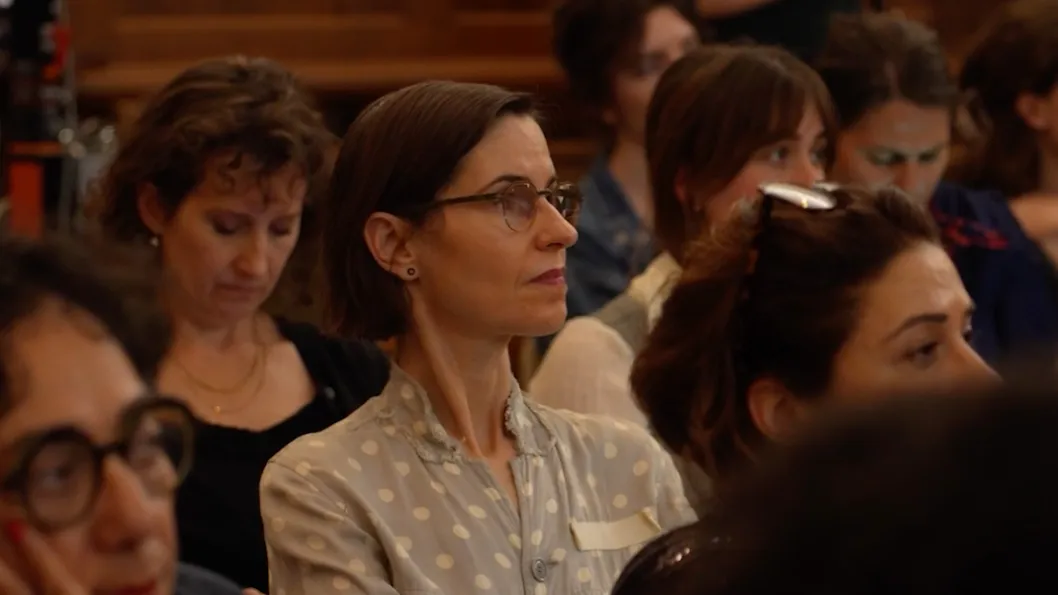
Julia Bryan-Wilson is Professor of Contemporary Art and LGBTQ+ Studies at Columbia University and core faculty in the Institute for the Study of Sexuality and Gender. Her research spans feminist and queer theory, artistic labor, performance, craft histories, and visual culture of the nuclear age. She visited Reid Hall in May 2026 as part of the Faculty Visitorship Program co-sponsored by the Columbia Global Paris Center and the Institute for Ideas and Imagination.
There is a version of art history in which the contemporary era begins in 1989 — with the fall of the Berlin Wall, the symbolic end of the Cold War, a world reorganized. Julia Bryan-Wilson is writing a different version.
Bryan-Wilson is a Professor of Contemporary Art and LGBTQ+ Studies at Columbia University, a Guggenheim Fellow, and a curator of international standing. Her current book project, an early work-in-progress provisionally titled AIDS Is Contemporary, argues that the decisive rupture in how artists understood the stakes of making art did not happen in 1989. It happened earlier, under more desperate circumstances. "Making art," she says, "was a matter of life or death.”
Bryan-Wilson contends that the AIDS crisis of the 1980s produced a fundamental shift in artistic practice — one that validated forms long dismissed by the art establishment: posters, zines, performance, textile work, ceramics, plaster, found objects. She calls this "medium promiscuity," a turn toward what she describes as so-called “low” or handicraft materials that came to the fore precisely because artists were sick, grieving, caregiving, and unwilling to wait for institutional permission to make work that mattered.
The project has been developing for years, in part through the classroom. Bryan-Wilson has taught an undergraduate seminar at Columbia — also titled AIDS Is Contemporary — twice now, discovering gaps in the scholarship through creating the syllabus.
For a generation that lived through COVID, the visceral reality that contact could be deadly is not entirely abstract. "They can get something of the feeling," she says. The course opens with Witnesses: Against Our Vanishing, the landmark 1989 exhibition curated by Nan Goldin, and closes with Exposé-es, the 2022 show at the Palais de Tokyo, whose intellectual foundation was laid by the French theorist Élisabeth Lebovici and her essential book What AIDS Did to Me. It was, in large part, the Palais de Tokyo exhibition that brought Bryan-Wilson to Paris.
Within the first week, Bryan-Wilson met with Lebovici and her partner, visited the Grand Palais to see the current Nan Goldin retrospective, and went to AWARE, the network dedicated to documenting women artists — recently incorporated into the Centre Pompidou. Her AIDS is Contemporary project aims to recenter the New York- and US-centric focus on the AIDS crisis, and AWARE’s international database of women artists pointed in useful directions. The book will be substantially a non-American story: the artists she is tracking are Ugandan, Argentine, and Brazilian – maybe even French. Bryan-Wislon cited the artist Niki de Saint Phalle, who created an altar in Italy dedicated to an assistant who died of AIDS, and wrote a children’s book in the early 80s titled You Can't Catch It Holding Hands. "She decided to use her skills to educate children about HIV/AIDS," Bryan-Wilson notes — while also acknowledging that the book contains some scientific errors, a record of what was simply not yet known.
The intellectual stakes of AIDS Is Contemporary are inseparable from Bryan-Wilson's own history with the crisis. In 1981 or 1982, when she was nine years old and living in Atlanta, her best friend's father was an early AIDS researcher at the CDC — and was frank with the children about what he was learning. "I think we were probably the most well-educated nine-year-olds in the world about HIV/AIDS at that time," she says. He agreed. She later had a best friend whose father died of AIDS. She worked at an AIDS testing facility in Santiago, Chile. She has lived alongside this history for decades, and her previous book, Fray, already engaged substantially with the AIDS crisis through the lens of the Names Project AIDS Memorial Quilt.
The moment that crystallized the new book came at a Madonna concert at Madison Square Garden. As the singer performed "Live to Tell," she projected photographs of friends and collaborators who had died of AIDS. Bryan-Wilson found herself thinking it was time to bring this into focus, and her course was born from that reflection.
Recent federal cuts to HIV education, prevention, and medication programs — including in sub-Saharan Africa — have made the unfinished nature of the crisis newly, horribly visible. "Millions of people are going to die preventable deaths," she says. "So I feel like there's a renewed urgency."
Much of the canonical attention in art history and remembrance of the AIDS crisis has gone to men — rightly, notes Bryan-Wilson, given the devastation visited on gay male communities — but she is equally interested in women, non-binary, and trans artists who responded to the crisis through forms of care and documentation. "I'm thinking about marginal subjects who are also, in a way, working with more marginalized materialities," she says.
Her curatorial work at MASP — the Museu de Arte de São Paulo, where she has served as Curator-at-Large for seven years, co-organizing exhibitions including Women's Histories and Queer Histories — has already brought her deep into the archives and relationships of South American art. She returns to Brazil in the coming weeks, and plans to travel to Argentina. The book, like the crisis it chronicles, refuses national borders.
During her stay in Paris, Bryan-Wilson attended a talk by colleague and fellow Columbia faculty visitor Kellie Jones, as part of the Meta Vaux Warrick Fuller Symposium at Reid Hall. Jones’ research on Augusta Savage raises a shared methodological question: how to tell histories that arrive in fragments, concerning figures who have been occluded or marginalized, when the archive is incomplete and speculation must sometimes stand in for certainty. "History comes in fragments," she reflects. For work that concerns artists who died young, whose practices were deliberately non-institutional, whose materials were chosen precisely because they were not oil on canvas, that incompleteness is not a problem to be solved — it is part of the story.
Bryan-Wislon also participated in a conversation at the Centre Pompidou-Metz in connection with their exhibition on Louise Nevelson — the subject of her book Louise Nevelson's Sculpture. Drag, Color, Join, Face (Yale University Press, 2023). In conversation with Anne Horvath, curator of the exhibition in Metz, she discussed the radical creative process of Nevelson’s work.