Beyond the Algorithm: Columbia Global Center Beijing Hosts Faculty Dialogue on AI and the Future of Society
Columbia Global Center Beijing hosted the faculty dialogue exploring how artificial intelligence is reshaping society and how universities can help guide this transformation. The event also marked an important milestone for Columbia Global Center Beijing as it celebrates its 17th anniversary.
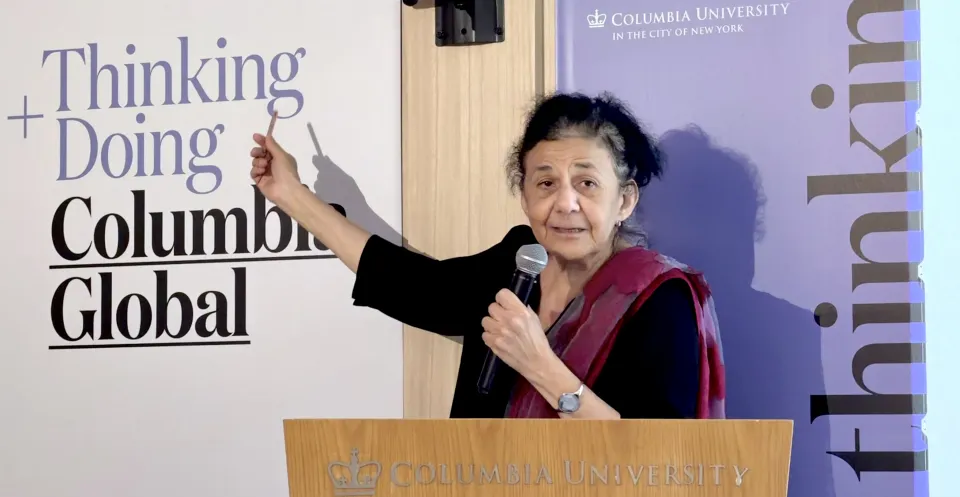
On June 27, Columbia Global Center Beijing hosted Beyond the Algorithm: Artificial Intelligence and the Future of Society, a faculty dialogue exploring how artificial intelligence is reshaping society and how universities can help guide this transformation.
As AI moves to the forefront of conversations on knowledge, innovation, and social responsibility, Columbia is deepening its engagement through interdisciplinary research and global collaboration. Columbia Global is rolling out a new Innovation Award on AI and Society to catalyze interdisciplinary research collaborations between Columbia faculty and partners around the world.
The event also marked an important milestone for Columbia Global Center Beijing as it celebrates its 17th anniversary. Over nearly two decades, the Center has served as a global gateway and regional hub for Columbia’s engagement in China and the region, supporting thousands of faculty members and students through global learning, research, public dialogue, and cross-border collaboration. Throughout changing global circumstances in recent years, the Beijing Center has continued to evolve and expand its impact with the support of an extraordinary community of alumni, partners, and friends.
Earlier this year, the Beijing Center relocated to a new office made possible through alumni philanthropy, underscoring its renewed commitment to advancing Columbia's global mission in China and across the region.
In her opening remarks, Wafaa El-Sadr, executive vice president of Columbia Global, focused on the importance of bringing together "thinking and doing" to address today's most pressing global challenges. She recognized the Beijing Center as an important platform for global learning, research collaboration, public dialogue, and global engagement that connects Columbia's academic excellence with regional opportunities, the Scholar-in-Residence Program, which enables Columbia faculty and researchers to pursue teaching, research, and professional activities while immersing themselves in local academic and cultural contexts; global learning opportunities that provide students with transformative experiences beyond the classroom; convening platforms that facilitate knowledge exchange across disciplines and sectors; and the Richard Rockefeller Fellowship, which cultivates emerging leaders and supports collaborative efforts to advance climate action.
The event also invited members of the Beijing Center's Advisory Board, whose leadership and support are instrumental to the Center's growth. Jack Hsu, CBS ’98, whose generous philanthropic support helped make the new office possible, reaffirmed his strong belief in Columbia's global engagement strategy. Reflecting on the changing demands of the next generation, he highlighted the importance of cultivating globally minded leaders equipped with the perspectives, experiences, and capabilities needed to address increasingly interconnected challenges.
Owen Xu,CC ’21, representing a new generation of alumni philanthropists and leaders, was invited to share his vision for advancing Columbia’s global mission through meaningful engagement and collective action. He spoke passionately about his enduring commitment to his alma mater and his aspiration to inspire and mobilize a broader community of alumni supporters. Emphasizing the transformative power of the Columbia alumni network, Xu highlighted its unique capacity to strengthen Columbia’s global presence, deepen its connections, and expand its impact across China and the region in the years ahead.
AI and the ‘Frictions” of Learning
Moderated by El-Sadr, the discussion on AI featured Benjamin L. Liebman, Professor of Law and Vice Dean for Intellectual Life at Columbia Law School; Adam Tooze, Professor of History and Director of the European Institute; and Tian Zheng, Professor of Statistics and co-leader of Columbia’s AI for Social Good and Society initiative.
The conversation opened with a practical measure of AI’s presence in academic life. Liebman estimated that he had spent about one-quarter of his time thinking about AI, in part because he co-chaired Columbia Law School’s AI task force. Zheng said nearly all of her sabbatical work time had gone into understanding how AI could be used in research. Tooze described AI as a daily tool in Chinese language learning and as a topic clouding students’ sense of the future.
From there, the discussion turned to higher education. Zheng argued that the core mission of universities has not changed. Higher education is still about creating knowledge and using it for real-world impact. What has changed, she said, is the speed and method through which that mission must now be pursued. She described learning as a process of “friction.” AI can remove some unnecessary struggle, such as routine technical pain points. Other forms of difficulty must remain because they train students to develop judgment and disciplinary intuition.
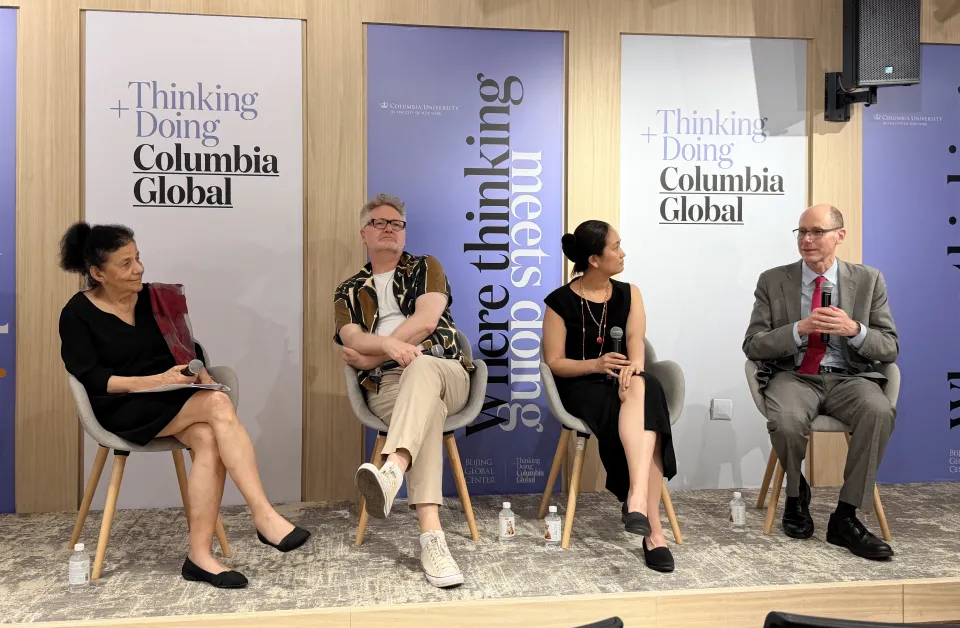
Liebman brought the discussion into legal education. Law schools, he said, have moved from treating AI mainly as a problem of academic integrity to asking how students should prepare for a profession that already uses AI tools. Employers still emphasize critical thinking, but they also expect graduates to develop AI fluency. Tooze pushed the question in a more philosophical direction. He asked what knowledge and habits students should carry “inside themselves,” rather than merely access through a prompt.
Human Judgment, Governance, and Global Society
The panelists then moved beyond the classroom to ask how AI should be governed in institutions that still depend on human judgment. Liebman said China’s courts and legal institutions have adopted AI faster than their U.S. counterparts, partly because of heavy workloads. Yet he stressed an important limit: Senior judges in China have said AI should not replace judges, and human responsibility must remain central. For legal systems, the central issue is not only efficiency, but accountability.
Zheng broadened the idea of AI literacy beyond technical knowledge. AI literacy, she argued, must include understanding how these systems shape human behavior and decision-making. Her examples showed why students should evaluate AI tools rather than use them passively. On careers, she advised students to show that they can apply AI to real problems and explain why a tool is appropriate.
Tooze placed AI in historical and geopolitical context. Its productivity effects remain uncertain, but the capital being mobilized around AI is already historically significant. Unlike earlier technologies, he argued, AI directly targets cognitive and symbolic functions. That makes its consequences difficult even for experts to assess. He also warned that AI is becoming tied to national security and platform power. It is also testing competing models of governance.
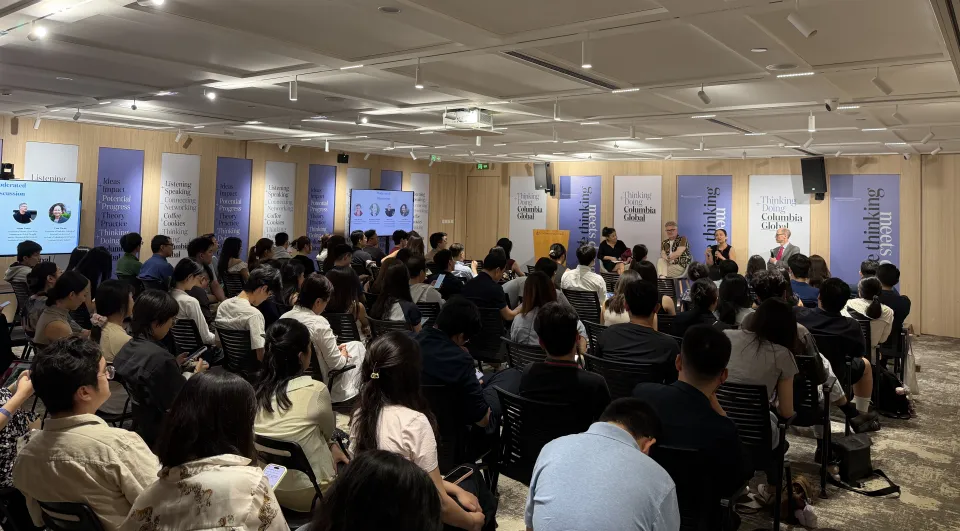
Audience questions moved the discussion into public-facing uses of AI. Tooze suggested that AI may offer accessible emotional guidance in societies facing serious mental health needs. He also cautioned that in finance, AI could intensify competition among institutions with the capital and data to move fastest. In history, he described the field as a form of mental travel that trains people to understand unfamiliar systems of meaning. Zheng added that curiosity is essential to critical thinking. Students must keep asking how they know what they know.
The event closed without offering a single prediction about AI’s future. Instead, it showed why universities and global convening platforms matter at this moment. AI is not only a technical question, it is also a question of education and human judgment. By bringing Columbia faculty into conversation with the Columbia community in Beijing, the Beijing Center demonstrated its role in Columbia’s global mission: connecting scholarship with local context and engaging urgent questions through both thinking and doing.