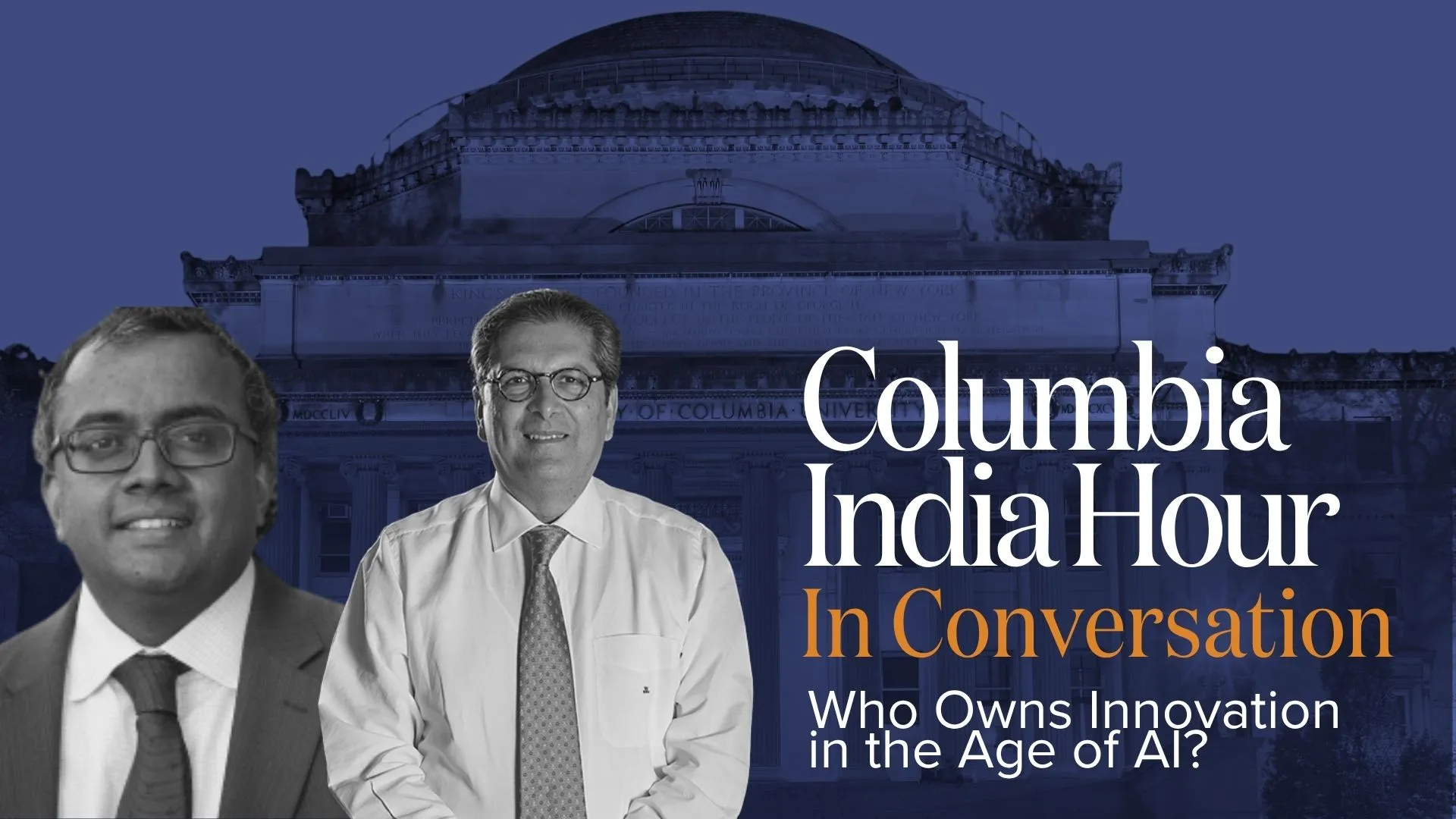
As AI becomes central to how we work, questions of copyright and who gets credit for AI-generated or AI-assisted work are becoming impossible to ignore. The recent controversy over a mathematician's unpublished Navier-Stokes work being used to train an AI model only underscores the urgency. In the third session of the Columbia India Hour series, Professor Shyam Balganesh (Sol Goldman Professor of Law, Columbia Law School) and Bahram Vakil (Co-founder & Senior Partner, AZB & Partners) took on AI and copyright explored the evolving legal landscape, the licensing deals now being brokered between publishers and AI companies, and what it all means for the future of the legal profession.
A legal landscape still taking shape
In the US, as many as 147 lawsuits have been filed against AI developers, but only two major rulings have come out so far. Both leaned toward fair use for training, and both were early-stage decisions the courts themselves described as fact-specific. They also drew a line between how a model is trained and how the data was obtained. The serious liability, including a $1.5 billion settlement, came from the second, not the first.
In India, the Delhi High Court's ANI v. OpenAI decision found that training on news content and making private internal copies did not amount to prima facie infringement. The court stretched a research exemption written for humans to cover AI training, and leaned heavily on national interest. Both speakers wondered whether courts should be making that kind of policy call, or whether it belongs with Parliament.
Licensing may settle it before the courts do
Both speakers agreed that the practical answer is coming from the market. Licensing deals between publishers and AI companies are multiplying, to the point where, in Shyam's words, they are rendering the lawsuits "a little bit irrelevant." Bahram said India is a bit behind here, but he already advises clients that licensing, not litigation risk-taking, is the way forward.
Regulation: finding the middle path
India is debating a comprehensive framework along the lines of the EU AI Act, with prohibited, high-risk and low-risk categories. Shyam was skeptical of a regulation-first approach, arguing it creates bureaucracy that struggles to keep pace. He prefers what he calls "institutional symbiosis," with Parliament setting high-level frameworks and courts developing the detail. Bahram pointed out that India's court backlogs make that hard, and suggested the UK's principle-based model and regulatory sandboxes as a more workable middle ground.
Authorship, and the human in the loop
AI cannot be an author or an inventor, since IP law exists to motivate human creators. The harder question is heavily AI-assisted work, such as a novel shaped over 15 hours of conversation with a chatbot. Shyam has argued for treating that through co-authorship rather than an all-or-nothing test.
Their advice to young lawyers applies well beyond law: draft your own thinking first, then compare it with what AI produces, and never let AI think first. Be transparent about how and why you used it. And don't avoid it, because fear-driven avoidance is the surest route to becoming, as Shyam put it, "real dinosaurs."
Read detailed takeaways | Watch the recording