Proof of registration, via a QR code on your phone or on paper, will be required to enter Reid Hall. Entry will be refused to those who are not registered. Please note that access will not be permitted 15 minutes after the start of the event.
This event will be held in English.
To be notified of upcoming Paris Global Center events, we invite you to sign up for our monthly newsletter.
—
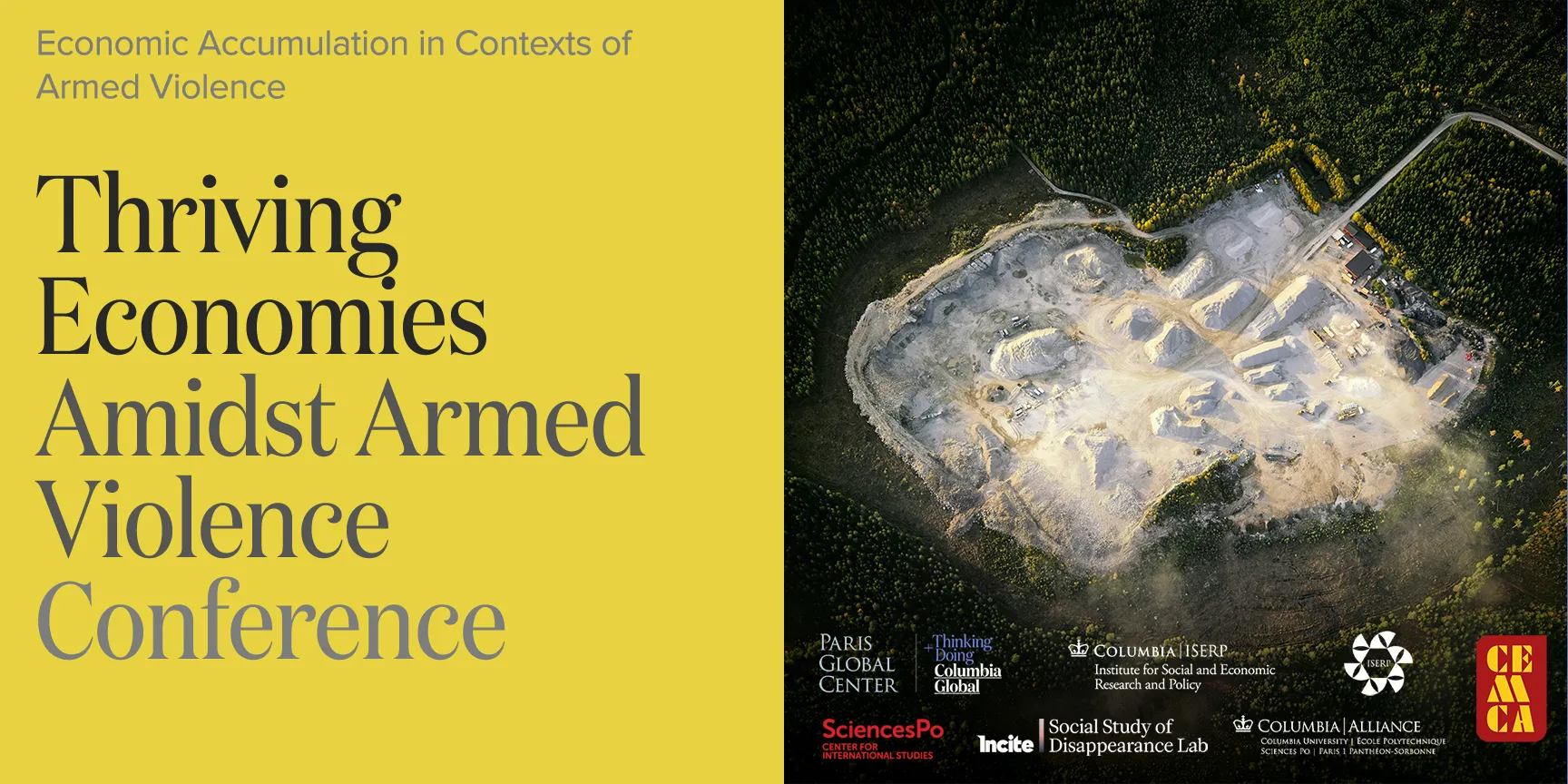
While stability, predictability, and legal certainty are commonly seen as indispensable to economic development, agro-industrial, extractive, manufacturing, and service sectors nevertheless thrive in contexts of armed violence, attracting tens of billions of dollars in international investment every year.
From the petrochemical corridor of Altamira in Mexico to Karachi’s textile and pharmaceutical plants in Pakistan; from the extraction of raw materials essential to AI in eastern DRC to banana and palm-oil plantations in Colombia’s northern Magdalena region, many leading sectors of contemporary capitalism—often presented as flagships of the formal economy—are expanding in environments marked by the daily experience of uncertainty and the presence of armed groups.
This conference examines how economic accumulation unfolds within such environments. Moving beyond narrow distinctions between legal and illegal sectors, participants will explore:
- Protection and brokerage arrangements linking firms, armed actors, and local intermediaries
- The integration of violent contexts into global supply chains
- The uneven distribution of profits, risks, and environmental costs
- The lived experience of working and residing in zones of economic expansion and insecurity
Rather than focusing solely on drug trafficking, smuggling, or conflict minerals, this conference investigates the integration of legal and illegal activities within contexts of violence, an evolving reality that has profoundly affected many societies for decades.
Bringing together scholars from diverse regional and disciplinary traditions, the conference also launches a longer-term collaborative agenda between Columbia University’s Social Study of Disappearance Lab, CERI–Sciences Po, and LAP–EHESS.
SCHEDULE
Breakfast: 8:30–9:00
Welcome & Introduction: 9:00–9:15
Panel 1: Productive Regimes Under Threat
9:15–11:00
Discussant: Susana Narotzky
- Claudio Lomnitz: “Migrant Remittances and Economies of Extortion (Mexico)”
- Laurent Gayer: “Making Economic Order Out of Disorder: Karachi's Gunpoint Capitalism”
- Adèle Blazquez and Adam Baczko: “The Profits of Uncertainty: The Rise of Altamira’s Petrochemical Corridor amid Violence (Mexico)”
Coffee Break: 11:00–11:30
Panel 2: Infrastructures of (Il)legal Accumulation
11:30–13:15
Discussant: Maud Simonet
- Martin Lamotte: “A tale about High-voltage lines, Concrete and Fuel. Supply chains between a war zone and a scam city in Myanmar.”
- Natalia Mendoza: “How an LNG pipeline makes its way through the US-Mexico borderlands”
- Fernando Montero: “Supply-Side Harm Reduction: Purposefully Reshaping Relations between Drug Sellers, Public Health, and Criminal-Legal Institutions in Philadelphia”
Lunch: 13:15–14:15
Panel 3: Turning War into Value
14:15–16:00
Discussant: Nadia Abu El-Haj
- Michel Naepels: “Capitalizing on War in Pweto and Kilwa (Katanga, Democratic Republic of the Congo). A Great Man and a Massacre.”
- Taras Fedirko: “Value and violence in the making of Ukraine’s war economy”
- Jacobo Grajales: “Peacebuilding and problem with transition: from wartime to post-war capitalism in Liberia”
Break: 16:00–16:30
Panel 4: Forging Norms Amid Uncertainty
16:30–18:15
Discussant: Gilles Dorronsoro
- David Picherit: “Cultivating Uncertainty: Law and Violence in the Political Economy of Wood Smuggling in South India”
- Rosalind Morris: “No Rush: The Underground Economy in Southern Africa”
- Naor Ben-Yehoyada: “Lords of the Trapanese Littoral: the performance of the morality of violence by Statepersons in 2000s Sicily.”
Evening Reception from 18:15
ORGANIZERS
Adam Baczko — CNRS Research Associate Professor, CERI–Sciences Po; CEMCA
Adèle Blazquez — CNRS Research Associate Professor in Anthropology, LAP–EHESS; CEMCA
Claudio Lomnitz — Professor and Chair, Anthropology, Columbia University
SPEAKERS
Naor Ben-Yehoyada — Assistant Professor of Anthropology, Columbia University
Taras Fedirko — Assistant Professor of Social and Political Sciences, University of Glasgow and Research Fellow at the IWM
Laurent Gayer — CNRS Senior Research Professor, CERI–Sciences Po
Jacobo Grajales — Professor of Political Science, CESSP–Pantheon Sorbonne University
Martin Lamotte — CNRS Research Associate Professor, Director, LAP–EHESS
Natalia Mendoza — Anthropologist and Co-Director, ALTAR: Centro de Investigación
Fernando Montero — Associate Research Scientist, Columbia University
Rosalind Morris — Professor of Anthropology, Columbia University
Michel Naepels — CNRS Research Professor, CEMS–EHESS;
David Picherit — CNRS Research Associate Professor, LESC–CNRS
DISCUSSANTS
Gilles Dorronsoro — Professor of Political Science, CESSP–Pantheon Sorbonne University;
Senior Fellow, Institut Universitaire de France
Susana Narotzky — Professor of Social Anthropology, University of Barcelona
SPONSORS
The project “Thriving Economies Amidst Armed Violence” is funded by Columbia Global at Columbia University. Columbia Global brings together major global initiatives from across Columbia University to advance knowledge and foster global engagement.
The conference is also funded by the Institute for Social and Economic Research and Policy (ISERP) at Columbia University.
Additional support is provided by the Alliance Program (Sciences Po / Columbia University), INCITE at Columbia University, and the Center for International Studies (CERI) the Centro de Estudios Mexicanos y Centroamericanos (CEMCA).
ZOOM INFORMATION
Livestream:
https://columbiauniversity.zoom.us/j/91929869167?pwd=JhVzPqIqJIrbsrUJNSSsrKmb2Iap3g.1
Please feel free to join 10–15 minutes before the start time. The conference will begin at 9:00 AM (Paris time). This link will remain active for all four panels throughout the day.
—
This event will take place in Reid Hall’s Grande Salle Ginsberg-LeClerc, built in 1912 and extensively renovated in 2023 thanks to the generous support of Judith Ginsberg and Paul LeClerc.
Reid Hall, the Columbia Global Paris Center, and the Institute for Ideas and Imagination are not responsible for the views and opinions expressed by their speakers and guests.