Columbia Global Emerging Scholar Adel Dashela Explores Chile’s Transitional Justice Path
He is part of the 2024-2025 cohort of fellows and is based at the Amman Center.
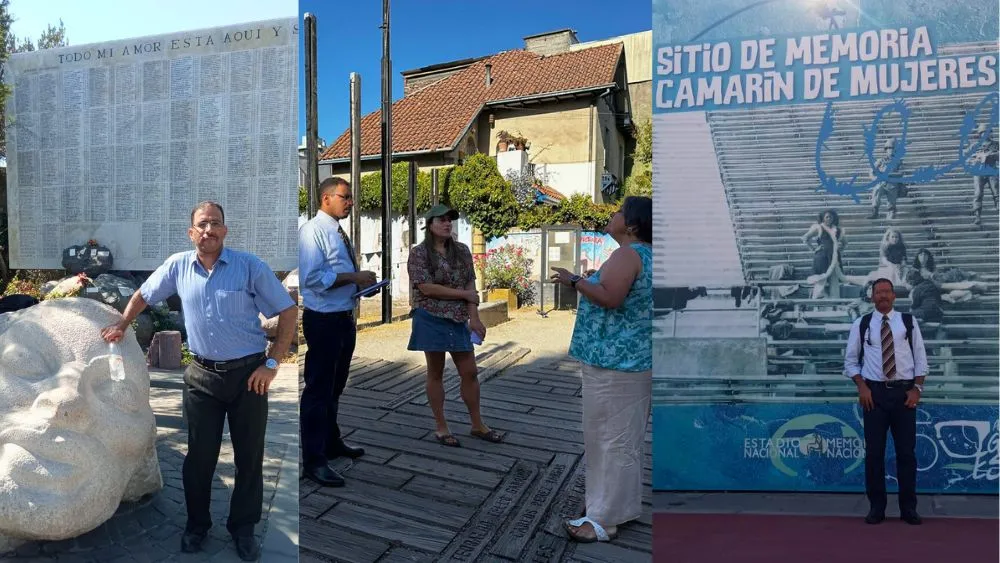
Adel Dashela, a Yemeni researcher and member of the 2024-2025 Columbia Global Emerging Scholars Fellowship cohort, recently visited Chile to examine the country’s innovative approaches to transitional justice, reparations, national reconciliation, and the protection of human rights. Hosted by the Columbia Global Center in Santiago, his visit provided valuable insights into Chile’s experience transitioning from dictatorship to democracy.
Currently based at the Amman Center, Dashela leads a research project titled “Yemeni Tribes and Post-Conflict Transitional Justice: Exploring Social Perspectives for National Reconciliation.” The Global Emerging Scholars fellowship supports early-career scholars with refugee status or experience of forced displacement, offering them opportunities to advance their research, build professional networks, and reintegrate into academia. During his two-week visit to Chile from late January to early February, he was guided by Carla Magri, the Santiago Center’s Communications and Development Officer, who is also a historian with experience researching transitional justice in post-dictatorial regimes. In his research, Dashela aims to understand how Yemen, a country devastated by war and political fragmentation, can draw from Chile’s transitional justice experience.
Visits to Memory Sites and Engagements with Experts
During his stay, Dashela visited key historical sites that played a pivotal role in Chile’s reckoning with the massive human rights violations that occurred during the 17-year civic-military dictatorship led by General Augusto Pinochet. These included the Museum of Memory and Human Rights, Santiago’s General Cemetery, and former clandestine detention and torture centers such as Villa Grimaldi, Londres 38, Casa de Memoria José Domingo Cañas, and the National Stadium, which once served as the country’s largest detention and torture site. He also explored the Fundación de Documentación y Archivo Vicaría de la Solidaridad, an institution that preserves critical evidence of the crimes of the Pinochet regime.
Beyond these visits, Dashela engaged in in-depth discussions with leading scholars and human rights advocates who played instrumental roles both under Pinochet and during Chile’s transition to democracy. Among them were:
Elizabeth Lira — One of the Architects of Transitional Justice in Chile
Recipient of the National Award for Humanities and Social Sciences and Director of the Human Rights Center at Universidad Alberto Hurtado, Elizabeth Lira is a psychologist, academic, and researcher specializing in human rights, history, and memory. She has played a critical role in shaping Chile’s transitional justice policies, having been a member of the Human Rights Dialogue Table (Mesa de Diálogo de Derechos Humanos) and the National Commission on Political Imprisonment and Torture (known as Valech Commission, and its successor, Valech II).
In her discussion, Lira addressed the concepts of reparation and amnesty, the social process of reconciliation, and how the Chilean dictatorship sought to ensure impunity before the transition to democracy. She also examined the emergence of transitional justice in Chile in 1990 within a global context where the concept was still underdeveloped, as international reparations only began gaining traction in 1993.
Lira emphasized the crucial role of political parties, particularly the Concertación de Partidos por la Democracia (Coalition of Parties for Democracy), which governed Chile between 1990 and 2010, in supporting the democratic transition and implementing transitional justice policies. She also discussed the work of the National Truth and Reconciliation Commission (Rettig) and the reparations laws enacted to support victims and their families, based on the Rettig Report’s recommendations.
Reflecting on how Yemen could benefit from Chile’s experience, Lira stated: “Yemen should begin by forming coalitions focused on specific rights. Working with isolated groups may yield little progress; however, collaborating in a coalition can produce results that demonstrate what is achievable. In Chile, following 17 years of dictatorship, many people were apprehensive about change.”
Boris Hau — The Role of Truth Commissions and Victims’ Family Organizations
Boris Hau, a professor at Universidad Alberto Hurtado and a member of the Transitional Justice Observatory at Universidad Diego Portales, outlined Chile’s long process of truth-seeking and justice. He detailed the work of truth commissions, including the Rettig Report (1991) and the Valech Reports (2004 and 2011), which documented cases of executions, disappearances, political imprisonment and torture.
Hau emphasized the critical role played by victims' families, particularly women, in demanding justice: “The strength of women has been pivotal in the fight for justice. Their efforts have driven transitional justice policies forward.” He also stressed that transitional justice is ultimately driven by the state: “While people can demand and make great speeches, state policy is necessary. transitional justice requires political will.”
José Domingo Cañas and Londres 38 — The Memory Sites
Dashela also met with Luciano García, a board member, and Marta Cisterna, director of the José Domingo Cañas memory site. They discussed the site's history, which initially served as the Panamanian embassy during the early months of the dictatorship, providing political asylum to over 200 people, including individuals from multiple countries who were in Chile at the time of the coup. After these individuals were evacuated from the country, the house was taken over by the DINA, the Pinochet regime’s secret police, and turned into a clandestine detention and torture center, where more than 90 people, who remain disappeared detainees to this day, were held.
García and Cisterna recounted how the surrounding community, aware of the atrocities committed there, pressured the Chilean state to reclaim the property after the return of democracy. Along with survivors and victims' families, they managed to recover the site even before the state officially took charge. The memory house opened its doors in 2010 and is now administered by Fundación 1367, a nonprofit organization that conducts outreach activities, human rights education, and cultural programming. They also act as human rights observers in processes in Chile and other countries.
Located in downtown Santiago, Londres 38 was the former headquarters of the Socialist Party before being turned into a detention and torture center during the dictatorship. There, Adel received a guided tour from Felipe Aguilera, Coordinator of the Memory Area and member of the Londres 38 working group, who delved into the history of the house, the dictatorship's operational methods, and the current work being done in preserving the memory of the place and the victims.
Alicia Lira — The Fight of Victims’ Families
Alicia Lira, President of the Association of Relatives of Politically Executed Persons, provided a powerful account of how families of victims spearheaded the struggle for justice. She detailed how their organization was formed in 1976, their relentless efforts in mobilizing, staging protests, and advocating for policy changes, often facing resistance both from the dictatorship and from the democratic governments that followed.
Lira emphasized that in Chile, nothing in the field of human rights, truth, and justice—nor in the preservation of memory sites—has happened without the efforts of victims' relatives and survivors of torture and recounted how women played a crucial role in keeping the movement alive.
She also discussed the challenges faced during the 1990s, when democratic governments attempted to prioritize reconciliation over justice, and how families of victims had to continue pushing for accountability despite political obstacles. “President Aylwin (1990-1994) commissioned the Rettig Report, officially called the Truth, Justice, and Reconciliation Report. We always criticized that name because reconciliation is a personal matter—it cannot be imposed by decree,” Lira said.
Lira also highlighted the relationship that the relatives’ organizations have had with the current government led by Gabriel Boric. “It has been much stronger. From his first day in office, President Boric has demonstrated a real commitment to human rights, and so far, he has followed through on his promises. His administration not only launched the National Search Plan for Truth and Justice, but also has shown dignity and respect toward the leadership of human rights organizations, has provided legislative support for the preservation of memory sites and maintained a consistent and serious focus on human rights issues,” she stated and added: “No other president had ever invited us to their presidential inauguration. Boric did. For the first time, a Chilean president invited human rights leaders and representatives from memory sites to witness the presidential transition. […] This dignifies our role, because we are contributing to this country,” she closed.
On lessons for Yemen, she advised: “You have to keep pushing, demanding, and holding political parties accountable. Even if there is a spirit of reconciliation, truth and justice must always come first,” she also stated that although “It is valuable when non-relatives commit to the cause, the moral weight is different when the movement is led by victims' families, because the strength of the organizations comes from us, even though here in Chile, we also had support from other organizations and groups, like the Vicaría de la Solidaridad.”
María Paz Vergara — Preserving the Historical Memory of the Vicaría de la Solidaridad
María Paz Vergara, Executive Secretary of the Fundación de Documentación y Archivo Vicaría de la Solidaridad, detailed the critical role played by the Vicaría during the dictatorship. The organization provided legal and social assistance to victims and their families, documenting cases of human rights violations and forced disappearances. After the return of democracy, its archives became key sources of evidence in the elaboration of the Rettig and Valech Reports as well as in judicial cases.
Today, the foundation continues to assist victims and their families in accessing historical records for personal memory preservation and legal cases. The documentation is still frequently requested by courts handling human rights cases, underscoring its enduring importance in the pursuit of justice. Additionally, the organization also engages in educational work “to ensure that young people value democracy. We provide education about tolerance and the importance of never again resolving problems in the manner we did it during the 1973 coup. We also conduct educational visits to schools and universities,” Vergara said.
A Rich Experience with Lasting Impact
Reflecting on his visit, Adel expressed deep appreciation for the insights gained: “I was pleased to visit Chile to explore its pioneering experience in transitional justice and national reconciliation, particularly the mechanisms used to compensate victims, preserve national memory, address human rights violations, and transition from a dictatorial regime to a democratic one.”
Dashela emphasized that the lessons from Chile would directly inform his research on Yemen’s post-conflict transition: “The insights gained will help develop culturally appropriate frameworks for engaging Yemeni tribal structures and social groups—such as women, youth, and marginalized communities—in reconciliation processes, truth-telling mechanisms, inclusive national dialogue, and sustainable peace-building initiatives.”
He also expressed gratitude for the support received: “I would like to express my gratitude to the Santiago Center for their invaluable support and guidance during my research visit. A special thanks goes to Carla for her assistance during this visit.”
By drawing lessons from Chile’s experience, Adel hopes to contribute to the development of practical solutions for Yemen’s own path to peace, justice and memory. His upcoming articles and media engagements in Arabic will ensure that the knowledge acquired during his time in Chile reaches broader audiences, fostering deeper discussions on justice, memory, and human rights in his home country.